

More news on this day
Flight cancellations to the Emirate of Ras Al Khaimah are emerging as a flashpoint in a wider Middle East aviation crisis, stranding holidaymakers and migrant workers across continents as airspace closures ripple through some of the world’s busiest long-haul routes.
A Small Gulf Gateway at the Center of a Global Disruption
Ras Al Khaimah International Airport, a modest but fast-rising hub in the United Arab Emirates, has found itself pulled into a fast-moving storm as conflict-driven airspace closures upend travel across the region. While global attention has focused on shutdowns at mega-hubs such as Dubai, Abu Dhabi and Doha, suspended services to secondary airports like Ras Al Khaimah are compounding the shock for carriers and passengers worldwide.
Indian low-cost and full-service airlines have announced fresh waves of cancellations to West Asia, including routes into and out of the northern Emirate. Flight curbs by major South Asian operators now span the breadth of the Gulf, from Dubai and Abu Dhabi to Sharjah, Fujairah and Ras Al Khaimah, extending earlier suspensions that began after U.S. and Israeli strikes on Iran triggered sweeping airspace closures late last week.
What might once have been a localized disruption has quickly become a global headache. Ras Al Khaimah, heavily marketed as a value alternative to Dubai for leisure travelers and package tours, relies on tightly coordinated schedules and inbound charter traffic. With airlines scrapping or rerouting services at short notice, that finely balanced model has been thrown off course, leaving tour operators, resorts and passengers scrambling.
At the same time, the Emirate’s cancellations feed back into the broader network shock. Aircraft and crews that would normally rotate through Ras Al Khaimah are now caught up in rolling changes across the Gulf, contributing to wider equipment shortages and complex re-planning of long-haul rosters.
From Bangkok to Geneva, Passengers Feel the Fallout
The impact of Ras Al Khaimah’s lost flights is being felt far from the desert coastline of the UAE. In Bangkok, Suvarnabhumi Airport has deployed extra staff, set up manned information points and expanded waiting areas as cancellations mount on services to Middle Eastern destinations. Officials there report dozens of affected flights, with passengers encouraged to stay away from counters unless they have confirmed alternative itineraries.
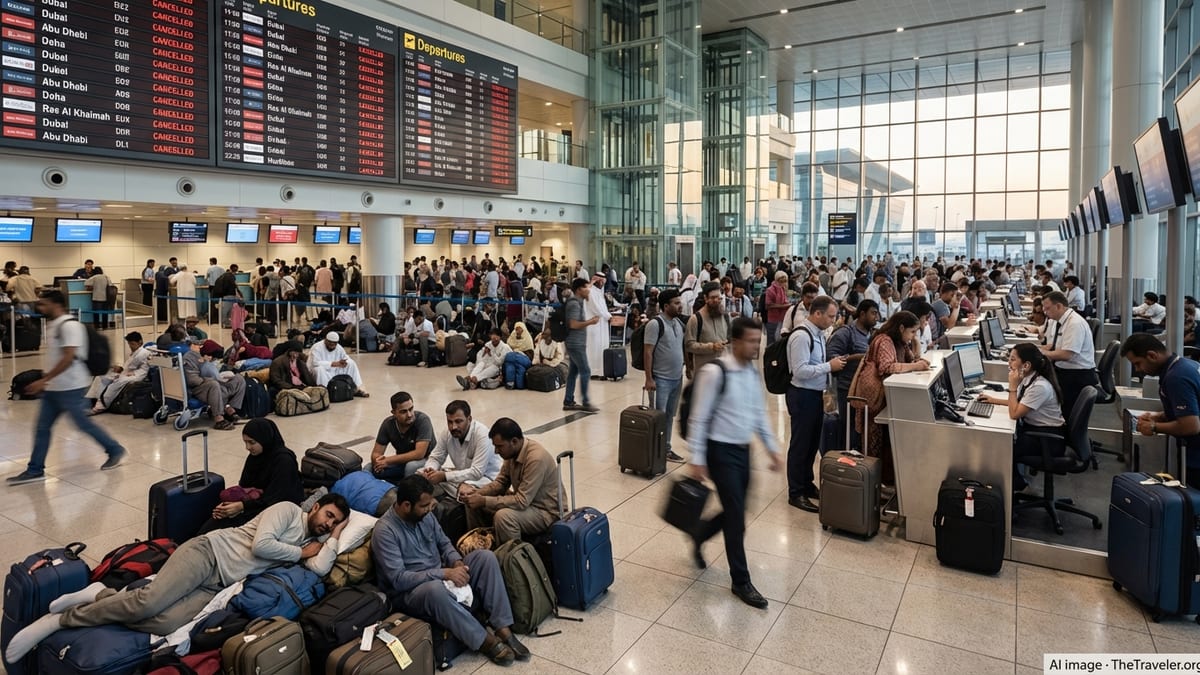
Across the Indian Ocean in South Asia, departure boards in Dhaka and Kathmandu have filled with red cancellations on services bound for Dubai and other Gulf cities. Many of the affected travelers are migrant workers and connecting passengers who would ordinarily fan out via hubs to smaller gateways such as Ras Al Khaimah. With those onward connections canceled, airport terminals have filled with families sitting on suitcases, waiting hours for updates that often bring little clarity.
In Europe, the shockwave has reached as far as Zurich and Geneva, where cancellations and long delays have piled up as airlines grapple with how to reposition aircraft and crews around the Middle East no-fly zones. Flights that once threaded efficiently through Gulf hubs, feeding traffic onward to Ras Al Khaimah and other secondary airports, now require lengthy detours or have been scrubbed entirely, reducing options for stranded travelers seeking a way home.
Analysts note that a single canceled leg into an airport like Ras Al Khaimah can set off a chain reaction of missed connections in Asia and Europe. Tour groups who began their journeys in smaller Indian cities or Southeast Asian resort towns often rely on complex, multi-stop itineraries. When one short sector into the UAE disappears, the whole journey can unravel.
Data Shows the Scale of the Middle East Air Travel Shock
Fresh aviation data underlines how quickly the crisis has escalated. Industry analytics show that, on some days since the strikes, nearly a quarter of all scheduled inbound flights to key Middle Eastern destinations have been canceled, with total cancellations soaring into the thousands when outbound services are counted. Major Gulf carriers, normally among the most reliable in the world, have scrubbed a substantial share of their schedules as airspace over Iran, Iraq, Kuwait, Bahrain, Qatar and parts of the UAE has gone dark.
Further analysis by specialist data providers indicates that airlines based in the region have cut a significant percentage of services, with some reporting cancellation rates well above 30 percent on their busiest days. With three major Gulf carriers alone typically funnelling around 90,000 connecting passengers through their hubs each day, the closure of skies has immediate global consequences, severing links between Europe, Asia, Africa and Australasia.
Against this backdrop, Ras Al Khaimah’s scrapped flights are one piece of a much larger puzzle. Routes that rely on airspace above conflict zones have either been rerouted at considerable cost and additional flight time or shut down entirely. Carriers from India, Europe and Southeast Asia have published rolling lists of affected services, including those touching the northern Emirates, often with just hours’ notice, leaving travelers and airport operators few good options.
The result is an aviation system operating under exceptional strain. Airlines are juggling safety assessments, fuel constraints and crew duty limits while fielding unprecedented volumes of calls and messages from anxious passengers desperate to know whether they can travel at all.
Human Stories Behind the Departure Board Chaos
Behind the statistics are passengers caught in limbo. From Bali to Bangkok, images have emerged of travelers clustered around airline desks, clutching passports and printouts of booking references for itineraries that evaporated overnight. Many had planned holidays along the Persian Gulf coast, combining stays in Dubai with quieter beach resorts in Ras Al Khaimah, lured by aggressive tourism campaigns and new hotel openings.
Others are workers trying to reach job sites in the Emirates or return home after contracts in the Gulf. For them, the cancellations mean not only uncertainty but also mounting costs for unplanned hotel nights, meals and rebooked tickets. Even where airlines offer accommodation and re-routing, capacity is stretched thin, and some passengers report being offered itineraries several days later, if at all.
Families waiting in India for relatives to return from religious gatherings or overseas assignments are watching the crisis unfold with growing anxiety. Reports have already surfaced of large groups stranded in Gulf cities after learning at the last minute that the final leg of their journey, sometimes into secondary airports like Ras Al Khaimah, had been removed from the schedule.
Travel insurers and consumer advocates warn that the fine print of many policies offers limited relief in the face of conflict-related disruption. While some travelers may be able to recover part of their costs, others could find themselves out of pocket, particularly if they booked separate connecting tickets that are not protected under a single itinerary.
What Travelers Should Do as the Situation Evolves
With no firm timeline for the reopening of affected airspace, officials and industry experts are urging travelers to avoid making unnecessary journeys into the region and to treat all existing bookings as subject to sudden change. Passengers with plans to fly to Ras Al Khaimah or to connect there via larger Gulf hubs are being advised to monitor airline communications closely and to assume that schedules may be revised at short notice.
Airports across Asia and Europe have moved to increase staffing at information counters and security checkpoints, anticipating further waves of disruption as airlines rework networks day by day. Some carriers have relaxed change fees, extended travel waivers or allowed free rerouting via alternative hubs where safe routes exist, but availability remains limited during peak periods.
For now, would-be visitors to the UAE are confronted with a rapidly shifting map of what is possible. While some services are operating via longer detours that skirt closed skies, the web of cancellations to secondary destinations such as Ras Al Khaimah is growing thicker, making spontaneous travel risky. Aviation analysts say meaningful normalization of schedules will depend on a sustained easing of regional tensions, something that appears distant as military activity and diplomatic uncertainty persist.
Until then, Ras Al Khaimah’s grounded flights stand as a visible symbol of a much larger breakdown in one of the world’s most important aviation corridors, a reminder that even smaller regional airports play a critical role in the fragile machinery of global travel.