


More news on this day
Train passengers across parts of the United Kingdom are facing growing disruption as a red extreme heat alert is extended, prompting rail operators to slow services, cancel departures and advise people to avoid non essential journeys.
Get the latest news straight to your inbox!
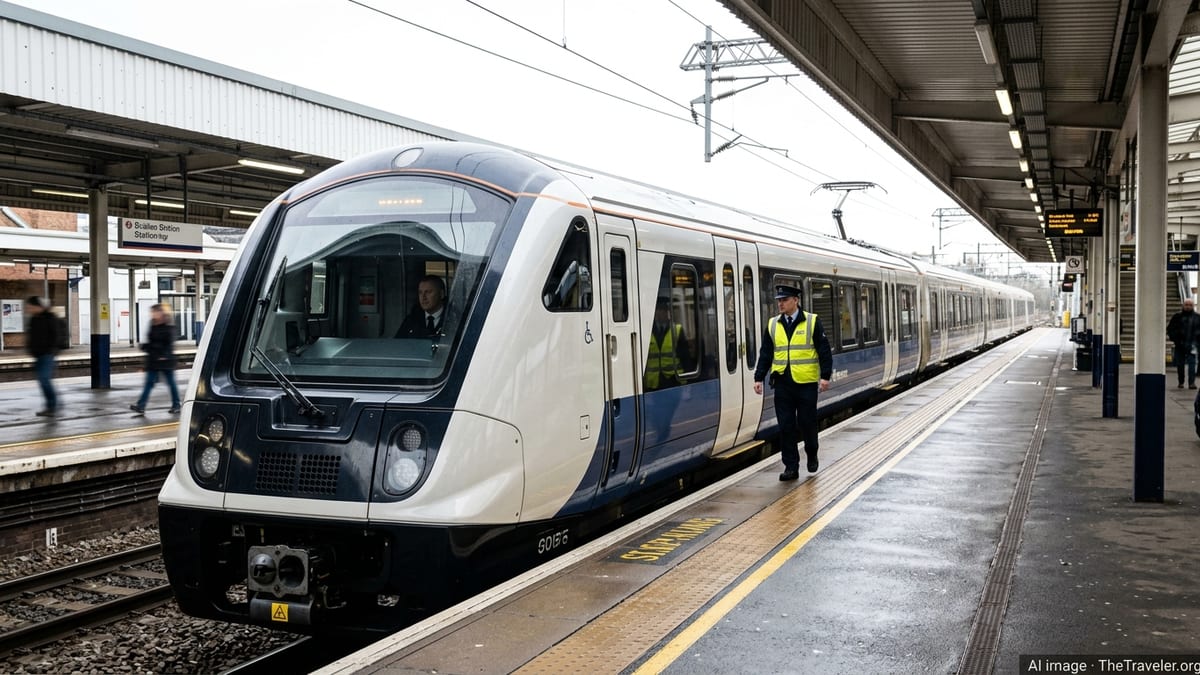
Red warnings lengthen as temperatures climb
The United Kingdom’s national forecaster has extended its highest level red alert for extreme heat into Friday, with London and swathes of southeast England at the center of the warning. Publicly available information shows that the alert follows several days of record breaking June temperatures and a broader amber warning that remains in force across much of southern England and Wales.
The red alert indicates a high risk of heat related impacts on health and infrastructure, particularly in densely populated urban corridors that rely heavily on commuter rail. Reports indicate that rail and road networks are especially vulnerable, with trackside equipment, overhead power lines and signal systems all exposed to prolonged temperatures well above seasonal norms.
Travel coverage across British and European outlets notes that the current heatwave is part of a wider “red zone” stretching from Spain and France to the Low Countries and the UK, where national meteorological agencies have issued their most severe heat alerts. Temperatures above 40 degrees Celsius have been recorded in parts of France and Spain, with overnight conditions remaining unusually warm.
Climate and transport analysts cited in recent reporting link the intensity and early timing of the heatwave to long term warming trends, noting that Europe has warmed faster than the global average and that infrastructure designed for cooler conditions is struggling to cope.
Rail operators cut services and slow trains
Across southeast England, rail operators have imposed blanket speed restrictions on key routes and scaled back the timetable in anticipation of track and signalling problems. Public statements from train companies indicate that slower running is intended to reduce the risk of track buckling, overhead line failures and train faults linked to overheating components.
In Kent and the wider southeast, regional operator Southeastern has extended advice to avoid non essential rail travel through at least Friday, warning that high temperatures are likely to continue affecting its network. The company has outlined a series of precautionary measures, including revised speed limits, additional engineering teams on standby and contingency plans to recover services if infrastructure fails.
National travel coverage also highlights disruption for passengers using services to and from London’s major stations, where peak hour trains are expected to be busier than usual as some departures are cancelled outright. Operators have encouraged customers who can delay journeys to do so and to check for last minute changes on the day of travel.
Further afield, European reports describe similar steps in France and Belgium, where parts of the high speed network are running at reduced speeds during the hottest hours of the day. On certain corridors around Paris and Brussels, one in ten or more commuter trains have been withdrawn from the schedule to reduce strain on infrastructure and staff.
Knock on effects for airports and international links
The extended heat alert is also affecting rail connections to major airports and cross Channel routes that are critical for summer holidaymakers. Recent travel reports note that multiple UK operators serving London Gatwick Airport and other hubs have been forced to cancel or curtail services during the week, advising passengers to allow considerably more time to reach flights.
Internationally, coverage of the European heatwave indicates that high speed services linking the UK with France and Belgium are operating under tighter speed controls on some sections, adding to journey times and reducing timetable flexibility. While core connections remain in place, operators have warned that further disruption is possible if temperatures rise again or if infrastructure faults emerge.
Tourism outlets report that travellers heading to popular city destinations such as Paris, Brussels and Amsterdam are being urged to review their rail bookings and consider travelling early in the morning or later in the evening, when conditions may be marginally cooler and some maintenance work can be completed.
Airport rail links are facing particular pressure because alternative road options may be constrained by congestion and heat impacts on motorways. Published guidance stresses that passengers should factor in the possibility of air conditioning failures or non functioning toilets on crowded services that remain in operation.
Health, safety and practical advice for passengers
Health agencies and transport planners are using the extended red alert period to reinforce basic safety guidance for people who do need to travel. Public information stresses the importance of carrying sufficient water, avoiding alcohol, wearing light clothing and seeking shaded or air conditioned areas where possible while waiting on platforms or at interchanges.
Reports from recent heatwaves show that rail disruption can lead to passengers spending extended periods on stationary or slow moving trains with limited ventilation. Travel advisories therefore recommend preparing for delays by bringing snacks, medications and a fully charged mobile phone, as well as identifying alternative routes in case services are suspended.
Rail companies have also urged those with reduced mobility, underlying health conditions or travelling with young children to think carefully before making journeys during the hottest parts of the day. Where travel cannot be avoided, passengers are being advised to sit in cooler parts of the train where available and to follow on board instructions in the event of a breakdown.
Industry bodies have highlighted that heavy demand for customer service support is likely during red alert periods, and that automatic compensation schemes may apply when trains are cancelled or significantly delayed. However, passengers may need to retain tickets and booking confirmations in order to make successful claims once the disruption eases.
Broader questions over rail resilience in a warming climate
The latest wave of disruption is renewing debate about how quickly rail infrastructure across the UK and Europe can be adapted to cope with more frequent and intense heat events. Analysis in European media points out that many tracks, signalling systems and power supplies were built for a cooler climate, with design tolerances that are now regularly being exceeded.
Engineering experts referenced in recent coverage argue that measures such as improved track stressing techniques, upgraded overhead lines, additional shade and ventilation at stations, and modern rolling stock with more robust air conditioning will be required to maintain reliability. Such investments, they suggest, need to be planned over years rather than in response to individual heatwaves.
Policy discussions around rail funding are increasingly framed in terms of climate resilience, with comparisons drawn to previous investments made to improve performance in winter conditions. Observers note that while cold weather can still cause serious disruption, extreme heat is now emerging as a consistent challenge at the very height of the travel season.
For travelers, the extension of red heat alerts and the resulting train disruption underline the importance of flexibility in summer plans. Industry and climate specialists alike suggest that, as record breaking temperatures become more common, checking heat related travel advisories may soon be as routine as watching for snow or storm warnings.