


Reims is often described as the "capital of Champagne", a quick hop from Paris where visitors dash in for a cellar tour and dash back out again. Yet this compact city in France’s Grand Est region rewards a slower look. Medieval coronation churches, handsome Art Deco boulevards, ambitious restaurants and walkable neighborhoods make Reims a strong contender for a one to three-day French city break in its own right, with or without a glass of bubbly in hand.
Get the latest updates straight to your inbox!
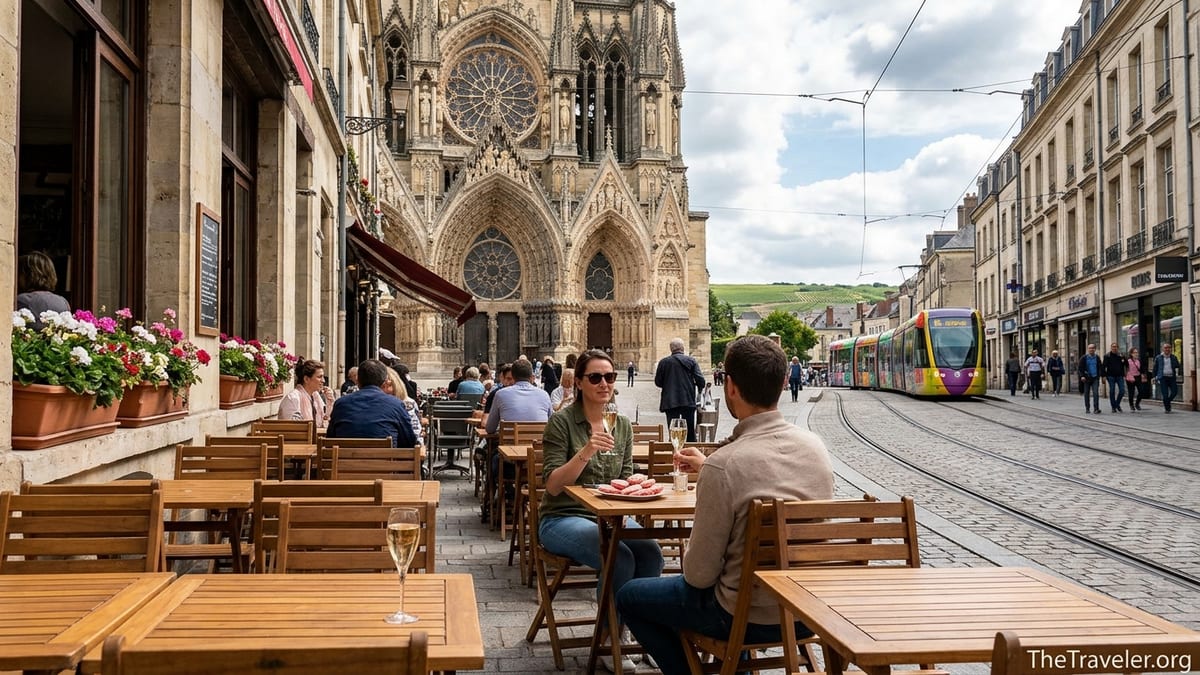
Why Reims Deserves More Than a Champagne Day Trip
Reims sits in northeastern France, around 130 kilometers east of Paris in the rolling vineyards of Champagne. Fast trains from Paris reach the city in about 45 minutes, putting it in the same easy-weekend orbit as Lille or Strasbourg. Yet where some French cities lean heavily on museums or river scenery, Reims offers a distinctive mix of sacred history, wine culture and early 20th century architecture, all on a human scale that suits short stays.
Travelers often weigh Reims against nearby Épernay, 25 minutes away by regional train. Épernay’s Avenue de Champagne strings together famous houses like Moët & Chandon and Mercier in a smaller, more overtly wine-focused town. Reims, by contrast, feels like a real city: there is a university, a tramway, busy shopping streets and nightlife around Place Drouet-d’Erlon, plus major historic sites that merit time even if you never set foot in a cellar. If you are choosing one base and want more than tastings, Reims is usually the better all-round option.
For many visitors, a single long day from Paris works: an early train, morning at Notre-Dame de Reims Cathedral, an afternoon cellar visit and a stroll via the Art Deco Carnegie Library before heading back west. However, an overnight stay allows Reims to exhale. With two full days you can add the Basilica and Musée Saint-Remi, sample local bistros, and perhaps detour to Épernay or the village of Hautvillers. With three days you can combine the main sights with a countryside vineyard tour and still have time for a relaxed market lunch at Halles du Boulingrin.
In practical terms, Reims is also less overwhelming than Paris or Lyon. The centerpiece cathedral area, station quarter and restaurant-lined squares are all walkable from each other, and public transport is straightforward. This makes Reims a good choice for first-time visitors to France who want history and gastronomy without metropolitan complexity, and for repeat visitors looking for somewhere new that still connects easily with Parisian flights and trains.
Essential Sights: From Coronation Cathedral to Roman Gate
Notre-Dame de Reims Cathedral is the single most important monument in the city. The Gothic church, a UNESCO World Heritage Site, hosted the coronations of French kings for centuries and rivals Paris’s Notre-Dame in scale and sculpture. Admission to the main cathedral nave is free, although guided tours, tower visits and special events carry charges. Official regional tourism information in autumn 2026 suggests allowing at least 45 minutes to one hour to appreciate the building’s interior and its famed stained glass, with more time if you opt for a tour of the towers or a detailed art visit.
Immediately south of the cathedral stands the Palais du Tau, former residence of archbishops during coronations and another UNESCO-listed building. As of late 2026, the palace is closed to the general public for long-term renovation, following a shutdown that began at the end of 2022. Educational groups may encounter temporary off-site programming, but typical travelers should plan to admire the exterior only and use the time instead for the nearby Musée Saint-Remi or extra exploration inside the cathedral.
A 20-minute walk south of the cathedral brings you to the Basilica of Saint-Remi, a Romanesque-Gothic church linked with Saint Remigius, who baptized Clovis, the first Christian king of the Franks. Entry to the basilica itself is free, and it feels calm and neighborhood-based compared with the busier cathedral. Adjoining it is the Musée Saint-Remi, housed in the former royal abbey buildings. The museum usually charges a modest admission fee, often just a few euros, granting access to archaeology, regional history and a cloistered garden; visitors should check current pricing on arrival, as municipal museums sometimes offer free or reduced days.
On the northwestern edge of the center, the Porte de Mars is a monumental Roman triumphal arch set in a public park. There is no admission fee, and the monument can be included in a self-guided walking route that loops from the railway station to the cathedral and back. Combine it with nearby Art Deco apartment blocks and the modern courthouse district for a sense of how Reims layers Roman, medieval and 20th century history within a compact radius.
A Walkable City: Organizing Your Route Around Reims
Reims is small enough that many visitors never use a bus or tram, especially if their accommodation is near the station or cathedral. A logical first-day walking route for new arrivals starts at Reims Centre station and heads north for a quick photo stop at the Porte de Mars, then turns southeast toward the cathedral. After exploring Notre-Dame, you can circle the building to appreciate the flying buttresses, then continue a few minutes south to the quiet cloisters of the Basilica of Saint-Remi if time and energy allow.
From the cathedral, it is an easy stroll west along largely pedestrianized streets to Place Drouet-d’Erlon, the city’s main restaurant and café strip. The square is lined with brasseries, crêperies and bars, many with outdoor terraces. This lively axis makes a convenient lunch or dinner stop and is also close to shopping streets where you can find bakeries, wine shops and everyday services. At night the square can be noisy, which is something to consider if your hotel room faces directly onto it.
Art Deco fans should extend their walk a few blocks from the cathedral to the Carnegie Library of Reims. Funded by Andrew Carnegie after World War I, the library is a textbook example of French Art Deco civic architecture, with stylized stone reliefs and crafted interior details. Entry to the building as a public library is usually free during opening hours, but access to some heritage rooms may be restricted if events are scheduled. Even a short visit rewards anyone interested in design, and the streets around it showcase additional 1920s and 1930s facades.
Travelers who prefer a structured approach can join guided walking tours organized through the local tourist office, which often include themed circuits focused on coronation history or post-war reconstruction. Alternatively, you can sketch your own circuit using a simple sequence: station, Porte de Mars, cathedral, Carnegie Library, Place Drouet-d’Erlon, and back to the station or your hotel. Most of this walk is flat, though cobbles in the cathedral precinct and some uneven pavements may pose challenges for visitors with mobility impairments.
Visiting Champagne Houses in Reims in 2027
Reims stands on chalk hills riddled with crayères, deep underground cellars where Champagne ages. Several of the region’s most prestigious houses open parts of their cellars to visitors, generally by advance booking. On the hill of Saint-Nicaise, just south of the center, you find names such as Taittinger, Pommery, Veuve Clicquot and Ruinart, all of which combine heritage tours with tastings. Because terms and prices can change, especially over several years, travelers planning for 2027 should double-check details closer to departure, but late-2026 information already gives a realistic picture.
Official price comparisons compiled in September 2026 report Taittinger’s standard 70-minute “Instant Rosé” visit in Reims from around 40 euros per adult, with reduced prices for teenagers from 7 to 17 years old around the mid-20 euro range. Environment-specific data suggests that children from seven can join the tour, though alcohol cannot be served to minors. Veuve Clicquot’s entry-level cellar experience appears to start from the mid-30 euro bracket for about one hour, based on information read from the house’s own visit pages in September 2026. Ruinart is often at the top of the price spectrum, with recent traveler reports mentioning guided visits in the 80 euro range. Pommery typically sits somewhere in between, sometimes with family-friendly packages or art installations in the cellars.
Booking policies tend to require advance reservations, particularly in high season from May to October and around major events. Taittinger’s official channels direct visitors to its own online booking platform, and other houses have similar systems or authorized resellers. While some travelers report success walking up for same-day spots, especially in shoulder seasons or on weekdays, relying on this approach is risky if you have only one day in Reims, as popular English-language tours often sell out. Cellar temperatures stay cool year-round, so bringing a light layer is advisable even at the height of summer.
Most Champagne houses welcome visitors who do not drink alcohol, but tasting portions will be replaced or omitted. There are normally no official minimum ages to enter the property, although several houses specify lower age limits for cellar tours themselves, sometimes seven or ten years old due to safety and staircases. Those who prefer not to drink can focus on architecture, history and the gardens, and may pay a reduced rate if they skip tastings. As always, anyone planning to drive after tastings should be extremely cautious and consider hiring a driver or joining an organized tour instead.
Reims for Non-Drinkers: Culture, Food and Everyday Life
Even for travelers who do not drink alcohol, Reims offers a full itinerary. The headline sights of Notre-Dame, Basilica Saint-Remi, the Musée Saint-Remi and the Roman Porte de Mars have no connection to wine tasting. The city’s broader heritage as a strategic crossroads and industrial center appears in its museums, but you can also simply enjoy the lived-in streets, tram system and riverbank paths without ever stepping into a cellar.
Food is an excellent anchor. Halles du Boulingrin, an indoor covered market northeast of the cathedral, hosts produce vendors, butchers, cheesemongers and casual food counters. Market schedules can shift, but late-2026 patterns indicate several market days a week, often including weekends. Picking up picnic supplies here and eating on a bench or back at your accommodation can keep costs down while offering a more local experience than restaurant hopping alone. Reims is also known for pink biscuits (biscuits roses de Reims), sold in many bakeries and delicatessens, traditionally dipped in wine but equally enjoyable with coffee or tea.
Casual dining options run from simple crêperies on and around Place Drouet-d’Erlon to contemporary bistros championing regional produce. Many establishments offer set lunch menus that might range from 18 to 25 euros, including starter and main or main and dessert, while evening meals climb higher depending on wine pairing choices. Affordable bakeries scattered around the center provide good-value breakfasts and takeaway sandwiches; expect to pay just a few euros for a croissant and coffee at the counter, more if seated on a terrace in a prime location.
For travelers sensitive to accessibility, Reims is mixed but improving. The mainline station has lifts and raised platforms added during TGV upgrades, and tram vehicles are low-floor, making it easier for wheelchair users and families with strollers to move between central districts and the Champagne-Ardenne TGV station. Inside historic buildings, however, staircases and uneven floors remain a challenge, particularly in bell towers and underground cellars. Those with limited mobility may prefer to prioritize street-level attractions and select museums with documented step-free access.
Where to Stay: Cathedral Quarter, Station Area or Quiet Streets
Accommodation in Reims clusters in three main zones: around the cathedral, near the railway stations, and in quieter residential neighborhoods slightly further out. Staying near the cathedral immerses you in the historic core, with evening strolls under illuminated stone carvings and quick access to museums and restaurants. Boutique hotels and apartments in this area often command higher prices, especially for rooms with views of the cathedral towers, but they minimize transit time and are ideal if you are in the city for only one or two nights.
The station district around Reims Centre offers another practical base. Here you will find chain hotels, mid-range properties and budget options within a five to ten-minute walk of most central attractions. This area suits travelers arriving late or leaving early by rail, as you can easily reach your platform on foot while keeping restaurant-lined streets like Place Drouet-d’Erlon within reach. Noise from station traffic is usually less intrusive than the nightlife hum on the main square, although rooms facing major roads may pick up tram bells and morning deliveries.
Quieter neighborhoods, including those south toward the Saint-Nicaise hill and near the Basilica of Saint-Remi, appeal to visitors planning a longer stay or multiple cellar visits. These districts feel more local and often feature guesthouses and apartments rather than large hotels. You will likely rely more on walking or trams to reach the station and central squares, but you gain calmer evenings and possibly better value for larger rooms. Families and light sleepers often gravitate here, trading a 20-minute walk for more space and less nightlife disturbance.
By late 2026, typical hotel rates in Reims for a standard double room span from around 70 to 100 euros per night at budget and basic chain properties, 110 to 180 euros in comfortable mid-range hotels, and upward from 220 euros for higher-end boutique or luxury stays, especially during Champagne harvest or December Christmas markets. For 2027, travelers should expect modest increases and should book ahead for weekends, major sporting events and school holidays when demand spikes.
Getting to Reims from Paris by Train or Car
Reims is one of the easiest regional cities to reach from Paris by rail. From Paris-Est station, direct TGV trains to Reims Centre station typically take about 45 minutes, with several services a day according to autumn 2026 timetables. Regional TER trains also connect Paris and Reims via intermediate towns, taking longer but sometimes costing less. For most short-stay visitors, a direct TGV from Paris-Est to Reims Centre is the most convenient choice, landing you a short walk from central hotels and the cathedral.
An important detail is that Reims has two stations associated with high-speed services. Reims Centre is the downtown station, while Champagne-Ardenne TGV station lies in Bezannes, around 5 kilometers south of the city center along the high-speed line. Some TGVs from Paris call at Champagne-Ardenne TGV rather than Reims Centre, and traveler accounts and official documentation show shuttle connections between them: a dedicated tram line links central Reims with the Champagne-Ardenne TGV station in roughly 25 to 30 minutes, and there are also shuttle trains that can cover the distance in around 10 minutes. When buying tickets, check carefully which station you are booking to, especially if you have a fixed tour reservation.
International travelers landing at Paris Charles de Gaulle Airport can sometimes travel almost door-to-door by train. Certain TGVs run from the airport’s TGV station to Champagne-Ardenne TGV in about 30 minutes. From there, the tram or shuttle into Reims brings you into town without needing to cross central Paris. Alternative routes involve taking the RER B from the airport into Paris, then walking or connecting to Paris-Est to catch a TGV or TER to Reims, which introduces extra transfers and potential delays.
Driving from Paris to Reims on the A4 motorway takes around 1 hour 45 minutes in uncongested conditions. Car rental can be useful for visitors planning to explore multiple villages, small producers and rural viewpoints, but it is not necessary for a straightforward city break in Reims itself. Parking in central Reims is a mix of on-street paid spaces and underground garages; several Champagne houses also have on-site parking. Because drink-driving limits in France are strict and enforcement in rural areas can be unpredictable, many wine-focused visitors either appoint a sober driver, limit tastings or join small-group minivan tours that handle logistics.
Sample Itineraries: One, Two and Three Days in Reims
With a single day in Reims, arrive on a morning TGV from Paris and walk directly to Notre-Dame de Reims Cathedral for an unhurried visit. If tower tours are running when you visit in 2027, consider booking a midday time slot for views over the city. After lunch on or near Place Drouet-d’Erlon, head south by foot or short taxi ride to a Champagne house on the Saint-Nicaise hill for an afternoon cellar tour. End the day with a stroll back via the Carnegie Library and the illuminated cathedral façade before catching an evening train back to Paris.
On a two-day stay, keep day one similar but skip the tower climb and instead wander through the Porte de Mars and nearby parks in late afternoon. On day two, devote the morning to the Basilica of Saint-Remi and Musée Saint-Remi, followed by a market lunch at Halles du Boulingrin if your visit falls on a market day. In the afternoon, you can either visit a second Champagne house, preferably one with a contrasting style to the first, or join a short countryside tour that includes a vineyard stop and tasting at a smaller grower. Evenings leave time for a relaxed dinner at a bistro, perhaps exploring dishes built around local produce and Champagne-friendly sauces.
With three full days, Reims becomes an excellent base for wider Champagne exploration. Dedicate one full day to an excursion to Épernay by TER train, around 25 to 35 minutes from Reims, where you can walk the Avenue de Champagne, visit a house such as Moët & Chandon and compare the more intimate feel of this smaller town. Alternatively, arrange a day tour that includes Épernay and the hillside village of Hautvillers, associated with the monk Dom Pérignon, along with viewpoints over the vineyards. Use your remaining days in Reims to deepen your engagement with its urban heritage: perhaps adding specialist museums, extra time at the Carnegie Library, or simply sitting on a terrace and watching local life go by.
If your priorities lean away from wine, you can still follow the same structure but replace cellar visits with extra museum time, shopping or side trips to nearby towns along the regional rail network. Families may opt for playground stops and tram rides, while history buffs could focus more closely on Reims’s World War I scars and reconstruction, visible in plaques, memorials and the very fabric of the Art Deco center.
Seasonal Weather, Christmas Markets and Budgets
Reims’s continental climate brings cool winters and pleasantly warm summers, with spring and early autumn often the most comfortable periods for city walks and vineyard views. In January and February daytime highs can hover just above freezing, while July and August can bring temperatures in the mid to high 20s Celsius, occasionally hotter during heatwaves. Rainfall is spread fairly evenly through the year, so packing a light waterproof layer and flexible footwear is sensible at any season.
The city’s Christmas market, usually held from late November into December around the cathedral and central squares, adds extra atmosphere with chalets, lights and seasonal food stalls. It also pushes up prices and crowds, particularly on December weekends when Parisians arrive for festive day trips. In harvest season, broadly from late August through September depending on the year, vineyard landscapes are especially attractive and Champagne houses can be busy with professional activity, limiting or reshaping visitor offerings. Travelers planning for 2027 should watch for updated schedules from both the tourist office and individual Champagne houses as these periods approach.
Sunday closures are still a practical consideration. Many independent shops close or keep limited hours on Sundays, though restaurants, cafés and some attractions remain open, especially in tourist-frequented zones near the cathedral and along Place Drouet-d’Erlon. Large supermarket chains on the outskirts may open on Sunday mornings only. If your visit includes a Sunday, consider planning that day around outdoor walks, religious services, markets or pre-booked attractions that you know are operating.
In terms of daily budgets in late-2020s conditions, a thrifty traveler who books train tickets in advance, stays in a budget hotel or simple guesthouse, and relies on market food, bakeries and one paid attraction per day might manage around 90 to 130 euros daily, excluding travel to and from Reims. A mid-range visitor opting for a central three-star hotel, one sit-down restaurant meal per day, a cellar tour and some shopping might expect to spend in the 170 to 260 euro range per day. Luxury-focused travelers choosing five-star accommodation, multiple fine-dining meals and premium house visits with higher-priced tastings can easily exceed 350 euros per day. These figures are estimates based on late-2026 prices; by 2027 modest inflation is likely, so it is wise to add a margin.
Is Reims the Right French City Break for You?
Reims will not replace Paris for blockbuster art museums or the Riviera for beaches, but it excels in its own niche. Travelers drawn to cathedrals, architecture, food and wine will find a concentration of experiences here that is hard to match so close to the French capital. The city is especially rewarding for those who enjoy walking, appreciate the interplay of medieval and modern urban fabric, and like the idea of tasting Champagne in the chalky cellars where it matures rather than just ordering a glass in a bar.
Compared with other easy trips from Paris, such as Rouen, Chartres or Dijon, Reims stands out for its combination of royal history and globally recognized wine culture. Épernay and Hautvillers deepen that story but are best seen as complementary excursions rather than outright substitutes, unless your focus is intensely on visiting as many Champagne houses as possible in a short time. Visitors who dislike crowds yet still want major monuments often find Reims a more relaxed alternative to some of France’s better-known cities.
On the other hand, travelers seeking extensive nightlife, large contemporary art scenes or broad shopping districts might find Reims compact after a couple of days. Families with very young children may need to balance cellar tours with playgrounds and open spaces, as underground visits and formal tastings can feel restrictive. Those with limited mobility must also weigh the challenges of historic buildings and cellar staircases against the benefits of a compact, mostly level city center and an accessible tram network.
For many, though, Reims fits neatly into a French itinerary: one to three days of Gothic stone and chalk cellars, café terraces and covered markets, all threaded together by efficient trains from Paris. Plan carefully, especially around which station you arrive at and which houses you book, and Reims will reward you with a city-break experience that goes far beyond clinking glasses in a tasting room.