


More news on this day
A newly released investigation into a recent passenger train crash concludes that the collision could likely have been avoided if the driver had correctly used an onboard emergency braking system designed to stop the train in hazardous situations.
Get the latest news straight to your inbox!
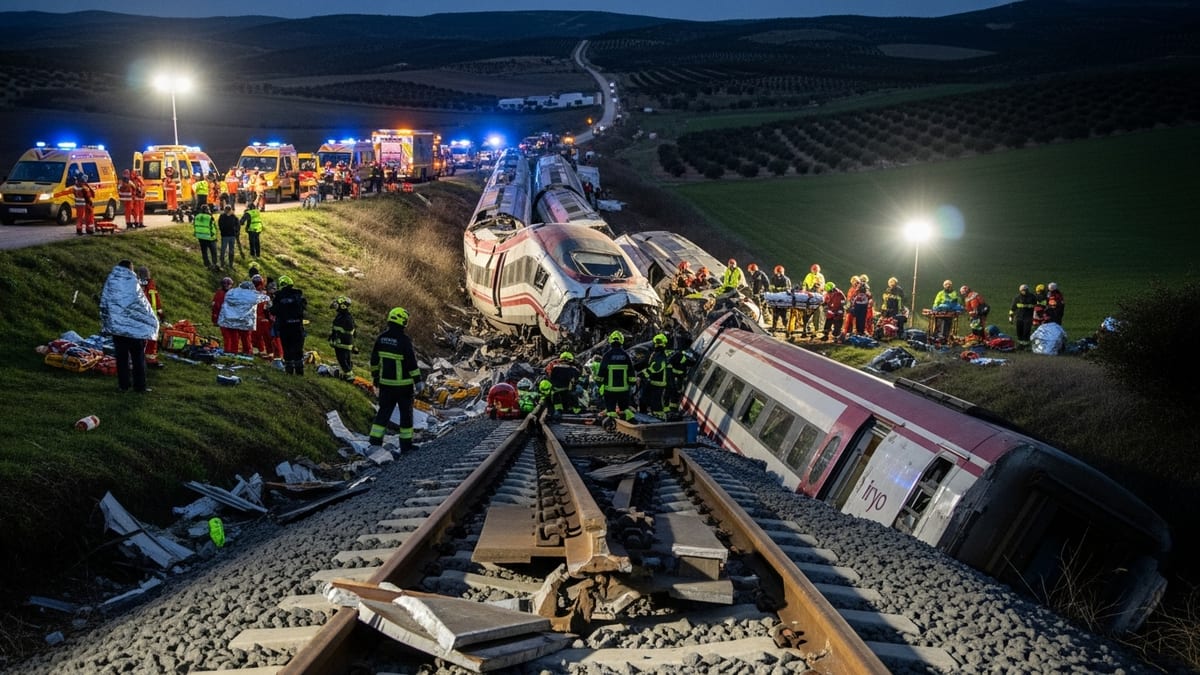
Findings point to missed use of critical safety feature
According to publicly available investigation documents and media coverage, the train involved in the crash was equipped with an emergency system intended to rapidly halt the service if the driver perceived an imminent risk ahead. The final report states that the driver did not activate this system in time, even though data recorders show there was a window of opportunity in which an emergency intervention might have prevented impact or greatly reduced the severity of the collision.
Technical analysis of the onboard equipment indicates that the safety system was functioning and available in the moments before the crash. Investigators report no evidence of mechanical failure that would have stopped the driver from using the emergency control. Instead, the report highlights a combination of late response and an apparent reluctance to engage the full emergency procedure until it was too late for the train to stop within the remaining distance.
Simulation work conducted as part of the inquiry suggests that an earlier emergency application would have provided sufficient braking performance to avoid the obstacle or, at a minimum, lower the speed at impact to a level associated with significantly less damage and fewer injuries. The authors of the report describe the unused capacity of the system as a central factor in classifying the crash as largely preventable.
Human factors and decision making under pressure
The investigation devotes substantial attention to human factors, including the driver’s workload, situational awareness and the influence of routine patterns on split-second decision making. Evidence drawn from train data logs and operating schedules indicates that the route on the day of the crash followed a pattern familiar to the driver, which may have fostered expectations that signals and track conditions ahead would remain unchanged.
Analysis of the driver’s actions suggests a delayed recognition of the developing risk and an initial attempt to manage the situation with standard service braking rather than immediate emergency action. The report notes that such hesitation is common in time-critical events, where operators may fear triggering an emergency stop that disrupts operations if the perceived hazard turns out to be less serious than it appears.
Investigators also point to training practices that emphasize adherence to normal operating rules but may not adequately rehearse rare, high-stress scenarios in which decisive use of emergency systems is essential. The findings indicate that while the driver had been instructed on the location and purpose of the emergency control, there was limited recent refresher training that simulated real-world conditions in which it must be used without delay.
Questions over safety culture and system design
Beyond individual decision making, the report raises broader questions about safety culture on the route and the way the emergency system was implemented. Review of company procedures shows that the emergency function was available but framed as a last-resort measure, with guidance that some experts now view as overly cautious about its use.
In addition, the physical design of the cab and control layout is cited as a contributing element. The emergency command was positioned separately from the controls used during routine operations, and there were no automated prompts or escalating alerts that encouraged the driver to switch from normal braking to emergency action as risk increased. The report notes that more modern systems increasingly blur this distinction by allowing automatic upgrade to emergency braking when danger thresholds are crossed.
Safety specialists commenting on the findings in published coverage argue that such design choices can unintentionally discourage timely use of lifesaving systems. When the burden rests largely on a single person’s judgment under intense time pressure, small delays in recognizing the need for emergency intervention can have catastrophic consequences, as illustrated by the sequence of events leading to this crash.
Implications for rail safety and future technology
The conclusions have renewed debate about how much responsibility should rest on individual drivers versus automated protections. The investigation underscores that the train’s emergency system was reactive and driver-controlled, rather than incorporating technology such as automatic train protection or positive train control that can intervene if human response is too slow.
In response to the report, rail safety advocates are calling for more widespread deployment of systems that continuously monitor train speed, signals and track conditions and automatically apply braking if predefined limits are exceeded. Published analyses of previous rail accidents indicate that such technology has already prevented numerous collisions in other jurisdictions by removing the need for a human to initiate the emergency command in the most critical seconds.
The case also highlights the need for railway operators to regularly reassess training, cab ergonomics and operating rules to ensure that emergency features are treated as integral safety tools rather than rarely used options. Experts note that drills, realistic simulations and clearer guidance about when to prioritize maximum braking can make it more likely that drivers will act decisively when seconds matter.
Calls for reforms and monitoring after the crash
Following release of the findings, attention is turning to how quickly the recommendations will be translated into concrete changes. The report calls for a review of driver training programs, revised instructions that encourage earlier use of emergency braking in defined scenarios and an evaluation of whether more advanced automatic protection systems should be installed on the route where the crash occurred.
Regulators and passenger advocates cited in media reports are urging close monitoring of how rail operators respond, emphasizing that lessons drawn from this crash have relevance across the wider network. The emphasis on a preventable outcome has intensified pressure to demonstrate measurable safety improvements rather than relying solely on policy statements.
For travelers, the incident serves as a reminder that many trains already carry sophisticated emergency technology whose full benefits are realized only when supported by strong safety culture, intuitive design and ongoing oversight. The findings suggest that closing the gap between system capability and real-world use will be essential to reducing the risk of similar avoidable crashes in the future.