


More news on this day
The United States State Department has intensified travel warnings across the Middle East, urging Americans to carefully consider leaving the region as the war involving Iran, Israel and U.S. forces deepens and the risk of wider regional escalation grows.
Get the latest news straight to your inbox!
Escalating Conflict Drives New U.S. Warnings
Publicly available advisories show that Washington’s guidance for Americans in the Middle East has shifted from general caution to much stronger language in recent months, as the 2026 Iran war has expanded beyond initial exchanges. Security alerts and travel advisories describe a volatile environment marked by drone and missile strikes, unrest around diplomatic facilities and rapidly changing flight conditions.
Coverage of the conflict indicates that joint United States and Israeli strikes on Iran earlier this year triggered a wave of retaliatory Iranian missile and drone attacks against U.S. bases and allied states in the region. These exchanges have affected not only active conflict zones but also countries that traditionally acted as regional transit hubs, raising concern that civilians and travelers could be caught up in sudden escalations.
Reporting on regional mobilizations notes that the United States carried out a major military buildup beginning in early 2026, deploying additional naval and air assets to deter further Iranian attacks. That buildup, combined with repeated warnings from Tehran that cooperating states could be drawn into the confrontation, has contributed to a sense that the conflict could shift quickly into a broader regional crisis.
As a result, recent State Department messages urge Americans in multiple Middle Eastern countries to reassess the need for being in the region at all, and to leave while commercial options remain available. The advisories stress that conditions could deteriorate without warning, and that government capacity to assist large numbers of citizens in an emergency is limited.
From “Exercise Caution” To “Be Ready To Depart”
Earlier travel alerts in the Middle East typically focused on localized terrorism threats, political unrest or crime. Over the past several months, however, public information from U.S. embassies indicates a clear tightening of language, with references to potential airspace closures, flight disruptions and attacks that may target locations frequented by Western nationals.
Published coverage of the 2026 Iran war records that by late winter and early spring, U.S. officials were already advising Americans in more than a dozen countries across the region to leave due to what were described as serious safety risks. Data compiled on evacuations during the conflict show that tens of thousands of Americans used commercial routes to depart between late February and early March, even as airlines began trimming schedules and rerouting flights around high-risk air corridors.
More recent security alerts, amplified by U.S. embassies in countries such as Bahrain, Israel, Jordan, Kuwait, Qatar, Saudi Arabia and the United Arab Emirates, urge Americans to be prepared for sudden changes in the travel environment. The messages point to the possibility of airports temporarily closing, airlines canceling services with little notice and overflight restrictions affecting onward connections to Europe, Asia and North America.
While the advisories stop short of promising organized evacuation flights, they emphasize personal responsibility and early decision making. Americans are urged to keep travel documents current, monitor local and international news closely and consider leaving before any major surge in demand or security incident makes departure significantly more difficult.
Impact On Regional Travel Hubs And Itineraries
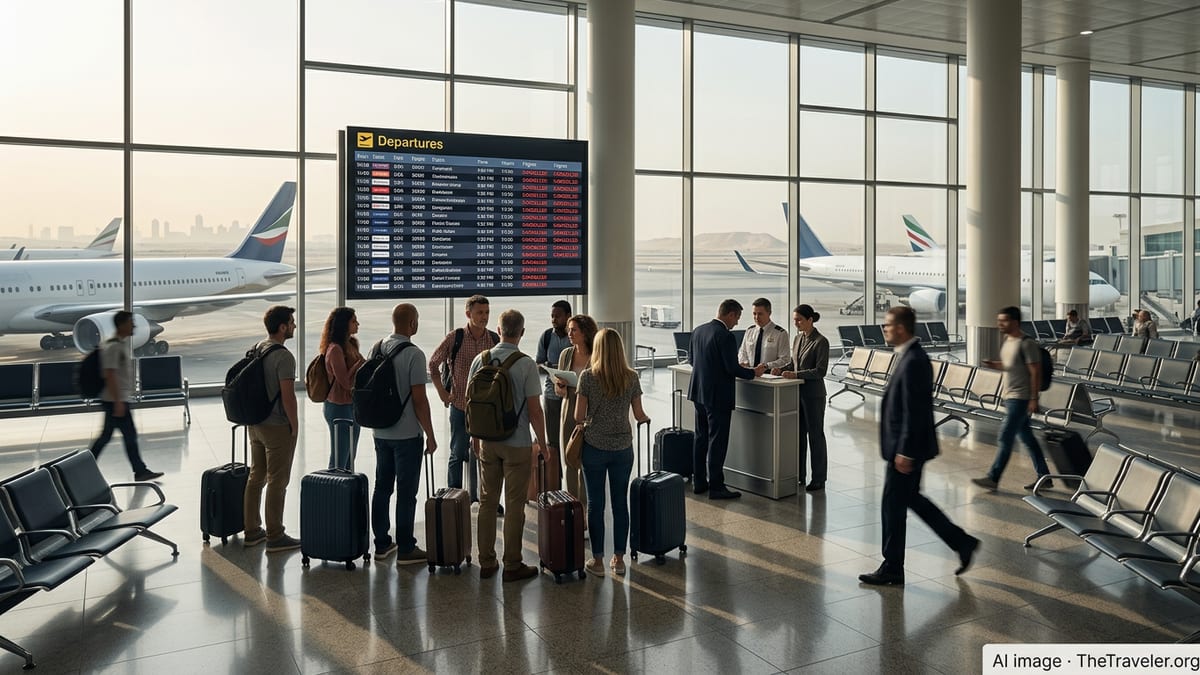
The conflict’s spillover effects are being felt across the broader travel landscape of the Middle East, a region that normally functions as a global crossroads linking East and West. Major hubs in the Gulf and the Levant are experiencing heightened security postures, additional screening and, in some cases, rerouted flight paths to avoid contested airspace.
Analyses of air travel patterns during the 2026 Iran war describe periodic closures or restrictions affecting parts of regional airspace. These changes have forced airlines to lengthen flight times, modify schedules and occasionally suspend certain routes altogether, disrupting not only residents and business travelers but also tourists in transit who might never have planned to set foot in active conflict zones.
For travelers, this has introduced new layers of uncertainty. Trips that once relied on smooth same-day connections through hubs like Doha, Dubai or other regional gateways now carry a higher risk of delay or last-minute rerouting. Public information from carriers and aviation trackers suggests that contingency planning has become a necessity, with some passengers opting for itineraries that bypass the region entirely when alternatives exist.
The tightening of State Department guidance is therefore not only a warning about physical security risks but also a signal that the reliability of the region as a transit corridor cannot be assumed. Travelers who decide to remain are being encouraged by publicly available advisories to maintain flexible plans, ensure they have access to emergency funds and be ready to adjust itineraries on short notice.
Americans On The Ground Face Difficult Choices
For the large community of Americans who live, work or study in the Middle East, the evolving guidance presents difficult personal and professional decisions. Many have deep ties to the region, including family, long-term employment or educational commitments that are not easily paused or relocated.
Letters from members of Congress and advocacy groups, referenced in public documents, underline concerns about the capacity of official channels to assist if the situation deteriorates suddenly. These communications point to experiences earlier in the year, when some Americans reportedly struggled to secure seats on outbound flights and encountered confusion about what support the government could realistically provide.
Against this backdrop, the State Department’s current messaging places strong emphasis on individual planning. Citizens are urged, through publicly accessible alerts, to register their presence with the department’s traveler enrollment systems, keep emergency contacts informed of their whereabouts and develop backup plans in case regular commercial routes are interrupted.
Travel risk specialists note that the calculus may differ from one country to another, depending on local security conditions, proximity to active military operations and the robustness of local infrastructure. Nonetheless, the broad nature of the advisories reflects a concern that escalation in one area could quickly reverberate across borders, affecting neighboring states that may, at present, seem relatively stable.
What The New Guidance Means For Future Trips
The reinforced warnings are already influencing how Americans approach future travel to the Middle East. Tour operators and corporate travel managers are reassessing itineraries, postponing nonessential trips and, in some cases, suspending group tours to destinations perceived as having elevated risk.
Travel industry analysts observing the region anticipate a sustained dip in demand for leisure travel while the conflict continues, particularly for first-time visitors who may be less willing to navigate a complex and fast-changing security landscape. At the same time, essential business and government-related travel continues, often with added layers of security planning and contingency routing.
For independent travelers considering new trips, the State Department’s alerts highlight several practical steps: reviewing detailed country-level advisories, checking airline operations before booking, and recognizing that insurance policies may treat conflict-related disruptions differently from weather or technical delays. The overall message is that travel to or through the region now requires a higher tolerance for uncertainty and a more proactive approach to safety.
How long the heightened warnings remain in place will depend on the trajectory of the conflict and diplomatic efforts to de-escalate tensions between Iran, the United States and regional actors. Until there is a clear and sustained reduction in hostilities, official guidance is likely to continue urging Americans in the Middle East to think carefully about their presence, make conservative decisions about future trips and, where feasible, leave before circumstances narrow their options.