


More news on this day
Four years after my last voyage north, I booked another Alaska cruise with mixed feelings. The scenery had stayed with me, but so had the exhaustion of chasing glaciers across time zones. Sailing again this season confirmed that the time change is still a shock to the system, yet the evolving Alaska cruise scene and the sheer drama of the landscape made the lost sleep feel like a fair price of admission.
Get the latest news straight to your inbox!
Time Zones, Late Sunsets and the Fatigue Factor
Most mainstream Alaska cruises depart from West Coast homeports such as Seattle and Vancouver, funnelling travelers from across North America into a tight summer window. For anyone flying from the Eastern or Central United States, that means an initial three-hour time difference even before boarding the ship, followed by the shift into the Alaska Time Zone once the voyage begins. The result is a cascade of early-morning port calls and late-evening sunsets that can leave travelers feeling permanently half a step out of sync.
On board, the clock changes quietly appear in the daily program, often while ships are steaming north along the Inside Passage or crossing open stretches of the Gulf of Alaska. For passengers, that can translate into what feels like lost sleep on nights when glacier viewing or scenic cruising is scheduled early the next day. Even in June and July, when daylight stretches well into the evening in ports such as Juneau and Skagway, the combination of shifting clocks and long days can make it difficult to wind down.
Travel forums and recent season reports describe similar experiences, especially among first-time Alaska cruisers who try to do everything: dawn wildlife watching on deck, long shore excursions, late shows and sunset photos that can come close to 10 p.m. on peak-summer itineraries. The practical advice that emerges is simple but not always easy to follow on vacation: accept that the time change will be tiring, and build in rest early rather than later in the week.
This year, going back after a four-year gap, the time difference felt just as abrupt as I remembered. But understanding in advance how the schedule would play out, and that the fatigue was a feature of the latitude as much as the itinerary, made it easier to plan around it instead of fighting it.
A Busier, Bigger Alaska Cruise Season
While the toll of the time change has not softened, the Alaska cruise landscape has shifted significantly since my last trip. Industry data and recent coverage point to 2026 as a landmark year for the region, with cruise lines adding capacity, redeploying larger ships and introducing new routes that extend deeper into Alaska. Reports indicate that several major brands are now treating the state as a core summer market, not a niche seasonal add-on.
Princess Cruises, for example, has announced what it describes as its biggest Alaska program yet, with eight ships and around 180 departures in the 2026 season. Other lines are increasing frequency of roundtrip sailings from Seattle and Vancouver and expanding one-way routes to and from Anchorage-area ports, giving travelers more choice on trip length, style of ship and level of onboard amenities.
For passengers, this growth has a visible impact. Ports such as Ketchikan, Juneau and Skagway are seeing more frequent calls, while smaller communities and scenic passages are being added or adjusted in response to environmental conditions and demand. Holland America Line, for instance, has reshaped parts of its scenic cruising program toward Endicott Arm on some itineraries, illustrating how operators are tweaking routes while still promising close glacier encounters.
Stepping back on board this year, the sense of Alaska as a “must have” in the cruise calendar was unmistakable. There were more options on the booking sites, more variation in itineraries and more competition for distinctive experiences, all of which raised expectations for what enduring a frustrating time shift should deliver.
Glacier Days That Justify the Early Alarm
Despite the sleep disruption, glacier days remain the defining argument in favor of an Alaska cruise. Most seven-night itineraries from Seattle or Vancouver include at least one full morning or day devoted to scenic cruising in areas such as Glacier Bay, Endicott Arm or Hubbard Glacier. Ship schedules are built around these passages, often bringing passengers to narrow fjords and ice-filled inlets in the early hours to take advantage of calmer winds and optimal light.
The trade-off is obvious when the itinerary lists an arrival window of 6 or 7 a.m. at a major glacier viewing area after a night that already included a time change. Yet travel reports consistently highlight these mornings as the most memorable of the voyage, with passengers lining railings, balconies and observation lounges to watch ice calve, listen to the cracks echo off the mountainsides and spot seals resting on floes.
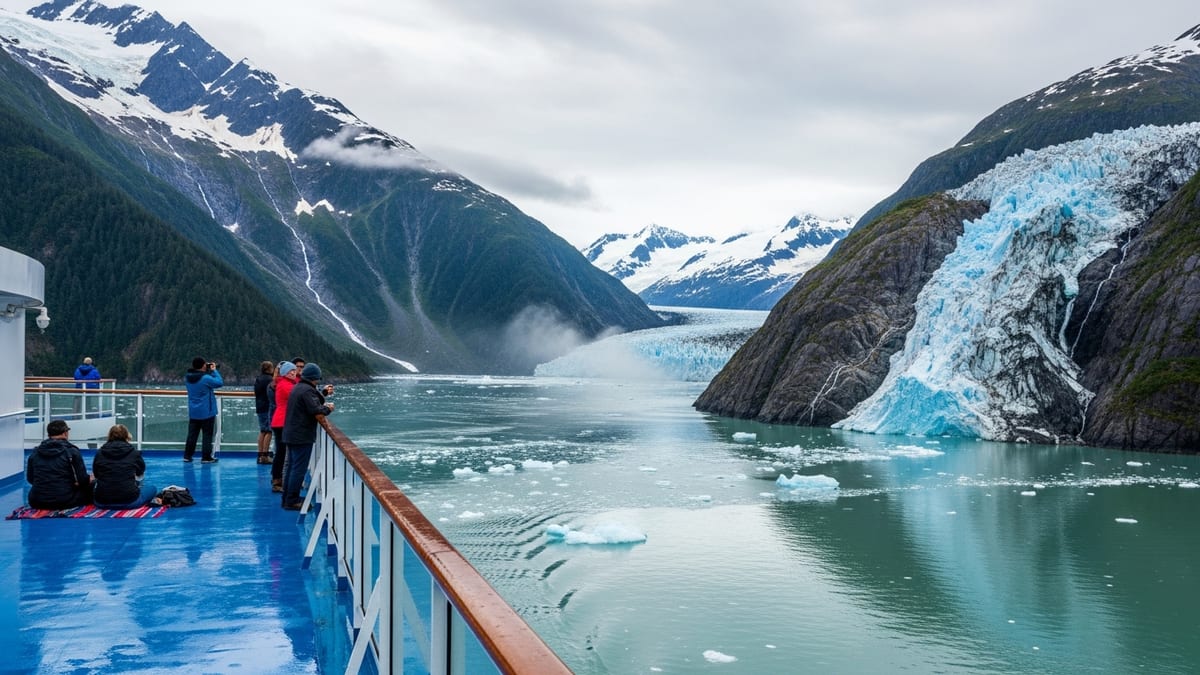
On this return trip, that pattern held. The ship eased into a fjord under a pale sky that felt more like late afternoon than early morning, cliffs rising sharply on both sides. Even with a head still foggy from the previous night’s clock adjustment, the scenery had a way of waking everyone up. It was difficult to remember the drag of the previous day’s yawns when the sun finally cleared the ridge and lit the glacier face in front of us.
That is the calculus many repeat visitors seem to make. The shortened sleep, the confusion over what time it is back home and the occasional missed show all become acceptable costs when set against hours of glacier viewing that would be difficult or far more expensive to replicate on land.
Ports of Call and the Pace on Shore
The impact of the time difference follows passengers off the ship as well. Alaska cruise itineraries are tightly choreographed, often arriving in port early in the morning and sailing again by late afternoon or early evening. Guides published by destination marketing organizations and cruise terminals for the 2025 and 2026 seasons show typical port times of eight to ten hours in key stops, framed by full sailing days through the Inside Passage.
For travelers still adjusting from home clocks, that schedule can create a sense of racing the day. Breakfast might feel like the middle of the night, yet a long excursion, such as a whale-watching tour, helicopter flight over glaciers or rail trip through mountain passes, can stretch for most of the hours ashore. By the time ships pull away and re-enter Alaskan or Pacific waters, many passengers are heading straight to early dinners or turning in before the last of the evening light.
During this year’s cruise, that tension between wanting to explore and needing rest was constant. Juneau offered a full slate of activities within a compressed window, from tram rides to high viewpoints to short hikes near glaciers at the edge of town. Skagway combined history, shopping and scenic rail journeys. Each port day felt satisfying but left little margin for adjusting to the shifting clock.
Industry observers note that some lines are responding by marketing longer itineraries and cruisetours that combine ship travel with inland stays near Denali and other interior destinations. Extra days on land can give travelers more time to adjust, but they also extend total trip length and cost, reinforcing Alaska’s reputation as a once- or twice-in-a-lifetime journey that requires planning and stamina.
Why Many Travelers Still Go Back
In the four years between my first and second Alaska sailings, memories of disrupted sleep and disorienting sunsets never fully faded. Yet they were overshadowed by recollections of ice, mountains, wildlife and the experience of standing on an open deck while the ship threaded narrow channels lined with forest and rock. As the region prepares for record passenger volumes in the coming seasons, it is clear that many travelers are reaching the same conclusion.
Publicly available data from cruise lines and port authorities suggest that Alaska continues to rank among the most sought-after itineraries in North America. Despite more capacity coming online, there are signs of strong demand for balcony cabins and itineraries that promise extended glacier viewing and scenic cruising days. In online discussions, repeat passengers often describe returning with family members who have never seen the region, accepting the fatigue as part of the experience they want to share.
This most recent trip underscored that dynamic. The time change still felt like an unwelcome travel companion, showing up as heavy eyelids at breakfast and early bedtimes on nights when entertainment stretched late. Yet each day also brought vistas that are difficult to match elsewhere on mainstream cruise routes, from low clouds scraping mountain ridges to whales surfacing alongside the ship.
In the end, the calculation remained the same as it was four years ago, just with a busier Alaska season and more ships sailing the route. The time-zone whiplash and long summer days took their toll, but the combination of evolving itineraries, record regional investment and the enduring pull of glaciers and fjords meant the journey still felt worth repeating.