


Riyadh’s King Khalid International Airport (RUH) has been changing fast, with terminals reshuffled and new shuttle and metro links coming online. For travelers connecting from a domestic flight within Saudi Arabia to an international departure, this can make the process confusing. This guide brings together the latest layout and policies so you know what to expect with terminals, baggage, immigration, security and how much connection time to allow in 2026.
Get the latest updates straight to your inbox!
Riyadh Airport Today: How the Terminals Are Used
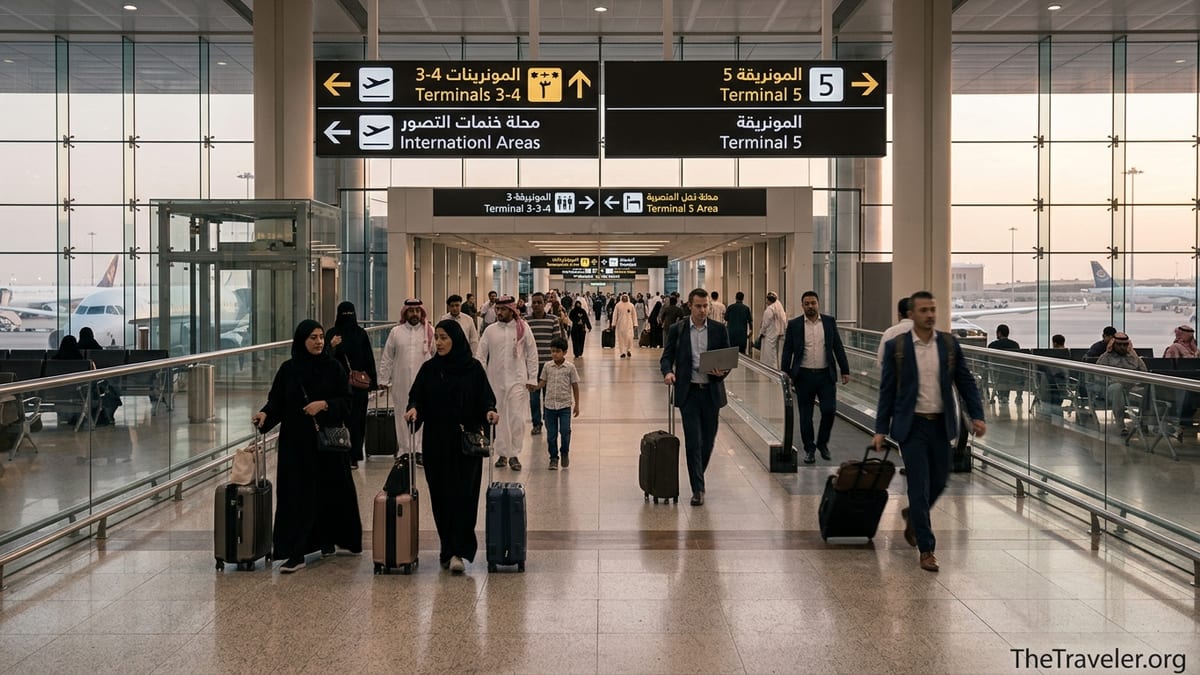
King Khalid International Airport sits around 35 kilometers north of central Riyadh and has five passenger terminals, but not all are currently used the way older guides suggest. In early 2026, Riyadh Airports Company announced a terminal transfer project that reshaped how flights are allocated. As of February 25, 2026, Terminal 5 is designated for international flights operated by foreign carriers, while Terminals 3 and 4 have been merged into a combined T3-4 complex that now handles domestic flights of national carriers such as Saudia and flyadeal. This is a major shift from the older pattern many travelers may remember, where Terminal 5 was the main domestic terminal.
In practice, this means a typical domestic to international connection now looks different from just a year or two ago. For example, a traveler flying Saudia from Jeddah to Riyadh and then connecting to Saudia’s long haul service to Paris will usually arrive and depart from the merged Terminal 3-4 area, staying within the same overall complex. By contrast, someone flying flynas from Dammam to Riyadh and then connecting onto Lufthansa for Frankfurt is more likely to arrive in T3-4 on flynas and depart from Terminal 5 on Lufthansa as a foreign carrier, requiring a transfer between these terminal zones.
Low cost and regional airlines also follow this new pattern. Many international airlines, including carriers such as Air India, report operating from Terminal 5, which has become a primary international gateway for foreign airlines serving Riyadh. Domestic operations for national airlines have been concentrated in T3-4 to simplify connections on the Saudi side and reduce walking times for local travelers coming from other cities such as Abha, Gassim or Tabuk.
Although some online maps and blogs still show the older layout, the key points to remember for a domestic to international transfer are simple. If your international flight is on a foreign airline, assume Terminal 5 unless your ticket or airline explicitly notes another terminal. If your international flight is on Saudia or another national carrier, expect to remain within the T3-4 complex. Always double check the terminal data on your booking or boarding pass in case of airline-specific exceptions.
Moving Between Terminals: Shuttle, Walking and Metro
Inside the main T1-4 building, the terminals are linked airside by walkways and concourses, so if you are moving between gates in T3 and T4 on a single ticket you will normally walk without leaving the secure area. Passengers report that this indoor walk feels similar to moving between concourses at many large hubs, with duty free and food outlets along the way, and it rarely takes more than 10 to 15 minutes at a normal pace.
The challenge comes when you need to move from T3-4 to Terminal 5. Terminal 5 sits slightly apart from the original terminal cluster, and while earlier travelers often relied on a landside shuttle bus that looped around the airport road, this service has been upgraded with higher frequency and integrated more formally into the airport’s transfer offerings. Recent announcements from Riyadh Airports mention shuttle intervals of around 4 minutes at peak times, along with complimentary taxi and Riyadh Metro transportation between terminals during the transition project period. In practice, however, you should still allow at least 20 to 30 minutes for the full door to door move between a gate in T3-4 and a check in or security point in T5, accounting for waiting times.
The Riyadh Metro adds another important option. Line 4, the Yellow Line, runs from the city to King Khalid International Airport with stations at Airport T5 and Airport T3-4, and then onwards to Airport T1-2. The Airport T5 station directly serves what is now the primary foreign carrier terminal. The Airport T3-4 station serves the merged domestic national carrier complex. Although the metro is primarily intended to connect the airport to the city, it has the practical side effect of creating a frequent, predictable rail connection between T5 and T3-4. Travelers connecting on separate tickets sometimes use the metro instead of the shuttle if it aligns better with their arrival point and time.
Realistically, if you land in T3-4 on a domestic leg and are continuing on a foreign carrier in T5, you will first clear baggage and immigration if required, then exit into the public area and follow signs to either the official shuttle stand or the metro station. For example, a passenger arriving from Madinah around midday with a 3 hour connection to an afternoon Emirates flight might take the shuttle for convenience, while someone arriving late at night could use whichever option has the shortest wait. In either case, expect the actual travel time between terminals to be roughly 10 minutes, with the rest of the connection time consumed by formalities.
Baggage Rules: Through Check vs Recheck
How your bags are handled at Riyadh during a domestic to international transfer depends mostly on your ticketing and airlines. If both flights are on the same airline or on partner carriers under a single booking reference, your checked bags are usually tagged through to your final destination at the origin airport. For instance, if you book a single Saudia ticket from Abha to Riyadh to London, the agent in Abha will typically tag your luggage all the way to London and you will not need to collect it in Riyadh. Instead, you follow “transit” or “transfer” signs after arrival, clear any necessary immigration procedures, and your luggage moves behind the scenes from the domestic to the international belt.
On the other hand, if your domestic and international flights are on separate tickets or on airlines without a baggage interline agreement, you should be prepared to collect your bag in Riyadh and recheck it. A common real world example is a traveler buying a low cost domestic ticket on flynas from Jeddah to Riyadh and then a separate long haul ticket on a foreign carrier such as Turkish Airlines from Riyadh to Istanbul. In this scenario, flynas will usually only tag your bag to Riyadh, and upon arrival you must go to baggage claim, pick up your suitcase, exit customs, then use the shuttle or metro to reach the appropriate international terminal and check in again.
Policies also vary by airline and airport handling agreements, so it is sensible to ask at your origin airport check in desk exactly where your baggage will be checked to and whether you will see it in Riyadh. Staff can show you the destination airport printed on the luggage tag. If the tag shows your final international destination, such as “LHR” for London or “DXB” for Dubai, that confirms through check in most cases. If it only shows “RUH,” you should assume you will reclaim and recheck in Riyadh.
Carry on baggage rules do not change specifically because of a domestic to international connection, but long walks and additional security checkpoints make it wise to keep hand luggage light. Saudia, for example, limits economy passengers on some routes from North America to a single carry on item with a modest weight cap. Other airlines have similar policies. If you are connecting through Riyadh on a tight schedule, traveling with a single, easy to manage cabin bag can significantly reduce stress when moving between terminals and queuing for secondary screening.
Immigration, Customs and Security: What to Expect
For most travelers, a domestic to international connection at Riyadh involves clearing Saudi exit immigration before boarding the outbound international flight, plus security screening before reentering the departures area. If your journey began within Saudi Arabia and you are leaving the country via Riyadh, you will generally not go through immigration on arrival from your domestic city. Instead, you follow signs to connecting flights or international departures, which eventually lead you to passport control where your exit is processed. The exception is when your itinerary forces you landside to recheck bags at a different terminal on separate tickets, in which case you will pass through a combination of domestic arrivals, baggage claim and then be funneled through the proper immigration desks for departure.
Security checks are layered. An arriving domestic passenger staying within the same complex might go through a quick transit security check before entering the international departures area, while a passenger who has gone landside and taken the shuttle or metro will face a full security screening at the international terminal entrance, similar to starting a journey in Riyadh. During busy hours, such as late evening waves when multiple long haul flights depart to Europe and Asia, lines at these checkpoints can extend to 20 or 30 minutes, even with additional counters open.
Customs comes into play only if you reclaim your checked baggage. For example, if you are flying Gassim to Riyadh to Doha on a single ticket with through checked bags, you never see your suitcase in Riyadh and simply walk past customs signage in the sterile transit flow. If you booked separate tickets and must pick up your bag, you will roll it through the green or red customs channel before heading to the shuttle or metro. For travelers carrying items like electronics for resale or large quantities of goods, this is where inspections are most likely.
Immigration and security procedures can lengthen during special periods such as Ramadan, school holidays, or when large groups travel for Umrah or events. In those times, airport staff often deploy extra lanes, but it is still prudent to assume that passport control plus security might take up to an hour combined at peak times. Travelers on tighter schedules should head straight from their domestic arrival gate to the transfer route without stopping for shopping or food until they can see their international gate listed and confirm boarding time.
How Much Connection Time to Allow
Official guidance and airline recommendations provide a useful baseline for timing. Airlines serving Riyadh often publish minimum connection times of around 2 hours 30 minutes for international to domestic connections, and similar or slightly shorter figures for domestic to international when flights are on one ticket. For first time visitors and those unfamiliar with the new terminal arrangement, allowing at least 3 hours for a domestic to international connection is sensible. This buffer accounts for possible delays on the inbound domestic leg, queues at passport control, shuttle or metro transit between terminals, and an additional security screening.
A practical way to think about it is to break down the stages. From aircraft door to leaving your domestic gate area typically takes 10 to 20 minutes, depending on how quickly you disembark and how far your gate is from the transfer point. Immigration and security together can range from 20 minutes in quiet off peak periods to 60 minutes or more at busy times. The shuttle or metro transfer between T3-4 and T5, if needed, can average 20 to 30 minutes from the moment you start walking toward the exit to the moment you reach your next check in or security point. That already totals between 50 minutes and 1 hour 50 minutes before you even walk to your new gate, which itself might be another 10 to 15 minutes away.
With those numbers in mind, a 90 minute domestic to international connection in Riyadh can work only in the most favorable conditions: same terminal complex, through checked bags, quiet time of day, and a punctual inbound flight. Travelers have reported making such tight connections, but it leaves no margin for disruption. If your itinerary forces you to change terminals and recheck baggage, anything less than 3 hours becomes risky, especially in the evening departure banks when many long haul flights push off within a short window.
Families, older travelers, or those unfamiliar with the airport should treat 3 to 4 hours as a comfortable target. This allows time for restroom breaks, a quick meal and prayer while still reaching the gate well before boarding. For example, parents flying from Dammam to Riyadh to connect onto a late night flight to Kuala Lumpur with two young children will likely find a 3 hour 30 minute layover far less stressful than a 2 hour window, given the extra time needed to move as a group and manage strollers or car seats through security.
Real Itineraries: What the Transfer Looks Like in Practice
Consider a business traveler flying from Jeddah to Riyadh on a morning Saudia service, then connecting to a European carrier operating from Terminal 5. The traveler lands in T3-4 around 10:00, walks off the aircraft and heads straight for the transfer signs. Because the next segment is on a foreign airline and booked on a separate ticket, the traveler collects a medium checked bag at the domestic belt, clears customs, and exits into the arrivals hall. Following signage to the shuttle stand, they wait about 5 to 10 minutes for a bus, then ride roughly 10 minutes around the airport loop to Terminal 5. Inside T5, they join the international check in queue, drop their bag, pass through exit immigration and security, and arrive at the departure gate with about 40 minutes to spare before boarding begins for a 13:30 departure. In this case, a 3 hour 30 minute connection feels reasonable, but a 2 hour one would have been uncomfortably tight.
Another scenario involves a family traveling on a single Saudia ticket from Abha to Riyadh and onward to Washington. Their bags are checked through from Abha to Washington at the start of the journey. Upon arrival in T3-4, they follow the “international connections” arrows without going to baggage claim. They walk along an airside corridor that keeps them within the secure area, eventually feeding into a series of passport control desks dedicated to departing passengers. After exit stamping and a brief security check, they find themselves in the main international departures hall, which may still be within the T3-4 complex if their Washington flight uses this side of the airport. Even if the long haul departs from a different pier, they remain airside and simply walk to the new gate. For this family, a 2 hour 30 minute connection is workable because they avoided bags, customs and landside shuttle transfers.
A third example shows why caution matters with separate tickets. A solo traveler books a last minute low fare on flynas from Tabuk to Riyadh landing at 19:00, then buys a separate ticket on a foreign carrier's 21:00 departure to Asia from T5. The itinerary leaves only 2 hours, including terminal change and recheck. If the Tabuk flight arrives even 20 minutes late or if there is a long queue at baggage claim, the traveler may struggle to check in again before the international airline’s counter closes, often 60 minutes before departure. Missing that cut off can mean an expensive same day change or overnight hotel cost. When booking, these real world timings show why a slightly more expensive combination with a longer layover may actually be better value overall.
These scenarios are not unique to Riyadh but the airport’s current mix of merged terminals, separate T5 location and evolving shuttle and metro services make advance planning especially important. The more you can consolidate tickets under a single reservation and choose itineraries that keep you within one side of the airport, the smoother your domestic to international transfer is likely to be.
The Takeaway
Domestic to international transfers at Riyadh’s King Khalid International Airport are manageable when you understand how the reconfigured terminals, shuttle, metro and formalities fit together. The new structure places domestic national carrier operations in the merged T3-4 complex and many foreign airlines in Terminal 5, with frequent but still time consuming transfers between them. Whether you need to reclaim and recheck baggage often hinges on whether your flights are booked on one ticket or separate reservations.
Allowing at least 3 hours for any connection that involves changing terminals, clearing immigration and possibly rechecking bags gives you a realistic cushion against routine delays and queues. Tighter domestic to international connections are possible when everything is on one ticket and remains within the same terminal area, but they leave little room for disruption. By checking your terminal assignments in advance, confirming baggage tagging at check in, and heading directly to transfer routes on arrival, you can turn Riyadh from a source of anxiety into a straightforward stepping stone on longer journeys.
FAQ
Q1. Do I need to collect my checked bags in Riyadh when connecting from a domestic to an international flight?
In many cases you do not, as long as both segments are on one ticket and the bags are tagged to your final destination. If your luggage tag only shows Riyadh as the destination or your flights are on separate tickets or unaligned airlines, you should expect to collect and recheck your bags.
Q2. How much time should I allow for a domestic to international connection at Riyadh Airport?
A minimum of 2 hours 30 minutes can work when flights are on one ticket and in the same terminal area, but 3 hours or more is safer, especially if you must change terminals, clear immigration and recheck baggage.
Q3. Are Terminals 3 and 4 separate at Riyadh, or are they combined now?
Terminals 3 and 4 are now operated as a merged T3-4 complex primarily serving domestic flights of national carriers. For most passengers, moving between T3 and T4 feels like walking within a single large terminal.
Q4. Which terminal handles most international flights at Riyadh?
Terminal 5 is the main terminal for many foreign carriers operating international flights, while national carriers may use the T3-4 side for international routes as schedules evolve. Always check your booking or boarding pass for the assigned terminal.
Q5. How do I transfer between Terminal 3-4 and Terminal 5?
You exit into the public area, then follow signs to the official airport shuttle or the Riyadh Metro stations that serve Airport T3-4 and Airport T5. The ride itself is around 10 minutes, but you should allow 20 to 30 minutes total including walking and waiting.
Q6. Will I have to clear immigration during a domestic to international connection in Riyadh?
Yes, if you are leaving Saudi Arabia you must clear exit immigration before your international flight, even if your journey began on a domestic segment. If you stay airside on a through ticket, you usually meet immigration along the dedicated transfer route to international departures.
Q7. Is it possible to stay airside during the connection, or must I always go landside?
If your domestic and international flights are on one ticket and handled within the same terminal complex, you can usually follow airside transfer signs without going landside. If you need to change terminals on separate tickets or reclaim bags, you will go landside and reenter through security.
Q8. What happens if my inbound domestic flight is delayed and I miss my international connection?
If both flights are on a single ticket, the delivering airline typically rebooks you on the next available flight at no additional fare, subject to availability. With separate tickets, you may have to buy a new ticket or pay change fees, so longer buffers are advisable.
Q9. Are there places to eat or pray during a transfer at Riyadh Airport?
Yes, both the T3-4 complex and Terminal 5 have cafés, fast food options and prayer rooms. With a connection of 3 hours or more, you should have time for a quick meal and prayer once you have confirmed your onward gate and cleared formalities.
Q10. Is the Riyadh Metro useful for airport transfers, or is it just for going into the city?
The Riyadh Metro’s Line 4 connects the city with Airport T5, Airport T3-4 and Airport T1-2. While it is designed mainly for city access, passengers can also use it as a predictable way to move between T3-4 and T5, especially during times when shuttle buses are crowded.