


More news on this day
A severed fiber optic line and failed communications circuit triggered a cascading air traffic outage across the US Northeast on Monday, delaying or canceling around 7,000 flights just as world leaders were flying into New York for the United Nations General Assembly.
Get the latest news straight to your inbox!
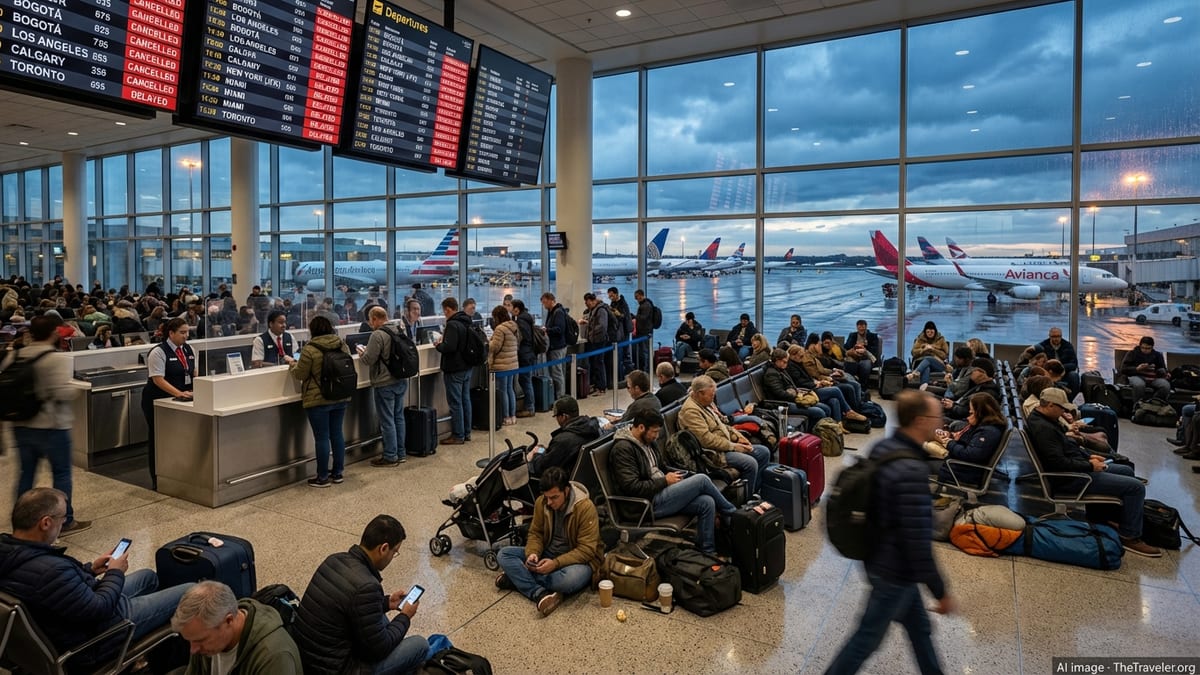
Telecom failure freezes key East Coast gateways
According to flight-tracking data and published coverage, the disruption began late Monday morning on September 21, 2026, when a primary communications circuit failed at a Federal Aviation Administration facility in Philadelphia that manages traffic for much of the northeastern United States. When systems attempted to switch to a backup route, controllers discovered that a separate fiber optic cable feeding the network had been severed, cutting critical radar and voice data to multiple airports.
Transportation and aviation reports indicate that the fiber was damaged during construction activity near an Amtrak rail corridor in New Jersey, leaving the FAA temporarily unable to safely manage dense traffic flows into some of the country’s busiest hubs. Ground stops and severe flow restrictions were imposed on arrivals into New York’s John F. Kennedy, LaGuardia and Newark Liberty airports, as well as Philadelphia and Boston Logan, with knock-on delays reported nationwide.
Analysis by flight-data providers shows that around 7,000 flights across the United States were delayed or canceled during roughly eight hours of disruption, with more than 1,200 to 1,400 affected at the three main New York airports alone. At Newark Liberty, commercial arrivals were effectively halted for much of the day, with no scheduled passenger flights landing for several hours during the peak of the outage.
By early evening, technicians had restored the damaged links and the FAA began lifting ground stops, but airlines cautioned that it would take many more hours for crews, aircraft and passengers to be repositioned and for schedules to stabilize.
Diplomatic arrivals to UN General Assembly thrown off course
The timing of the outage amplified its global impact. The United Nations General Assembly’s high-level week is scheduled in New York from Tuesday through Thursday, with around 130 heads of state and government, along with dozens of foreign ministers and senior officials, due to arrive in the region. Many of those delegations travel on tightly choreographed itineraries that rely on specific arrival slots at New York area airports.
Publicly available information on flight movements and official schedules shows that several government aircraft were diverted, delayed or forced to adjust timing as the telecom failure rippled through the system. Some leaders and ministers arriving from Europe and Latin America circled in holding patterns or were rerouted to alternate airports while approach corridors into New York and Philadelphia remained constrained.
Canadian and European media coverage indicates that at least one G7 leader missed side events planned for Monday on the margins of the General Assembly because of the disruption, arriving in New York only later in the evening once traffic had partially normalized. Delegations arriving on commercial flights faced the same congestion as other passengers, with some connections missed and last-minute rebookings required.
Despite the scale of the disruption, core UN proceedings scheduled to begin on Tuesday were expected to go ahead, although some bilateral meetings and side summits were rescheduled or compressed to account for late arrivals.
Airlines, airports and travelers scramble to recover
Airlines operating into the affected hubs moved quickly to thin schedules, canceling dozens of flights in advance once the severity of the communications problem became clear. Major US carriers offered flexible rebooking options, waiving change fees for passengers due to travel into New York, Boston or Philadelphia during the outage period and into Tuesday, according to publicly posted travel advisories.
At airport terminals, passengers faced long lines at customer service desks and crowded gate areas as departures boards filled with delay notices. Travelers reported waits of several hours to secure new itineraries, particularly for transatlantic routes already constrained by high autumn demand and the concentration of diplomatic traffic tied to the UN meetings.
Airport operators in New York, Boston and Philadelphia used social channels and terminal announcements to urge passengers to check status with airlines before heading to the airport. With some aircraft and crews out of position, early Tuesday morning operations still showed elevated numbers of delays and cancellations, although tracking services indicated a gradual return toward normal capacity as the day progressed.
Consumer-rights guidance published after the incident notes that because the root cause lies in air traffic control infrastructure rather than airline operations, travelers on affected routes are generally not entitled to cash compensation under typical US and European Union rules. Carriers remain responsible, however, for providing rebooking, refunds where applicable and a basic standard of care such as meals or hotel vouchers when passengers are stranded overnight.
Spotlight on aging US air traffic infrastructure
The failure has renewed scrutiny of the resilience of US air traffic control technology, particularly in high-density corridors such as the Northeast. Recent federal budget documents show that Congress approved around 12.5 billion dollars in funding in 2025 to modernize systems and expand controller staffing after a series of previous outages and chronic congestion at key hubs.
Industry analysts note that regional centers like the Philadelphia facility are designed with redundancy, including primary and backup data routes. The combination of a circuit failure and a severed backup cable in this case exposed a single point of vulnerability capable of cascading across multiple major airports. Comparisons are already being drawn to a 2025 incident that caused substantial delays at Newark during another UN General Assembly arrival period, also linked to technical issues at the same regional center.
Policy discussions following Monday’s disruption are expected to focus on hardening critical telecom links that support radar and communications feeds, improving coordination with third-party infrastructure projects such as rail construction, and accelerating the roll-out of newer satellite-based navigation and data systems intended to reduce reliance on aging ground cables.
Travel industry groups argue that such failures carry outsized economic and reputational costs, given that a single day of severe disruption in the New York–Boston corridor can affect thousands of flights and hundreds of thousands of passengers, including tourists, business travelers and high-level diplomatic delegations.
What the disruption means for upcoming trips
For travelers with flights booked into or through the northeastern United States this week, schedules are gradually stabilizing, but residual effects remain. Airlines have been adjusting aircraft rotations to catch up on maintenance and reposition planes, which can lead to short-notice schedule changes even after the immediate crisis ends.
Published airline advisories recommend that passengers heading to New York, Boston or Philadelphia over the coming days build in extra time for connections, monitor their booking through airline apps or websites, and register for text or email alerts. Those with same-day international connections, especially through Newark or JFK, may wish to consider earlier departure options where possible.
Travel compensation services report increased interest from passengers seeking clarity on their rights. While most travelers affected by this particular outage are unlikely to qualify for regulatory compensation because the root cause lies with air navigation services, they may still be eligible for refunds if flights were canceled and they chose not to travel, or for reimbursement of certain additional expenses depending on airline policies.
For visitors heading to New York specifically for the UN General Assembly period, hotel availability and traffic congestion are already more challenging than at other times of the year. The added strain of an air traffic disruption underscores the importance of allowing buffer days around critical events, particularly when travel involves tight diplomatic or business schedules.