


Landing at Riyadh’s King Khalid International Airport (RUH), about 35 kilometers north of the Saudi capital, your first real decision is how to get into the city. With the Riyadh Metro now operating to the airport, a busy network of ride hailing cars, traditional taxis and a growing choice of private transfers and rentals, the best option depends on your budget, luggage, arrival time and where you are staying.
Get the latest updates straight to your inbox!
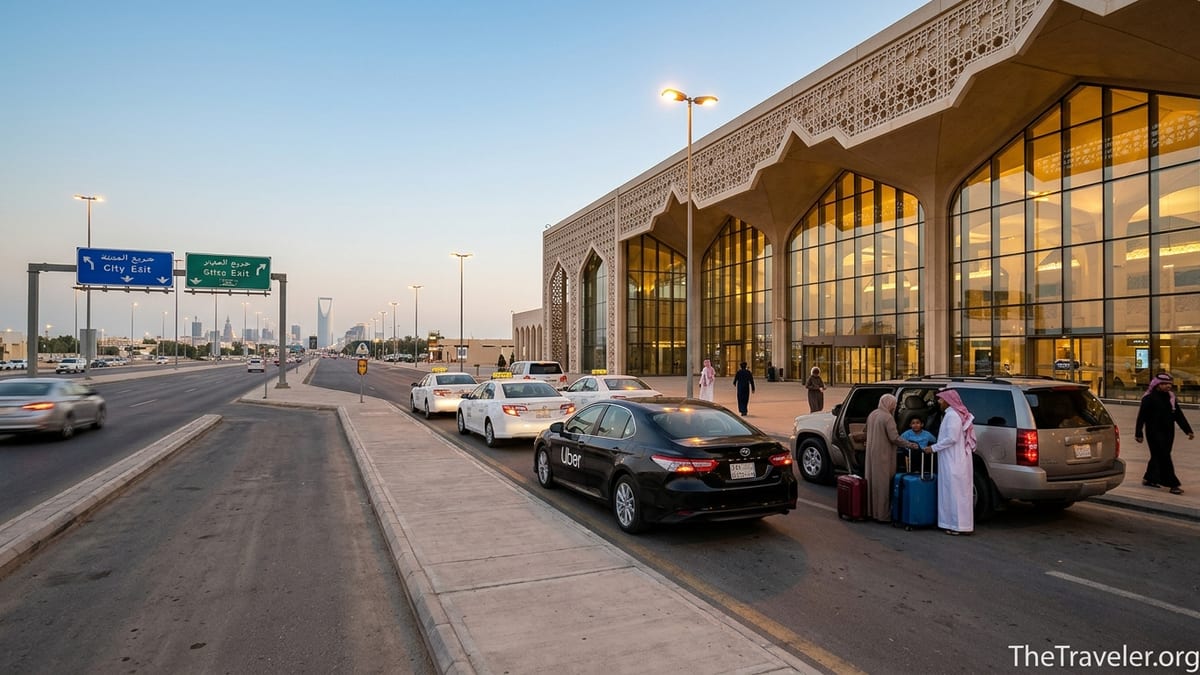
Understanding the Route from RUH to Riyadh
King Khalid International Airport sits roughly 35 kilometers north of central Riyadh, connected to the city mainly by Airport Road, which feeds into major corridors such as King Fahd Road and routes toward business districts like the King Abdullah Financial District and Olaya. In light traffic, the drive into the city can be as quick as 25 to 30 minutes, but at peak rush hours it can stretch closer to 45 minutes or more.
Most hotels and business addresses that first time visitors use cluster around a few key areas: the Olaya and King Fahd Road corridor with landmarks like Kingdom Centre, the King Abdullah Financial District to the north, and older central neighborhoods sometimes called “Downtown” around Batha and Malaz. Understanding roughly where your hotel sits along this north south axis helps you decide whether fast highway access, a metro connection or door to door service matters most.
Traffic in Riyadh tends to peak on weekday mornings from about 7:30 to 9:30 and again from 16:30 to 19:30. If you land at RUH on a Sunday evening at 18:00, for example, an Uber or taxi into Olaya might take 45 minutes in moderate congestion. A similar journey after 22:00 is often closer to 30 minutes. Late night arrivals and early morning flights usually enjoy quieter roads, which can make taxis and ride hailing both faster and a bit cheaper.
For most visitors, especially on a first trip, there is no single universally “best” mode from RUH to Riyadh. Instead, your ideal choice will be a balance between cost, comfort, how much luggage you are carrying and how comfortable you feel navigating in a new city on day one.
Riyadh Metro: When the Train Makes Sense
Riyadh Metro’s Line 4, often called the Yellow Line, links King Khalid International Airport with the King Abdullah Financial District and other key stations inside the city. The airport’s dedicated station is at Terminal 5, which is primarily used for domestic flights. If you land at an international terminal, you will need to follow airport signs or take the internal shuttle to reach the metro station at T5.
The metro can be an attractive option for solo travelers with light luggage arriving during the day or evening. Typical journey time from the Airport T5 station to central stops toward the financial district is in the range of 30 to 40 minutes, which compares well with a car in moderate traffic. Fares on Riyadh’s public transport are generally low by international standards, so a one way metro ride is usually only a fraction of what you would pay for a taxi or Uber into town.
However, the metro does not yet reach every hotel area directly, and you may still need a short taxi or ride hailing trip from your arrival station to your final destination. For example, if you are staying near Kingdom Centre in Olaya, you might ride the yellow line into the KAFD area and then take a 10 to 15 minute Uber for the last few kilometers along King Fahd Road. This combination can still work out cheaper than a direct car from the airport, especially if you are traveling alone.
Travelers with multiple large suitcases or young children often find the metro less convenient, particularly after a long international flight. Platforms, escalators and trains are modern and air conditioned, but managing heavy bags in an unfamiliar system can add stress. If your hotel is not near a metro station or you arrive very late at night, a direct road transfer is usually more practical despite the higher cost.
Airport Taxis: Simple and Familiar, but Check the Details
Official airport taxis remain a straightforward choice at RUH, especially if you prefer to walk out of arrivals and get into a car without using an app. The airport’s own information notes that taxis are available at designated ranks outside each terminal, with signage in English and Arabic and staff directing passengers. Vehicles are typically standard sedans or larger cars, all air conditioned, and you can expect drivers to know the main hotel districts like Olaya, King Fahd Road and KAFD without detailed directions.
Pricing for airport taxis is generally metered or based on set tariffs rather than a fixed flat fee to the city center. Recent local examples suggest that a daytime ride from RUH to a mid range hotel near Kingdom Centre might fall somewhere in the approximate range of 80 to 120 Saudi riyals, depending on traffic and exact address, with late night or heavy traffic pushing costs higher. Because fares can change and surcharges apply, it is wise to confirm how the fare will be calculated before you depart.
One advantage of airport taxis is space for luggage. Many vehicles are mid size sedans or larger, with decent trunk capacity for a couple of large suitcases and hand luggage. For a family with multiple checked bags, this can be less stressful than fitting everything into a rideshare compact car. On the other hand, some visitors report that ride hailing services like Uber and Careem now feel more predictable because the estimated price is shown in the app up front.
If you are arriving alone late in the evening and staying in a well known hotel in Olaya or the financial district, a taxi can be a fast and comfortable option. Just be prepared to pay in cash or card depending on the individual driver’s setup, and keep in mind that English levels vary, so having your hotel name and address written in Arabic on your phone or booking confirmation can smooth the trip.
Uber and Careem: Flexible Door to Door Convenience
Ride hailing services including Uber and Careem are widely available at King Khalid International Airport and in greater Riyadh. The airport’s own guidelines and recent traveler reports confirm that dedicated pickup areas for these services exist outside arrivals, typically marked with signage and numbered pillars, making it easier to match with your driver. You request your car through the app once you have collected luggage and cleared customs.
For most visitors, Uber and Careem offer a good balance of price, comfort and predictability. When you enter your hotel, for example Hyatt Regency Riyadh Olaya or a serviced residence near KAFD, the app will show an estimated fare before you confirm. Recent examples from residents suggest that a typical off peak UberX or Careem sedan from RUH to central Riyadh often falls roughly in the 70 to 120 riyal range. During busy periods, surge pricing can push that higher, as some travelers have noted paying closer to 100 riyals or more for what is normally a cheaper route.
These apps are particularly useful if you do not speak Arabic, because the pickup location, drop off address and fare are all handled through the platform. Both Uber and Careem accept international credit cards saved in the app, so you do not need local currency immediately. You can also choose larger vehicles such as SUVs if you are traveling with family or extra luggage, though these options cost more.
One minor complication is finding the correct pickup zone. A common pattern at RUH is that the app will instruct you to walk to a specific pillar number or signed zone outside the terminal. For first time visitors, it can feel a bit confusing, but there are usually airport signs pointing to ride hailing areas, and you can message your driver through the app if necessary. Building in an extra 10 minutes to locate the pickup point is sensible if you are in a hurry to reach a meeting or reservation.
If cost is your main concern and you are comfortable with apps, Uber and Careem are often the most economical door to door solution into the city, especially when traffic is light and surge pricing is not active. They are particularly convenient for hotels scattered along King Fahd Road, in residential districts, or in newer business zones where taxi drivers may be less familiar with exact addresses.
Private Transfers and Hotel Cars: Comfort and Certainty
Private airport transfers are increasingly popular in Riyadh, especially for business travelers, families and anyone arriving after a long overnight flight who wants a stress free arrival. Many local transport companies and global booking platforms offer pre arranged cars from RUH into the city, often with an English speaking driver waiting in the arrivals hall holding a sign with your name.
Typical prices for a standard private sedan from RUH to central Riyadh fall in an approximate range of 120 to 180 riyals, depending on provider, vehicle type and time of day. Higher end options such as luxury sedans or SUVs naturally cost more. Compared with a metered taxi or UberX, you pay a premium for the assurance that someone will be waiting even if your flight is slightly delayed, and for the extra assistance with luggage and navigation in the terminal.
Many four and five star hotels along Olaya, in King Abdullah Financial District and near the diplomatic quarter offer their own airport transfer services. For example, a major international hotel near Kingdom Centre might quote around 200 to 300 riyals for a private hotel car pickup, sometimes including bottled water and Wi Fi in the vehicle. While this is more than a standard rideshare, company travelers often value the ability to charge the transfer directly to the room or to a corporate account.
Private transfers are also the most comfortable way to travel if you are arriving with elderly relatives, small children or very bulky luggage such as exhibition materials or sports equipment. A pre booked driver can usually help you load and unload without rushing, and larger vehicles can be arranged in advance. If you are staying in a residential compound outside the main hotel districts, providing your exact address and gate details to the transfer company before arrival will help avoid confusion at security checkpoints.
Car Rental: Freedom for Confident Drivers
For travelers who plan to explore beyond Riyadh or make multiple trips across the city, renting a car at RUH can be a cost effective option. International and local rental brands operate desks in the arrivals area, and picking up your vehicle at the airport lets you drive straight into the city without relying on taxis or ride hailing. Daily rates vary widely by vehicle class and season, but compact cars are often competitively priced when booked in advance.
Driving in Riyadh is on the right hand side of the road, with modern highways but fairly assertive local driving styles. If you are comfortable navigating multi lane roads and high speed traffic, the route from RUH down Airport Road into the city is straightforward and well signposted in English and Arabic. Using a navigation app with live traffic is strongly recommended, especially at peak hours when congestion can build around major intersections and business districts.
Parking rules differ by neighborhood, but large hotels along King Fahd Road, KAFD and many shopping malls offer either free or paid parking for guests. Older central areas may have more limited street parking. Fuel prices in Saudi Arabia are generally lower than in many European countries, so running costs for a rental car remain modest compared with some other destinations.
Car rental makes the most sense if you are in Riyadh for several days and expect to move between meetings, shopping malls, cultural sites and perhaps day trips out of town. If you are only staying one or two nights, mostly within central districts, the combination of ride hailing and occasional short metro rides is usually cheaper and far less stressful than renting and parking a car you will barely use.
Comparing Costs, Luggage Space and Traffic Sensitivity
When weighing your options from RUH to the city center, there are three practical variables to keep in mind: cost, how much luggage you have and how sensitive your arrival is to traffic delays. A solo traveler with a cabin bag heading to a hotel near a metro connected district at midday will make a different calculation than a family of four arriving at 01:00 with three large suitcases.
In broad terms, the metro is the lowest cost option but requires the most self navigation and is least flexible with heavy luggage. Uber, Careem and airport taxis sit in the middle of the price range, offering door to door convenience with variable fares that rise in congestion or at busy times. Private transfers and hotel cars cost the most but deliver the smoothest arrival, particularly if someone is meeting you in the terminal and you prefer not to handle logistics after a long flight.
Luggage is another decisive factor. If you are carrying only a backpack and a small suitcase, you can comfortably manage the metro or a standard rideshare sedan. With two or more large checked bags per person, a station transfer and escalators may feel unwieldy, and booking an SUV or private car becomes more appealing. Many ride hailing apps in Riyadh offer a larger vehicle category specifically designed for extra passengers and luggage, which can be good value for groups when the fare is split.
Traffic mainly affects road based modes. On a weekday afternoon arrival into RUH, a taxi or Uber to Olaya might take 45 minutes and cost toward the upper end of the usual range. Late at night, the same journey could be 25 to 30 minutes and somewhat cheaper if demand for rides is low. If you must reach a time sensitive appointment, such as an evening business dinner or prayer time at a specific mosque, building in an extra buffer of at least 20 to 30 minutes is sensible, even if real time navigation shows a shorter estimate.
Best Options by Major Hotel Area
If your hotel is in the Olaya or King Fahd Road corridor, which includes many of Riyadh’s international business hotels and landmarks like Kingdom Centre and Al Faisaliah Tower, ride hailing services and airport taxis are usually the most practical choice. Journey times in normal traffic range from around 30 to 40 minutes, and both Uber and Careem are familiar with these addresses. For a mid range business stay, booking an UberX on arrival often strikes the right balance between cost and comfort, while higher end travelers might use a pre arranged hotel car.
For guests staying in the King Abdullah Financial District or northern business parks, Riyadh Metro’s Line 4 becomes more attractive. You can ride from the Airport T5 station toward KAFD and then walk or take a short taxi to your hotel or office. This can significantly cut costs for solo travelers and reduces your exposure to peak hour road congestion in the northern suburbs. That said, if you arrive late at night or with heavy luggage, a direct Uber, Careem or private transfer will still be more convenient, especially if your accommodation is deep inside a corporate campus or residential compound.
Travelers based in older central neighborhoods such as Malaz, Batha or the diplomatic quarter may find that taxis and ride hailing offer the simplest solution. These areas do not always have metro stations within easy walking distance of every hotel, and the street layout can be more complex for new visitors. In such districts, giving the driver a clear hotel name and nearby landmark is helpful. For example, you might tell your Uber driver you are heading to a specific hotel near a known park or mall, so they can confirm the route.
If you are staying further south or west of the city, perhaps in a villa, Airbnb or suburban compound, car rental or pre booked private transfer can be a smart choice. Compounds sometimes have security procedures and gate numbers that are easier to share with a dedicated driver in advance. Once in the city, having your own car can make everyday errands and excursions more straightforward, although you should be comfortable with Riyadh’s traffic and parking norms.
The Takeaway
Getting from Riyadh’s King Khalid International Airport to the city center has become more flexible as new transport options have come online. Where travelers once relied almost entirely on taxis or hotel cars, you can now choose between a modern metro line, widely available ride hailing services, a range of private transfers and convenient car rentals.
If you are traveling light and staying near the financial district or connected areas, pairing the Riyadh Metro with a short rideshare can be an economical and efficient way into town. For most visitors staying along Olaya and King Fahd Road, Uber, Careem and official airport taxis provide the most straightforward door to door journey, with reasonable travel times and clear pricing.
Families, business travelers with tight schedules and anyone who values a completely friction free arrival may find the premium for a private transfer or hotel car well worth paying, especially after a long international flight. Meanwhile, confident drivers planning to explore the wider region can take advantage of competitive car rental rates and straightforward highway access from RUH into the city.
Whatever option you choose, planning ahead pays dividends. Check your hotel’s location relative to the metro, estimate current ride hailing fares shortly before landing and consider how your luggage and arrival time will influence comfort and cost. With a little preparation, your first journey from RUH into Riyadh can be as smooth as the rest of your stay.
FAQ
Q1. How long does it usually take to get from Riyadh Airport to the city center?
In normal traffic it often takes around 30 to 40 minutes by car from King Khalid International Airport to central areas like Olaya or King Fahd Road, with peak rush hours sometimes extending the trip closer to 45 minutes or more.
Q2. Is the Riyadh Metro a good option from the airport for first time visitors?
The metro can be a very good option for solo travelers with light luggage, especially if you are heading toward the King Abdullah Financial District, but you may still need a short taxi or ride hailing trip from your arrival station to your hotel.
Q3. Are Uber and Careem allowed to pick up passengers at Riyadh Airport?
Yes, Uber and Careem can pick up at RUH using designated ride hailing pickup areas outside arrivals, and both apps provide directions to the correct zone once you request a ride.
Q4. How much should I budget for a ride hailing car from RUH to a central hotel?
Recent examples suggest that an UberX or similar Careem sedan from the airport to a hotel near Kingdom Centre or the Olaya area often falls in an approximate range of 70 to 120 Saudi riyals in normal conditions, with higher prices possible during busy periods.
Q5. Is it worth paying extra for a private airport transfer in Riyadh?
For families, business travelers or anyone arriving after a long overnight flight, paying more for a private transfer can be worthwhile because a driver meets you in the terminal, helps with luggage and offers a guaranteed door to door service even if your flight is slightly delayed.
Q6. Should I rent a car at Riyadh Airport or rely on taxis and ride hailing?
If you plan to stay mainly in central districts for a short visit, taxis, Uber and Careem are usually easier and more cost effective; renting a car makes more sense if you will be in Riyadh for several days and expect to travel widely around the city or take day trips.
Q7. Which option is best if I have a lot of luggage or bulky items?
For multiple large suitcases or bulky equipment, a private transfer, hotel car or a larger ride hailing vehicle such as an SUV is generally more comfortable than the metro or a compact sedan.
Q8. Can I pay for taxis and ride hailing cars with a foreign credit card?
Uber and Careem accept international cards saved in the app, while payment options for street taxis vary, so it is sensible to carry some local currency or confirm card acceptance with the driver before departing.
Q9. What is the safest option for late night arrivals at RUH?
For late night arrivals, a pre booked private transfer or hotel car offers the most predictable experience, though Uber, Careem and official airport taxis also operate 24 hours and can be safe choices if you prefer app based or on the spot booking.
Q10. How should I choose the best transfer option for my hotel area?
If you are staying near Olaya or King Fahd Road, taxis and ride hailing are usually best; for KAFD and nearby zones, the metro plus a short car ride can work well, while more distant residential or compound areas often favor private transfers or car rental for convenience.