


Choosing between the train and a rental car from Rome to Bari depends on how far beyond Bari you plan to roam. If you are visiting Bari itself with perhaps a simple day trip or two along the Adriatic coast, the train to Bari Centrale combined with local rail is usually the faster, cheaper and far less stressful option. If your plans focus on Alberobello, the Valle d’Itria, rural masseria stays or a multi-stop Puglia road trip, then picking up a car becomes increasingly worthwhile despite motorway tolls, fuel costs and strict driving rules inside Bari’s historic core.
Get the latest updates straight to your inbox!
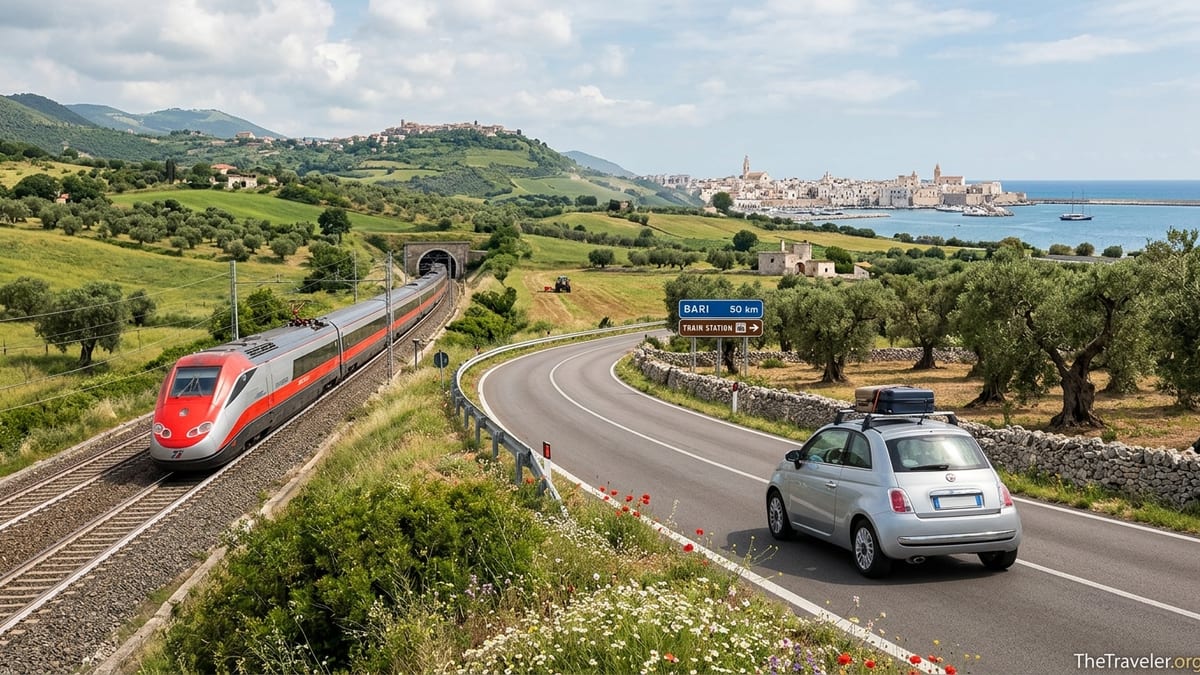
Train or car from Rome to Bari: who should choose what
For a short city break based in Bari, the train from Roma Termini or Roma Tiburtina to Bari Centrale is the clear recommendation. You arrive directly in the modern city center a few minutes’ walk from Bari Vecchia, avoid motorway fatigue and ZTL fines, and rarely need a car to reach the cathedral, seafront and main shopping streets. Regional trains along the coast make Polignano a Mare, Monopoli and Ostuni easy day trips without the hassle of parking or navigating unfamiliar roads.
Travelers planning to explore inland Puglia, especially Alberobello, Locorotondo, Martina Franca or scattered masserie in the countryside, benefit more from a car. Public transport toward these hill towns is run by Ferrovie del Sud Est and often involves slower diesel trains or replacement buses with sparse evening services. A rental car lets you link Bari to Alberobello, then on to Ostuni and perhaps Matera on your own schedule, rather than shaping your days around infrequent departures.
For mixed itineraries, a hybrid strategy can work well. Many visitors now take the Frecciarossa from Rome to Bari or to another major hub such as Bari or Lecce, enjoy a couple of car-free days in the city, then rent a car only for the rural portion of the trip. This reduces parking costs and the risk of ZTL violations, while still giving you the flexibility of a road trip when you most need it.
Frecciarossa and Intercity trains from Rome to Bari
The Rome–Bari rail corridor is part of Trenitalia’s national network, served by Frecciarossa high-speed trains and by classic Intercity services. Following a restructuring completed in 2026, trains that were branded Frecciargento on the Rome–Bari–Lecce route have been folded into the Frecciarossa brand, with modern ETR1000 and ETR600 sets replacing older stock on most departures. This means that when you search today from Roma Termini or Roma Tiburtina to Bari Centrale, you will typically see a mix of Frecciarossa and Intercity trains with different speeds and prices.
On a mid-season weekday timetable, there are usually several direct Frecciarossa departures from Rome to Bari, some starting at Roma Termini and others only at Roma Tiburtina, particularly during periods of track work near Termini. Recent schedules show non-stop or limited-stop Frecciarossa services taking roughly 4 hours to reach Bari Centrale, alongside slower Intercity trains that can take 5.5 to 7 hours depending on intermediate stops and routing. When you search specific dates, pay attention to whether your train is marked as “FR” or “IC” and whether it departs from Termini or Tiburtina.
Trenitalia’s national price list indicates that the base 2nd class Intercity fare for Roma Termini to Bari Centrale is a little over 50 euro one way, with 1st class around 70 euro. Advance-purchase offers on Frecciarossa, such as Super Economy and Economy fares, often reduce 2nd class tickets to the mid-20s or 30s if booked several weeks ahead, while last-minute flexible fares on popular trains can be considerably higher. It is important to distinguish “class” from “fare type”: you can travel in 2nd or 1st class, with each class sold at several fare levels that differ mainly in change and refund rules rather than comfort.
On board, Frecciarossa trains offer air conditioning, power sockets, Wi‑Fi on many services and a choice of Standard, Premium, Business and Executive environments, while Intercity trains provide more basic 1st and 2nd class coaches. Seat reservations are compulsory on Frecciarossa and Intercity and are included in the ticket; you must take the specific train shown on your booking unless you have a flexible fare that explicitly allows changes. Regional trains, by contrast, do not have assigned seats and tickets can be valid on multiple departures within a time window, which becomes relevant once you connect onward beyond Bari.
Luggage rules, comfort and the Rome–Bari rail route
Luggage is one of the main worries for visitors, but Trenitalia does not set a formal suitcase limit on national services such as Frecciarossa and Intercity. You can board with typical travel bags like a large checked suitcase plus a cabin-size bag and a personal item, as long as you can carry them yourself and store them safely. Frecciarossa trainsets provide overhead racks, spaces at carriage ends and gaps between back-to-back seats for larger suitcases, while Intercity coaches often have large racks at the coach entrance in addition to overhead shelves. Oversized items such as full-size bike boxes or extremely bulky sports equipment can be more restricted, and some reports from early 2026 show staff refusing very large boxes on Frecciarossa but allowing them on regional and Intercity services.
In terms of comfort, the roughly 4-hour Rome–Bari run on Frecciarossa is comparable to a medium-haul flight but with more generous legroom and the ability to walk around. Standard and Premium classes have 2+2 seating across the aisle; Business and Executive slim this to 2+1, which many travelers with laptops or children find more comfortable. Intercity trains are older, often with slightly less refined interiors, yet the slower pace can suit travelers who prefer a quieter, less busy environment and more open windows in some coaches. Families with strollers appreciate the level boarding at major stations like Roma Termini, Roma Tiburtina and Bari Centrale, though mind the small step between train and platform.
The rail route itself leaves Rome heading east across the Apennines, passing hubs such as Caserta or Benevento before descending toward Foggia and following the Adriatic line south to Bari. Not every service has identical stops or timings because some Frecciarossa trains skip intermediate stations entirely between Rome and Foggia, while others add calls like Caserta or Benevento that lengthen the trip by several minutes each. Intercity services usually make many more intermediate stops, contributing to their longer overall duration even though the rail distance is similar. Infrastructure constraints and ongoing upgrade projects also explain why certain trains are routed via Roma Tiburtina instead of Termini on specific dates.
Driving Rome to Bari: routes, tolls and fuel
Driving from Rome to Bari mainly involves the A1 and A16 motorway network, then the A14 toward Bari. From central Rome you typically join the A1 south of the city, head toward Naples, then branch onto the A16 Autostrada dei Due Mari toward Canosa di Puglia, which connects with the A14 that runs down the Adriatic coast to Bari. Depending on your exact starting point, route choice and detours for fuel or food, the distance is roughly 430 to 460 kilometers.
Real-world driving times reported by motorists for Rome to Bari via the A1 and A16 cluster around 4.5 to 5.5 hours of actual driving, assuming steady motorway speeds within the legal limit and no major traffic incidents. The A16 leg through the Apennines has long tunnels, mountain sections, sharp downhill curves and slower trucks on climbs, so it usually feels more tiring than the mostly level A14 section closer to Bari. With a short coffee and fuel stop around the halfway point near Grottaminarda or another service area, many drivers consider six hours door to door between city hotels a realistic non-rushed estimate.
Costs depend on fuel prices at your time of travel and the exact distance you drive, but recent calculators that combine tolls and petrol for a one-way Rome–Bari trip in a typical mid-size petrol car give totals in the region of 110 to 130 US dollars, which roughly converts to about 100 to 120 euro. Official documentation from the national motorway concessionaire shows base car tolls around 0.06 euro per kilometer plus small supplements on mountain stretches, so for 430 to 460 kilometers of tolled motorway you can expect tolls of roughly 25 to 35 euro each way. Fuel for an efficient rental car at current prices often adds another 40 to 60 euro, giving a ballpark car operating cost of 70 to 90 euro per one-way trip before rental fees.
For a pair of travelers sharing costs, that equates to roughly 35 to 45 euro per person purely in tolls and fuel. For a family of four, the same car cost drops to 18 to 25 euro per person, which is why larger groups start to find driving financially attractive, especially compared with four individual Frecciarossa tickets bought close to departure at higher fares. However, this simple comparison excludes rental fees, one-way surcharges, excess insurance, city parking and the financial risk of ZTL fines, all of which can be significant.
Rental car pricing, parking in Bari and ZTL rules
Rental prices from Rome for a compact car vary with season, booking channel and demand, but a realistic mid-season estimate for tourists picking up at a Rome city location or airport and dropping back in Bari is often around 45 to 70 euro per day before optional insurance. Adding full coverage or reduced-excess insurance can easily add 15 to 25 euro per day, and many one-way rentals between different cities include a drop charge if you do not return the car to the same location. For a three-day rental used simply to get from Rome to Bari and then sit in a garage, rental and insurance alone might total 180 to 250 euro.
Bari’s historic center, Bari Vecchia, is covered by a strict Zona a Traffico Limitato. Municipal announcements and updated ZTL maps confirm that from late 2025 and especially after new rules coming into force on 1 July 2026, the entire old town peninsula is reserved for vehicles with permits tied to residents, businesses and authorized spaces. It operates essentially 24 hours a day with seven electronic gates around the perimeter. Unlike in some Italian cities, hotels within Bari Vecchia generally cannot register guest license plates to obtain temporary access, so driving in even briefly to drop bags can generate automatic fines.
Because of these rules, most visitors with cars are strongly advised to park outside the ZTL, either in off-street garages at the edge of the old town or in signed blue-line street spaces in the modern grid of Murat, the 19th century district around Bari Centrale. Commercial garages near the station and seafront typically charge in the range of 15 to 25 euro per 24 hours for standard cars, with some premium or historic-center-adjacent facilities higher. Hotels in Murat often either have a small private garage for a nightly fee or agreements with nearby car parks, while many guesthouses in Bari Vecchia explicitly tell guests not to attempt to enter with a vehicle.
The combination of rental, fuel, tolls and parking can therefore make car travel significantly more expensive if you are only using the vehicle to reach Bari and then parking it for two or three days. For example, a couple renting for three days from Rome, paying around 60 euro per day rental and insurance, plus 80 euro in tolls and fuel to reach Bari and 50 euro for two nights of central parking, could easily face a total near 310 euro for the journey and short stay. Compared with two advance Frecciarossa tickets in the 30 to 40 euro range each way per person, the train often remains competitive or cheaper, especially once the value of a relaxed, car-free stay is considered.
Arriving at Bari Centrale and onward trains around Puglia
Arriving into Bari Centrale by train is highly convenient for visitors staying in either the new town or Bari Vecchia. The station sits at the edge of the Murat grid, with wide pavements and clear pedestrian routes leading toward the seafront. Walking from Bari Centrale to the edge of the historic center around Piazza del Ferrarese typically takes about 15 minutes on level ground, passing shops and cafes along Via Sparano or Via Argiro. Many hotels in Murat lie within a 5 to 10 minute walk, which makes rolling suitcases practical even for families.
From Bari Centrale, dedicated rail and bus services connect onward to Bari Karol Wojtyła Airport, located northwest of the city. The airport train station on the regional line toward Barletta offers a quick rail link from the main station, while shuttle buses provide an alternative for times when trains are less frequent. For onward coastal travel, Bari Centrale is the departure point for Trenitalia regional and regional fast trains heading south along the Adriatic line to Polignano a Mare, Monopoli, Fasano and Ostuni, and further to Brindisi and Lecce.
These coastal trains are integrated into the national Trenitalia network, with standard regional ticketing and no seat reservations. On recent timetables, Bari to Polignano a Mare can take around 25 to 35 minutes depending on train type, Bari to Monopoli roughly 30 to 40 minutes, and Bari to Ostuni around 50 to 70 minutes. Fares with Trenitalia’s regional tariff are modest, so many visitors buy tickets on the day via machines or the app and validate where required. This makes Bari an excellent rail base for day trips to the Adriatic cliffs and beaches without needing a rental car.
Services toward Alberobello and other inland towns operate differently. The network south from Bari toward Putignano, Alberobello and Martina Franca is run by Ferrovie del Sud Est, a separate regional operator. Its lines are partly single-track, with limited frequency, and on some sections trains are replaced by buses due to ongoing upgrades or seasonal timetable changes. Evening and Sunday services can be sparse, and some journeys require changes at intermediate stations without the same coordinated national booking that Trenitalia provides on the Adriatic main line.
Sample costs: Rome–Bari by train versus car
To understand the practical budget impact, consider two travelers planning to leave Rome on a spring weekday. If they book a month ahead, they may find Frecciarossa Super Economy fares in the range of roughly 25 to 35 euro per person in 2nd class. Even using a higher flexible or Economy fare around 45 to 55 euro per person for a popular mid-morning departure, their combined cost for the point-to-point Rome–Bari journey could sit between about 50 and 110 euro in total. Add a few euro more for Bari bus or regional train tickets during their stay and their transport budget for getting there and moving around the city remains manageable.
If the same couple decides to drive, a realistic cost picture must include daily rental and insurance in addition to tolls and fuel. Suppose they rent a compact automatic car for three days to allow flexibility on departure and some potential day-trip use, at a mid-range price of around 60 euro per day including added insurance. That totals 180 euro. Add about 80 euro for tolls and fuel on the one-way Rome–Bari trip plus 40 to 50 euro for two nights of central parking at a garage on the edge of Bari Vecchia, and they are already at roughly 300 to 310 euro before any further driving in Puglia.
For a family of four, the picture shifts slightly because fuel and tolls are still around 80 euro one way while train fares multiply. Four last-minute Frecciarossa tickets on a busy summer Saturday at higher flexible fares can easily exceed 80 to 100 euro each, making the train more expensive than car plus motorway costs in pure transport terms. However, children’s discounts, advance booking and the lack of rental and parking fees can keep rail competitive. Families also weigh non-financial factors such as the stress of managing children on a 5 to 6 hour drive, the need for child seats in rental cars and luggage capacity versus the open space and on-board toilets of a Frecciarossa.
When budgeting, also factor connection buffers if you are flying into Rome on the same day. With trains locked to specific departures, many experienced travelers recommend leaving 3 to 4 hours between a scheduled flight arrival at Fiumicino and a long-distance Frecciarossa, in case of delays at immigration or baggage claim. Missing a non-flexible train fare can mean buying a new ticket at the current price. Those who prefer a relaxed pace sometimes overnight in Rome, then take a mid-morning train to Bari the next day.
Itineraries: two days in Bari car-free and three days in wider Puglia
For a two-day Bari stay without a car, arriving by train sets you up for a smooth experience. On day one, check into a hotel in Murat within walking distance of Bari Centrale, then explore the seafront promenade and Bari Vecchia on foot. You can visit the Basilica of San Nicola, the Cathedral of San Sabino and the Swabian Castle, watch women making orecchiette in the old-town lanes, and dine at a traditional trattoria near Piazza Mercantile. Distances are short and taxis are available if you prefer not to walk back at night.
Day two could be devoted to a coastal highlight by train. An early Trenitalia regional train whisks you from Bari Centrale to Polignano a Mare in around half an hour, where you can stroll the historic center and admire views over Lama Monachile’s cove. Continuing one or two stops down the line brings you to Monopoli with its waterfront walls and port. With regional tickets bought on the day, you can choose to linger in one town and return to Bari in the evening on whichever train suits you. At no point do you need to think about parking, tolls or returning a rental car.
For a three-day Puglia plan that justifies renting a car, imagine starting with a Frecciarossa to Bari, spending the first night car-free in the city, then picking up a rental the next morning from one of the agencies clustered around Bari Centrale. Drive south on the SS16 and branch inland to Alberobello, staying in a trullo for the night. With a car, you can also fit in Locorotondo or Martina Franca the same day, which would be difficult with the more limited Ferrovie del Sud Est services.
On day two, continue by car to Ostuni, parking in a lot signed outside its upper old town and exploring the whitewashed lanes on foot. You could then overnight at a masseria in the countryside between Ostuni and Fasano, taking advantage of the car to reach rural restaurants and farm stays that are not served by rail. On day three, drive back up the coast, perhaps stopping in Monopoli or Polignano a Mare, and return the rental either in Bari or at Bari Airport before boarding a train or flight onward. In this scenario, the car works hard every day and clearly earns its cost.
Accessibility, luggage and family travel considerations
Accessibility and luggage handling are crucial when deciding between train and car. Bari Centrale and Roma Termini both have lifts and escalators between platforms and the concourse, which assists travelers with heavy suitcases, mobility issues or strollers. Frecciarossa trains offer level or near-level boarding at high platforms in major stations, though smaller intermediate stops on some routes can still have gaps or steps. Once on board, families appreciate the ability to store prams and medium suitcases near doors or at coach ends and to move around during the journey, which is not possible in a car.
For travelers who use wheelchairs or have limited mobility, both options have pros and cons. Trenitalia publishes assistance services that must be reserved in advance to guarantee boarding ramps and designated spaces, and Bari Centrale staff can accompany passengers between train and exit. In a car, you have full control over stops but must consider accessible toilets on the route, the challenge of transferring into a rental if it is not adapted, and the availability of accessible parking spaces at your destination. Many commercial garages in Bari reserve specific spots for disabled drivers, but prior confirmation is essential.
Families with young children often find the train less stressful for the Rome–Bari leg because children can nap, use the toilets or watch scenery without long periods strapped into seats. However, car seats are required by law for children under a specified height and age, and rental companies can supply them for a daily fee, which adds to car-trip costs. With a car, you have more flexibility to stop at playgrounds or quiet service areas, yet the driver remains fully engaged for hours on motorways that demand attention, especially on the winding Apennine stretch of the A16.
Luggage capacity is another deciding factor. A mid-sized rental car easily swallows several large suitcases and beach equipment, which is useful for longer Puglia stays. On the other hand, hauling heavy bags across station platforms and through Bari’s paved streets is manageable if you pack light, but can become tiring in summer heat. Many Bari hotels near the station or in Murat lie on level streets with smooth sidewalks, while Bari Vecchia has more cobbles and steps, so travelers staying deep inside the old town might prefer to pack more compactly if relying on the train.
Verdict: best choice for Bari, coastal holidays and Puglia road trips
For a focused city break in Bari and simple coastal excursions, the train from Rome is usually the best choice. Frecciarossa services cover the roughly 4-hour journey comfortably with no motorway stress, Bari Centrale puts you within easy walking distance of Bari Vecchia and the Murat district, and frequent Trenitalia regional trains along the Adriatic coast unlock Polignano a Mare, Monopoli and Ostuni without needing to think about parking or ZTL cameras. Financially, a couple can often reach Bari by rail for less than the combined rental, toll, fuel and parking costs of driving, especially with advance-purchase fares.
For coastal-focused holidays that include several different seaside towns but little inland exploration, the decision is more nuanced. Staying three or four nights each in Bari, Monopoli or Polignano a Mare is perfectly achievable by train and occasionally by taxi from local stations, so a car is not strictly necessary unless your accommodation is far from a station or you travel with bulky beach gear or small children who benefit from door-to-door transport. In these scenarios renting a car only for specific days, rather than for the entire trip, can be a smart compromise.
When your plan turns into a true Puglia road trip, including Alberobello, the Valle d’Itria, inland market towns and rural masserie, a rental car quickly becomes the more practical solution. Ferrovie del Sud Est routes and bus replacements can handle point-to-point travel but rarely allow the spontaneity of combining multiple small villages in one day or staying in countryside properties. Here, accepting the added costs of motorway tolls, fuel, insurance and parking is usually worthwhile for the convenience and flexibility gained.
Overall, think of the Rome–Bari train as your default for Bari city breaks and coastal stays focused on towns with stations, and treat the car as a powerful add-on reserved for itineraries that genuinely require rural access and multi-stop freedom. By matching your transport choice to your exact route through Bari and Puglia, you can minimize cost and stress while still reaching the Adriatic clifftops, whitewashed hill towns and olive groves that brought you south in the first place.