


More news on this day
A cascading operational breakdown at San Diego International Airport has triggered a wave of disruption across the West Coast, with publicly available data showing at least 166 significant delays affecting Southwest Airlines and Alaska Airlines flights and leaving thousands of travelers facing missed connections, stranded overnights, and rapidly shifting rebooking options.
Get the latest news straight to your inbox!
Power, Systems and Airfield Constraints Converge at San Diego
Initial reports indicate that Monday’s disruption originated at San Diego International Airport, where a combination of system outages and airfield congestion rapidly overwhelmed an already capacity‑constrained operation. Aviation dashboards and airline status feeds show departure banks from the single‑runway facility bunching into extended ground holds, with knock‑on effects on arrivals as gates and ramp space became scarce.
San Diego International is known for operating near the limits of a compact airfield layout, and industry analyses have repeatedly highlighted how even minor slowdowns can cascade into broader disruption. On this occasion, irregular operations appear to have coincided with peak summer schedules and an uptick in leisure demand along the California and Pacific Northwest corridors, amplifying the impact on both local and connecting passengers.
Publicly available air traffic planning documents and recent advisory notices point to a pattern of ground delay programs affecting the airport on busy days, particularly when weather, runway usage, or traffic management initiatives constrain arrival and departure rates. The latest meltdown fits that pattern, but on a larger scale, with delays extending well beyond the usual 30 to 60 minute window.
While investigators and airport planners work to quantify the exact trigger, early operational snapshots suggest a mix of technology stress, high aircraft volume, and tight turn times converging at one of the West Coast’s most space‑restricted commercial airports.
Southwest and Alaska Bear the Brunt of the Disruption
Flight‑status aggregators and airline operations trackers show Southwest and Alaska Airlines absorbing the majority of the fallout from San Diego’s latest breakdown. Combined, the two carriers recorded at least 166 substantial delays tied to San Diego origin, destination, or connecting flights, with many departures pushed back more than an hour and some rolling into multi‑hour waits.
Southwest, the largest carrier at San Diego, saw its dense network of short‑haul routes across California and the broader West Coast particularly affected. Delays on early‑morning departures quickly propagated through the day as aircraft and crews arrived late into secondary airports such as Oakland, San Jose, Sacramento, Phoenix, and Las Vegas, forcing schedule compressions and occasional last‑minute aircraft swaps.
Alaska Airlines, which has been expanding its presence at San Diego with new West Coast and mountain routes, also experienced a wave of late departures and extended taxi times. Tracking data shows sequences where inbound flights circled in arrival holds or diverted to alternate airports before returning once congestion eased, further straining available aircraft and pushing turn times beyond their planned limits.
The concentration of delays among these two airlines reflects their network structures out of San Diego, where tight turnarounds and frequent point‑to‑point services leave little margin when gate availability or pushback windows slip. Once those margins erode, even a localized disruption can reverberate as far as Seattle, Denver, Portland, and smaller regional markets that rely on consistent feed from Southern California.
West Coast Ripple Effects Snarl Connections and Crews
The operational problems at San Diego quickly radiated beyond Southern California. As late‑running flights departed for other West Coast hubs, airport status boards in cities such as Seattle, Portland, San Francisco, and Phoenix began to show rising numbers of late arrivals and missed connection windows for passengers booked on onward services.
Publicly available aviation analytics point out that the West Coast network functions as a tightly interconnected grid, in which an aircraft or crew delay in one city can create compounding mismatches elsewhere. In this case, late inbound flights from San Diego left aircraft out of position for subsequent departures, forcing airlines to choose between holding connecting passengers for delayed aircraft or operating later flights with unbalanced loads.
Complicating matters further, reports from traveler forums and real‑time delay trackers describe instances of crew duty‑time limits being reached as the day wore on. When flight attendants or pilots timed out after extended waits on the ground or in holding patterns, some flights required new crews to be sourced from already stretched bases. In several cases, that meant additional cancellations or rolling delays as airlines worked through their reserve pools.
The result was a patchwork of irregular operations across the West Coast, with some airports showing relatively normal activity while others experienced clusters of late departures tied back to the San Diego disruption. For passengers, this translated into difficult rebooking decisions, unexpected overnight stays, and shifting routings through alternate hubs that still had available capacity.
Travelers Face Long Lines, Limited Options and Rising Costs
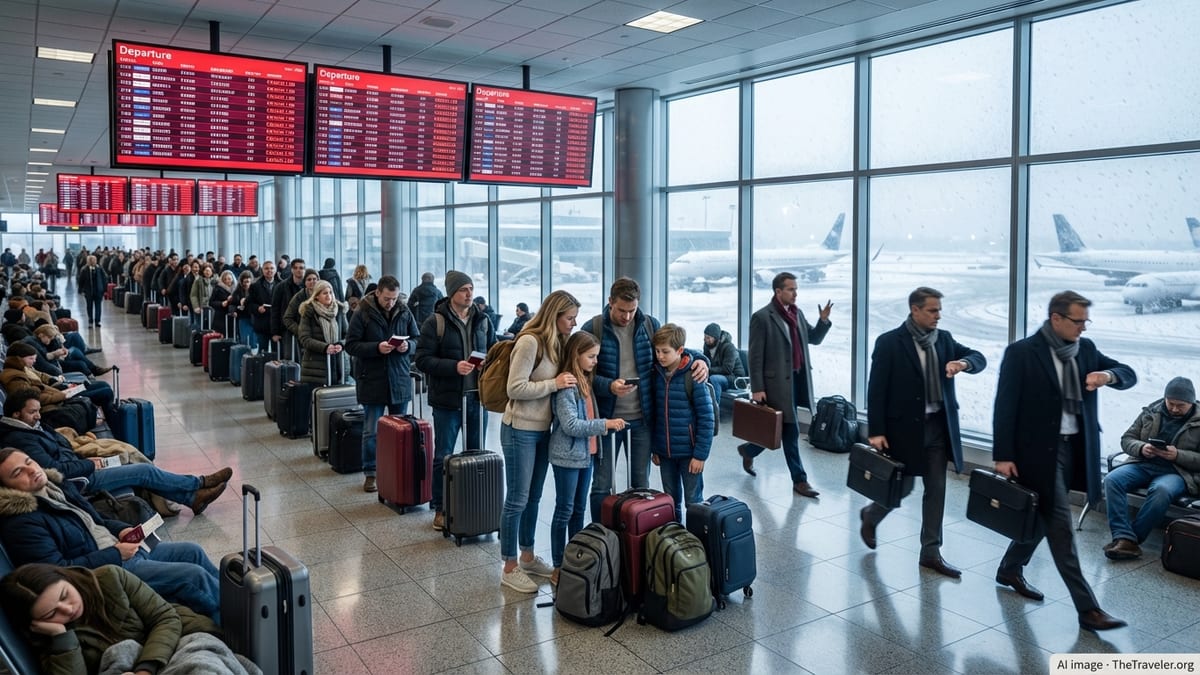
For travelers caught in the meltdown, the most visible impacts were long queues at customer service desks, crowded gate areas, and rapidly changing departure boards. Social media posts and traveler accounts described scenes of packed concourses as Southwest and Alaska customers sought new itineraries, meal vouchers, or confirmation that their flights would still operate.
With peak‑season loads already high, same‑day rebooking proved challenging. Many affected passengers reported being offered rebooked flights later in the day or on the following morning, with limited availability on nonstops and a greater reliance on connecting options through less congested hubs. Hotel availability around key airports tightened as irregular operations stretched into the evening, increasing out‑of‑pocket costs for those not covered by airline‑provided accommodations.
Industry analysts note that events of this scale also tend to drive up last‑minute fares on unaffected flights as remaining inventory is snapped up by stranded travelers. Even those not directly tied to San Diego found that alternatives on parallel routes, such as Los Angeles or Orange County departures to the same destinations, became more expensive and harder to secure as the day progressed.
For frequent travelers, the meltdown serves as another reminder of the importance of monitoring flight status tools, building longer connection windows during peak summer months, and maintaining flexible backup plans, particularly when itineraries rely on a single constrained airport or a small set of carriers.
Scrutiny on Resilience as Summer Travel Peaks
The San Diego disruption arrives just as airlines and airports brace for one of the busiest summer travel seasons in recent years, heightening attention on the resilience of West Coast operations. Recent planning documents for San Diego have emphasized infrastructure upgrades and terminal redevelopment, but the single‑runway constraint and limited surrounding airspace continue to pose challenges when irregular operations emerge.
Aviation observers argue that carriers with dense schedules at constrained airports may need to reexamine buffer times, gate utilization strategies, and contingency staffing as passenger volumes climb. The chain of delays triggered by this latest incident has renewed questions about whether existing margins are sufficient in the face of growing demand and increasingly frequent weather, technology, and air traffic management disruptions.
Publicly available on‑time performance data for major U.S. airlines suggests that both Southwest and Alaska have improved reliability in recent reporting periods, yet events such as this highlight how quickly that progress can be undermined by a single, high‑impact breakdown in a key market. For regulators, airport planners, and airline network teams, the San Diego meltdown is likely to feature prominently in ongoing discussions about capacity management and operational resilience on the West Coast.
As investigations into the precise triggers continue and airlines work through residual delays, passengers planning upcoming trips through San Diego and other West Coast hubs are likely to watch schedules more closely, factoring in the risk that a localized failure can spread rapidly across an interconnected aviation system.