

More news on this day
Scandinavian Airlines is introducing a new real-time luggage tracking experience in partnership with Google, positioning Copenhagen and Stockholm as early Nordic hubs for a digital revamp of how passengers monitor and recover checked bags.
Get the latest news straight to your inbox!
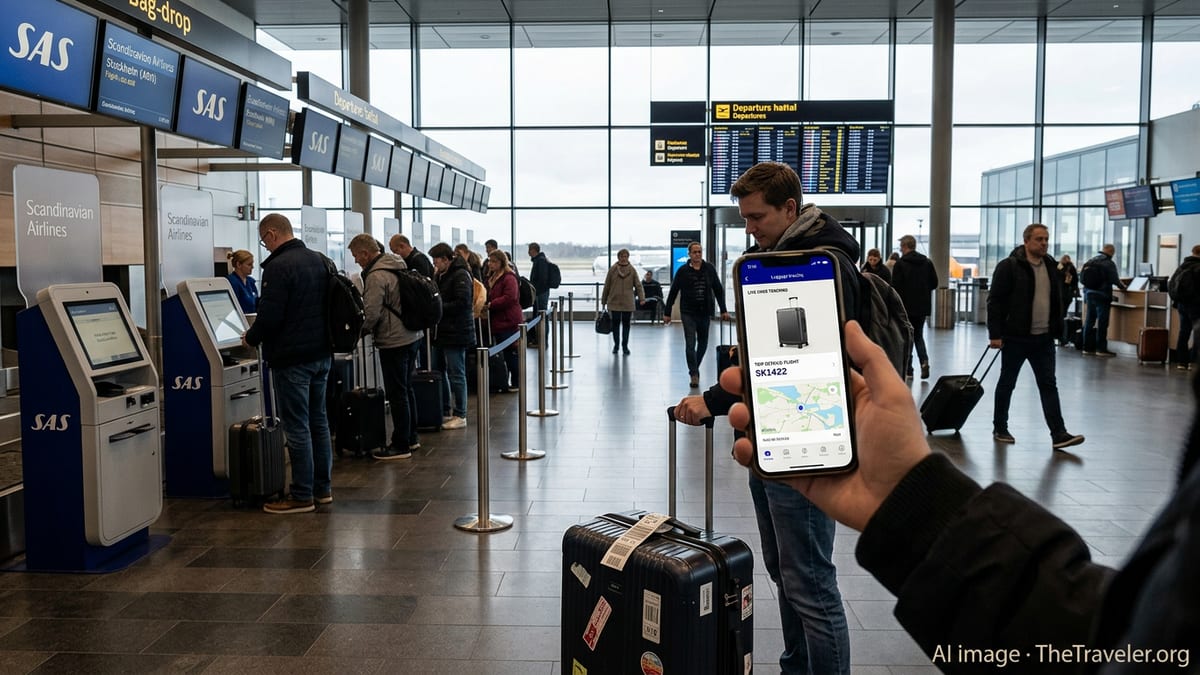
New tech partnership targets lost-baggage frustration
Publicly available information from Scandinavian Airlines and Google indicates that the carrier is adopting Google’s Find Hub location-sharing tools to improve how delayed or misplaced luggage is handled. The initiative allows passengers using compatible tracking tags to share live bag location information with SAS through a secure link, instead of relying solely on internal airport systems and manual searches.
The collaboration is being introduced as part of a broader push to modernize baggage handling after years of passenger complaints across Europe about delayed and missing bags. Recent coverage of the aviation sector shows that real-time tracking is increasingly seen as a competitive differentiator for full-service airlines focused on business and long-haul travelers.
Industry reports suggest that more than ten carriers worldwide now accept Find Hub location sharing, with SAS among the first movers in Northern Europe. The airline’s integration is being closely watched because of its strong presence at Copenhagen Airport and Stockholm Arlanda, two of Scandinavia’s most important international gateways.
How real-time luggage tracking will work for travelers
According to product descriptions from Google and SAS, travelers will attach a compatible tracker tag that participates in Google’s Find Hub network to their checked luggage before bag drop. Once the bag is checked in, passengers can monitor its approximate location on their Android device and, if the bag goes missing, create a time-limited, encrypted link that shares the bag’s live location with SAS through the carrier’s digital self-service tools.
The shared link enables airline teams to see where a tagged suitcase was last detected within the airport ecosystem, potentially narrowing searches to a specific baggage hall, carousel, transfer area, or even another airport if the bag has been misrouted. This is designed to complement existing barcode and tag scans rather than replace them, providing a second, passenger-driven data stream that can help teams focus their efforts.
Publicly available technical outlines of Find Hub emphasize that users retain control over what is shared and for how long. The live-location link can be disabled at any time from the passenger’s device, and the data is handled separately from traditional airline reservation information. This privacy-focused design is expected to be important in the European market, where travelers are accustomed to strict data protection rules.
Copenhagen and Stockholm positioned as digital test beds
Copenhagen Airport and Stockholm Arlanda are expected to be at the center of the rollout, reflecting SAS’s strategy of building a strong hub network in Denmark and Sweden. Recent route and capacity announcements show Copenhagen continuing to grow as SAS’s primary long-haul and transfer hub, while Stockholm remains a key gateway for both domestic Swedish and international traffic.
Industry observers note that introducing real-time luggage tracking tools at these airports is strategically significant. Both hubs see large volumes of connecting passengers whose bags move between regional and long-haul flights, a scenario where misrouted luggage is more likely. Enhanced digital visibility of bag locations could help reduce the number and duration of baggage disruptions during tight or irregular connections.
Travel analysts point out that Copenhagen and Stockholm are also attractive testing grounds because of the high rate of smartphone adoption and digital service usage among Nordic travelers. Passengers in Denmark and Sweden are generally comfortable using airline apps, digital boarding passes, and biometric gates, conditions that may support rapid uptake of the new tracking features.
Implications for passenger experience and airline operations
Travel technology coverage indicates that real-time luggage tracking has become a focus area for airlines seeking to rebuild trust after operational disruptions and baggage backlogs in recent years. By allowing customers to see that their suitcase is at least moving through the system, carriers can reduce anxiety and the volume of calls to customer service centers, which in turn frees staff to concentrate on solving the most complex cases.
For SAS, the Google partnership could also help shift perceptions among frequent flyers who have voiced frustration over past baggage and digital-service issues at major Nordic airports. If the new tools lead to quicker bag reunions and fewer cases classified as permanently lost, the move could support the airline’s broader strategy of positioning itself as a technologically advanced, customer-focused carrier in Northern Europe.
Operationally, gaining access to passenger-authorized tracking data may help baggage handlers and airport partners prioritize resources. Instead of manually searching large storage areas based only on paper tags, teams can use the shared live-location link to focus on a smaller zone where a tracker was last detected, which can be particularly valuable during peak summer and holiday travel periods.
A step in a wider digital race among global airlines
Reports from travel and technology publications indicate that the SAS and Google collaboration forms part of a larger shift toward integrated digital ecosystems that connect travelers’ personal devices with airline and airport operations. Rival initiatives, including partnerships built around other consumer tracking platforms, illustrate how quickly real-time baggage visibility is becoming a mainstream expectation rather than a niche perk.
Analysts suggest that this competitive dynamic is likely to benefit passengers flying through Copenhagen and Stockholm, where multiple carriers are vying to be perceived as leaders in reliability and convenience. By embracing shared-location technology, SAS is aligning itself with a trend that could eventually make opaque baggage searches and long waits at lost-luggage counters less common across the Nordic region.
As more airlines and airports join the Find Hub ecosystem, observers expect interoperability and common standards for digital baggage communication to become key topics. For travelers in Denmark and Sweden, the early adoption by SAS means that upcoming journeys through Copenhagen and Stockholm could offer a noticeably more transparent and controlled luggage experience, signaling a broader transformation in how checked bags are tracked worldwide.