


More news on this day
Amsterdam Airport Schiphol has suffered another severe bout of disruption, with operational data showing 80 flights canceled and 221 delayed in a single day, forcing KLM, Air France and easyJet to implement major schedule cuts and leaving thousands of travelers facing missed connections and last minute itinerary changes.
Get the latest news straight to your inbox!
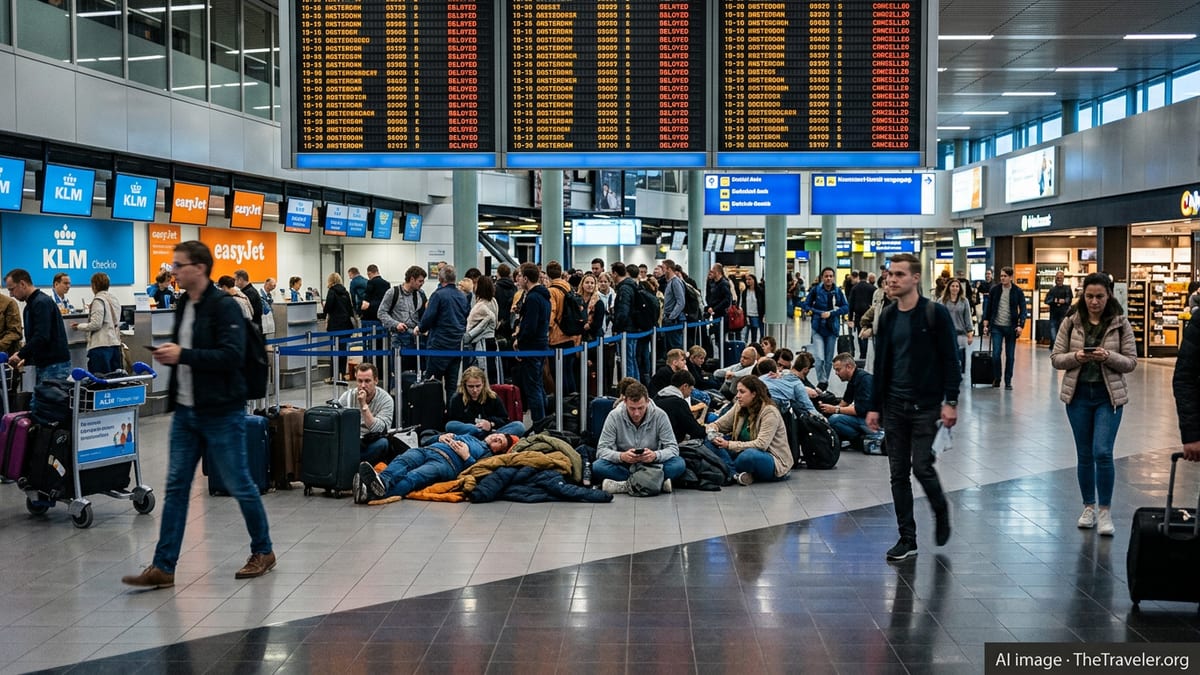
Severe Operational Strain at a Major European Hub
The latest disruption underscores how vulnerable Amsterdam Schiphol remains to spikes in operational strain during the peak travel season. As one of Europe’s busiest hubs and the primary base for KLM, with additional services by Air France and easyJet, even a few hours of capacity reduction can quickly cascade into widespread cancellations and rolling delays across the network.
Publicly available flight tracking data for the affected day indicates that 80 scheduled services were removed from the timetable while 221 others departed significantly behind schedule. The imbalance between cancellations and delays suggests that airlines attempted to preserve as much of the core network as possible, trimming selected rotations while allowing others to operate with extended turnaround times.
The disruption affected both short haul and long haul traffic. Schiphol’s role as a transfer hub meant that delays on intra European sectors fed directly into missed onward connections to North America, the Middle East, Africa and Asia. Reports indicate that passengers transiting through Amsterdam often discovered only at the gate that their onward services were rescheduled, retimed or, in some cases, removed from the schedule entirely.
Recent months have seen several high impact days at Schiphol, with operational bottlenecks and weather events combining at times to create long lines, crew positioning issues and congested airspace. The latest episode, however, stands out for the concentration of disruption into a single trading day and the heavy impact on a small cluster of major carriers.
KLM, Air France and easyJet Implement Major Schedule Cuts
KLM, the dominant airline at Schiphol, appears to have borne the brunt of the disruption. Publicly accessible schedules and airport departure boards showed multiple KLM services cut from the timetable, particularly on European routes with several daily frequencies where the carrier could consolidate passengers onto remaining flights. Long haul departures generally continued to operate but often with late pushback times as inbound aircraft and flight crews arrived behind schedule.
Air France, which links Amsterdam primarily with Paris Charles de Gaulle and relies on its partnership with KLM for broader connectivity, also trimmed its schedule. Data shows selected rotations removed from the Amsterdam Paris corridor and knock on changes across the Air France KLM joint network. For travelers booked on through itineraries, such as regional European cities via Amsterdam or Paris, this led to rebookings, unexpected overnight stays and reroutes through alternative hubs.
Low cost carrier easyJet, a key player in point to point leisure and city break markets from Schiphol, was forced to cancel and delay a notable share of its operations as well. Routes to popular destinations such as London, southern Europe and key city pairs saw aircraft grounded for extended periods while crews and equipment were repositioned. Travelers on these services often faced fewer same day alternatives, given that low cost models typically operate tighter turnarounds and condensed schedules.
These schedule cuts followed a pattern seen in previous months, when operational disruptions at Schiphol led airlines to prioritize core trunk routes and long haul departures, while trimming marginal or highly flexible frequencies. The emphasis this time again appeared to be on protecting connectivity for intercontinental passengers, even at the cost of severe inconvenience for travelers on shorter European legs.
Ripple Effects for Passengers Across Europe and Beyond
The immediate impact of the 80 cancellations and 221 delays was felt at Schiphol, where crowded departure halls, changing gate assignments and protracted security and boarding processes turned routine journeys into day long ordeals. However, the ripple effects extended well beyond the Netherlands as aircraft and crews fell out of position across the broader KLM, Air France and easyJet networks.
Travelers departing from secondary airports in neighboring countries experienced knock on delays when their inbound aircraft from Amsterdam arrived late or failed to arrive at all. In some cases, regional services were combined, with passengers reprotected on later flights or rerouted via different hubs, further complicating travel plans. Connections involving other alliance and partner carriers were also affected as missed interline transfers cascaded into rebooking queues.
Published coverage of recent European disruptions highlights how days like this can strain airport infrastructure, airline operations and passenger support systems simultaneously. Long lines at service desks, overloaded call centers and busy self service platforms often leave travelers relying on mobile apps and automated tools to piece together new itineraries in real time.
For those already in transit, the disruption translated into missed holidays, delayed business trips and extended stays in airport hotels. The combination of cancellations and long delays also created difficulties for passengers with tight visa windows, time sensitive events or non refundable arrangements at their destination.
Passenger Rights, Rebooking Options and Compensation
Under European Union and United Kingdom air passenger regulations, travelers affected by cancellations and long delays may be entitled to assistance, rerouting and in some cases financial compensation, depending on the cause of the disruption and the notice given. Publicly available guidance notes that compensation levels can reach several hundred euros per person on longer routes when flights are canceled at short notice or arrive hours behind schedule.
Consumer advocacy platforms and legal information sites advise passengers first to keep boarding passes, booking confirmations and any written documentation about the disruption. With that information, travelers can use airline websites or third party tools to check whether their specific flight meets the criteria for compensation or reimbursement. If the disruption is deemed within the airline’s control and not solely due to extraordinary circumstances, financial redress may be available in addition to standard rebooking support.
Rebooking policies published by major carriers indicate that passengers whose flights are canceled or heavily delayed are typically allowed to change to alternative departures without additional fare differences, subject to seat availability. Many airlines also enable travelers to request refunds when delays exceed a set threshold or when cancellations make the trip no longer viable. Hotel accommodation, meal vouchers and ground transport reimbursement may be offered in some cases, particularly when overnight stays become unavoidable.
Given the volume of affected flights at Schiphol on the disrupted day, experts commonly recommend that passengers act promptly to secure replacement options, whether via self service channels or customer support teams. Seats on remaining flights can disappear quickly once a major disruption hits a hub, especially during busy travel periods when load factors are already high.
Ongoing Questions About Resilience at Amsterdam Schiphol
The latest wave of cancellations and delays adds to a growing list of challenging days at Amsterdam Schiphol, raising questions about the airport’s resilience during peak seasons and in the face of mounting operational pressures. Recent history at the hub includes disruptions linked to staffing shortages, security bottlenecks, weather events and broader network issues affecting key carriers.
Aviation analysts and passenger groups have pointed to Schiphol’s dual role as both a vast transfer hub and a major origin destination airport as a structural factor in its vulnerability. High volumes of connecting traffic mean that delays in one part of the system can quickly propagate across multiple banks of flights, while the local demand for early morning and late evening departures leaves limited room in the schedule to absorb shocks.
For airlines, the latest incident provides another reminder of the fine balance between efficient scheduling and operational flexibility. Tight turns and complex connection banks maximize aircraft utilization in normal conditions but leave limited slack when a day deteriorates due to weather, air traffic constraints or resource shortages on the ground. When such pressures converge at a central hub like Schiphol, carriers such as KLM, Air France and easyJet can find themselves with little option but to cut flights in bulk to restore order.
With summer and peak holiday flows ongoing, travelers using Amsterdam Schiphol in the coming weeks are likely to watch operational data and airline updates closely. Industry observers note that while days of extreme disruption remain relatively rare, the pattern of repeated high impact events across Europe this year suggests that passengers may benefit from building extra time into itineraries, considering earlier departures and keeping contingency plans in mind when connecting through major hubs.