

More news on this day
Singapore Airlines and low cost subsidiary Scoot have extended the suspension of several Middle East routes to at least mid March, disrupting travel between Singapore and major hubs in the United Arab Emirates and Saudi Arabia as regional conflict continues to unsettle airspace and itineraries.
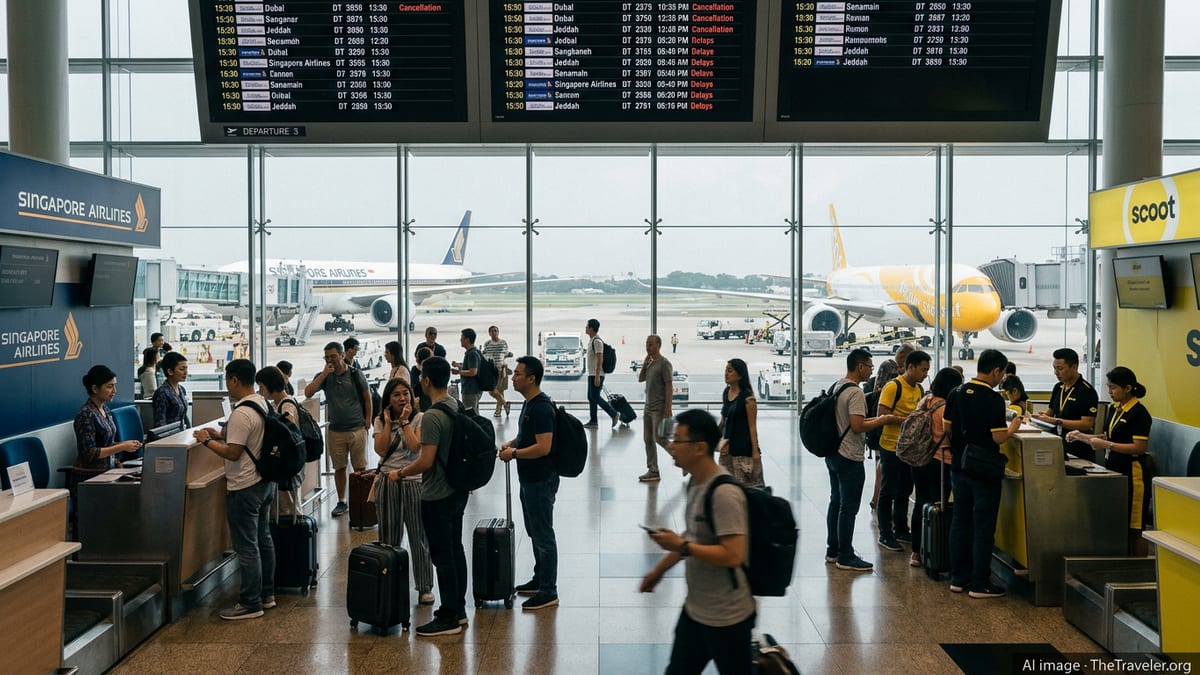
Key Routes Between Singapore, UAE and Saudi Arabia Affected
The latest schedule updates from the Singapore Airlines Group show continued cancellations on flights linking Singapore with Dubai and Jeddah, among other Middle Eastern gateways. Services on these corridors have been halted since February 28, when escalating conflict linked to Iran prompted widespread airspace closures and diversions across the region.
Flag carrier Singapore Airlines has suspended flights between Singapore Changi and Dubai International Airport, a route that also feeds significant transit traffic from Australia and Southeast Asia onto European services. Scoot, the group’s budget arm, has similarly halted its Singapore Jeddah operations, cutting a key low cost connection for religious travel and labour traffic between Southeast Asia and Saudi Arabia.
The group has indicated that many of these cancellations will run at least through March 15, with the possibility of further adjustments if the security situation and overflight restrictions fail to stabilise. Customers holding tickets on the affected routes are being offered alternative routings where possible, or refunds for the unused portions of their journeys.
Industry analysts note that the prolonged suspension reduces capacity between Asia and the Gulf at a time when demand for east west travel remains strong, and comes just months before Singapore Airlines is due to launch new non stop services to Riyadh, its second Saudi Arabian destination after Jeddah.
Travelers Face Disruption as Repatriation Efforts Continue
The suspension has left some travellers stranded across the Middle East and in Singapore, particularly those who had planned to transit through Dubai or Jeddah on their way to and from Europe and Africa. With Singapore Airlines and Scoot scaling back operations, affected passengers have had to rebook on other carriers or wait for limited seats on remaining services as governments organise repatriation flights.
Singapore’s authorities have been coordinating with regional partners to help residents and visitors leave affected areas. Special flights from Singapore to Muscat in Oman have been arranged to facilitate onward travel for foreign visitors whose original itineraries via the United Arab Emirates or Saudi Arabia were disrupted by the sudden airspace shutdown.
Other Gulf carriers, including Emirates and Etihad Airways, have gradually restarted some services between the UAE and Singapore after initial suspensions, but capacity remains constrained and schedules subject to late changes. Travellers are being urged to reconfirm their flights before heading to the airport, and to remain flexible as airlines juggle aircraft and crews around new routings that avoid sensitive airspace.
For Singapore based travellers, the loss of direct links to Dubai and Jeddah has narrowed options for reaching parts of the Middle East, North Africa and southern Europe that are commonly accessed via Gulf hubs. Many are now routing through alternative gateways such as Istanbul, Doha, or European capitals, often with longer travel times.
Airlines Adjust Networks Amid Geopolitical and Operational Risks
The Singapore Airlines Group has framed the extended suspensions as a necessary response to evolving safety and operational assessments, noting that the situation remains fluid. Airlines globally have been forced to reroute or cancel flights after the latest flare up of conflict, which has affected key air corridors over parts of the Middle East.
Operationally, flying around restricted or higher risk airspace can add hours of extra flight time, raising fuel burn and crew duty costs. For some routes, those burdens render services commercially or logistically unviable in the short term, prompting carriers to ground specific rotations until a clearer picture of airspace access emerges.
For Singapore Airlines and Scoot, the timing is particularly sensitive. The group has been rebuilding its international network and adding new destinations following the pandemic era downturn, including plans to resume non stop flights to Riyadh from June 2026. The current conflict has undercut that growth trajectory in the Middle East, at least temporarily, and highlighted the exposure of long haul networks to geopolitical risk.
Nevertheless, the group has reiterated that safety remains its top priority and that any decision to restore Dubai or Jeddah flights will be guided by regulatory advice, security assessments and the reopening of key air corridors rather than purely commercial considerations.
Options and Advice for Affected Passengers
Customers booked on Singapore Airlines or Scoot services to or from the Middle East in the coming weeks are being advised to monitor their booking status closely. The airlines are contacting passengers on cancelled flights and offering rebooking on alternative routes where seats are available, or refunds when travel is no longer possible or desired.
Those with urgent travel needs are being encouraged to consider itineraries that avoid the most affected countries, particularly transit points in the UAE and Saudi Arabia, and instead connect via relatively unaffected hubs in Europe or parts of Asia. However, with many travellers seeking to reroute at once, fare levels may fluctuate and lower priced seats can sell out quickly.
Travel agents report a surge in queries from travellers seeking to switch away from Middle East transits entirely, with Singapore, Kuala Lumpur, Bangkok and Hong Kong emerging as preferred alternative gateways. Some passengers are also building in longer connection times to allow for potential delays or operational changes as airlines fine tune modified routings.
Passengers are being reminded to ensure that their contact details are updated in airline booking systems so that schedule changes and cancellation notices reach them promptly, and to check travel insurance policies for coverage related to conflict driven disruptions and forced itinerary changes.
Regional Connectivity Outlook Remains Uncertain
Looking ahead, aviation observers caution that it is too early to predict when Singapore to Middle East routes will normalise. The duration and geographic spread of the conflict, as well as the pace at which airspace restrictions are eased, will determine how quickly carriers such as Singapore Airlines and Scoot can reinstate Dubai and Jeddah flights on a stable basis.
There is also uncertainty around how passenger demand patterns may shift even after flights resume. Some travellers may continue to avoid transits through certain countries for a period of time, opting instead for routings via alternative hubs, even if that entails longer journeys or higher fares.
For the broader travel industry, the suspensions represent a setback just as Asia Middle East traffic was regaining momentum. Hotels, tour operators and destination marketing bodies in the Gulf and beyond are watching developments closely, aware that reduced air connectivity from Southeast Asia can weigh on visitor numbers and business travel flows.
Until the security picture clarifies, airlines and travellers alike will be navigating a patchwork of schedules and advisories. For now, Singapore’s flagship carrier and its low cost affiliate are signalling caution, keeping key Middle East routes on hold while preserving flexibility to ramp up quickly once conditions allow.