


Landing at Siem Reap Angkor International Airport and wondering if you should go straight to the Angkor Ticket Office to buy your pass, or wait until later? With the new airport sitting around an hour from town and Angkor’s own opening rules to navigate, the choice affects not only your budget but also how much temple time you actually get on day one. This guide breaks down the practical route, costs, and timing so you can decide whether buying the Angkor Pass right after landing makes sense for your trip.
Get the latest updates straight to your inbox!
Angkor Pass Basics: What You Need to Know Before You Land
The Angkor Pass is mandatory for almost all visits to the Angkor Archaeological Park, including Angkor Wat, Bayon and Ta Prohm. As of mid‑2026, passes are typically sold in 1‑day, 3‑day and 7‑day versions, with prices in US dollars and photos taken on the spot. Children under 12, Cambodian nationals and some special categories are exempt, but most foreign visitors will need a valid pass for every day they enter the park.
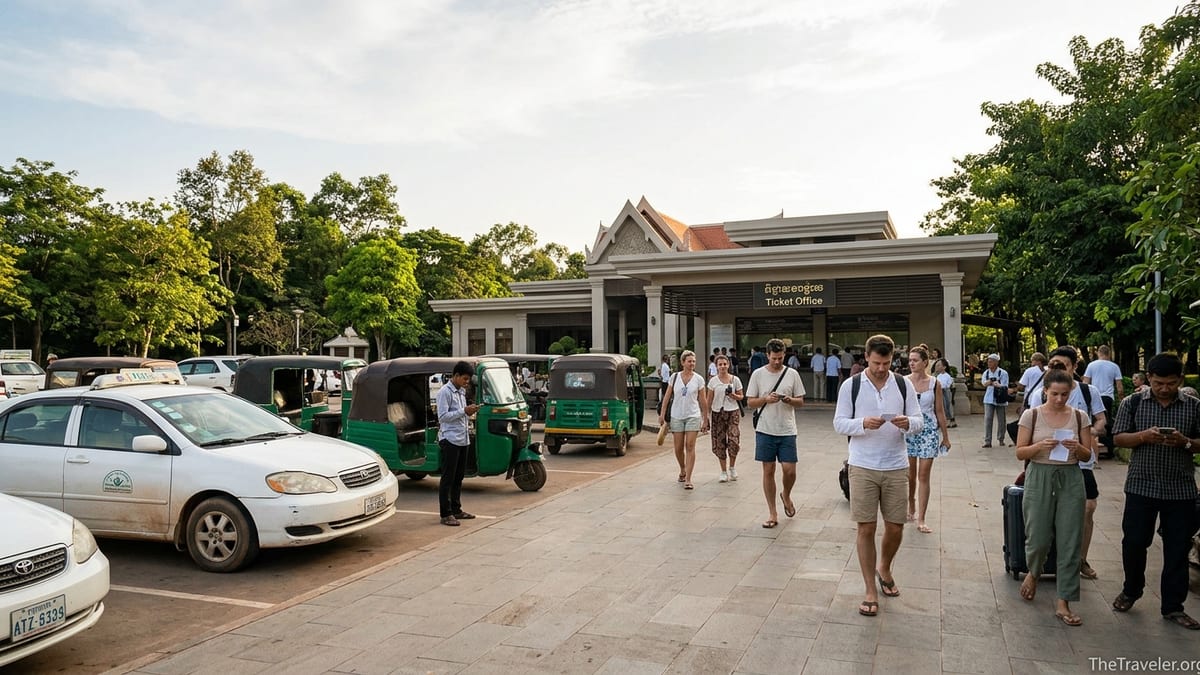
There is one main place to buy the pass in person: the Angkor Ticket Office, also known locally as Angkor Enterprise, on the northern edge of Siem Reap city. You cannot buy a valid paper pass at the new Siem Reap Angkor International Airport itself, and tickets are not sold at the gates of Angkor Wat or other temples. Some reputable tour operators and hotels can pre‑arrange passes, but what they actually do is send a staff member to the same ticket office on your behalf.
The ticket office issues photo passes printed with your name and the date range. These are checked at the main park checkpoints and again at key temples. You must carry the pass with you at all times inside the archaeological park. If you are caught inside without one, expect to be escorted to buy a ticket and potentially be fined or refused entry.
Understanding these basics matters when deciding whether to stop at the ticket office right after landing or to wait. Since there is no sales counter at the airport and online purchase options remain limited and changeable, the real choice is between detouring from the airport to the ticket office on the way into town or visiting the office later from your hotel.
Location & Opening Hours: Can You Realistically Go Straight There?
Siem Reap Angkor International Airport (SAI) opened in 2023 and sits roughly 45 to 50 kilometers southeast of Siem Reap city. The Angkor Ticket Office, by contrast, lies just north of the city along the road used for most temple tours. Driving from the airport to the ticket office is therefore not a straight line. In practice, you travel first toward town on the main highway, then skirt or pass through Siem Reap before heading north to the office.
In normal daytime traffic the airport to city transfer by car takes about 45 to 60 minutes. Reaching the ticket office from the airport usually adds another 15 to 20 minutes compared with going straight to a central hotel. In other words, if your hotel near the Old Market would be a 1‑hour ride, asking your driver to go via the Angkor Ticket Office may turn that into roughly 1 hour 15 minutes.
The Angkor Ticket Office itself opens very early. Current practice is for sales counters to open at around 4:30 a.m., allowing visitors to buy passes before the park officially opens around 5:00 a.m. This early start is geared mainly toward sunrise visitors, but it also means that an early‑morning arrival into Siem Reap could, in theory, go straight from the airport to pick up a pass and continue to the temples without detouring back to town.
In the evening, ticket sales usually run until around 5:30 p.m. to 5:30 p.m. or slightly later, though hours can shift with seasons and visitor demand. A well‑known rule still generally applies: if you buy a pass after mid‑afternoon, it is valid for that day plus the following day or days, depending on the type of pass. That late‑day flexibility is central to deciding whether a late‑afternoon arrival should head to the ticket office immediately or wait until the next morning.
Transport Options from Siem Reap Angkor Airport: What It Costs in Reality
Because the new airport is far from town, transfer costs are higher than visitors who knew the old, in‑town airport might expect. Most travelers now pay in the region of 25 to 35 US dollars for a private taxi or SUV from the airport into central Siem Reap. Reports from early 2026 mention 25 dollars for a basic sedan arranged at the official airport taxi counter, up to about 30 or 35 dollars for pre‑booked minivans or large SUVs with more luggage space.
At arrivals you will find an official taxi desk and uniformed staff offering fixed‑price cars. This option is straightforward and safe for first‑timers, particularly if you are landing late at night. You pay a set fare based on your final destination in town, usually by cash in US dollars, and the staff will assign a driver. If you want that driver to make an extra stop at the Angkor Ticket Office, you should negotiate it clearly before paying. Some drivers will include the short detour for an extra 5 dollars or so, while others may quote a bit more because the office sits in the opposite direction from some hotel clusters.
Online ride‑hailing services such as Grab theoretically operate in Siem Reap city, but coverage at the new airport has been patchy. Travelers in late 2025 and 2026 frequently report that no Grab cars are available directly at the terminal, or that wait times are long because drivers hesitate to make the long run out to the airport. A common workaround is to check the estimated Grab fare in advance, then use that as a reference when negotiating with airport taxis or pre‑booking a private transfer with a local operator.
For budget‑minded travelers, a shuttle bus connects the airport with central Siem Reap, usually stopping near the Old Market and other convenient spots. Tickets tend to cost roughly 8 US dollars per person for a one‑way ride. The downside is that the shuttle does not stop at the Angkor Ticket Office, so you cannot conveniently buy your pass on the way into town using this option. You would still need a secondary ride, such as a tuk‑tuk from your hotel, to visit the ticket office later.
Should You Buy the Angkor Pass Right After Landing?
Whether to buy your Angkor Pass immediately after landing depends mainly on your arrival time and how you plan to use your first half‑day in Siem Reap. For early‑morning arrivals, for example a flight touching down around 7:30 a.m., going straight from the airport to the ticket office can be efficient if you intend to begin temple sightseeing the same morning. You could land at 7:30 a.m., clear immigration and baggage by 8:15 a.m., reach the ticket office by around 9:15 a.m., and be at Angkor Wat by roughly 9:30 or 9:45 a.m. This works well for travelers on tight schedules or those holding a 1‑day pass who want to maximize their time.
For midday arrivals, such as landing between 11:00 a.m. and 3:00 p.m., heading straight to the ticket office from the airport often makes less sense if you are tired, jet‑lagged or arriving from a long‑haul connection. The peak heat in Angkor usually comes in the early afternoon, when temple visits are physically draining. In this case, many travelers prefer to check into their hotel, rest, and then arrange either a sunset visit without heavy walking or buy the pass late in the day for use starting the next morning.
Late‑afternoon arrivals are where the “buy now or tomorrow” decision becomes most interesting. Imagine a flight scheduled to land around 4:00 p.m. If everything runs smoothly, you could be in a taxi by 4:45 p.m. and at the ticket office a little after 5:30 p.m., potentially just before closing. Buying a 3‑day pass at that time would usually activate it from the next day, effectively giving you a short bonus window for a quick sunset or dinner near the park that same evening, depending on checkpoints. However, any delay with baggage, immigration or traffic could easily push you past closing time, leaving you with an unnecessary detour and no pass.
For night arrivals, especially flights landing after 8:00 or 9:00 p.m., going anywhere other than straight to your accommodation is rarely worth it. The ticket office will be closed, the road to Angkor largely quiet, and you will be better served by rest and an early start the next morning. In that scenario, there is no practical advantage to trying to buy the pass the same night, so simply factor a ticket office stop into your first‑day plans.
Suggested Itineraries: How Timing Shapes Your Route Choices
Consider a traveler arriving from Bangkok on a morning flight scheduled to land at 9:00 a.m. They land on time, clear immigration quickly and are in a taxi by 9:45 a.m. With light traffic, they reach the Angkor Ticket Office around 10:45 a.m., buy a 3‑day pass, and head straight to Angkor Wat for a late‑morning visit. After exploring until around 1:30 p.m., they break for lunch in a nearby restaurant, then visit quieter temples like Preah Khan in the mid‑afternoon before returning to their hotel around 4:30 p.m. In this example, stopping at the ticket office on the way from the airport makes very good use of the arrival day.
Now imagine a long‑haul traveler from Europe, reaching Siem Reap around 2:30 p.m. after an overnight connection. They are exhausted and in no state for thoughtful temple exploration. Instead of heading straight to the ticket office, they go to their hotel, shower and rest. Around 4:30 p.m., their pre‑booked tuk‑tuk driver collects them from the hotel and takes them to the Angkor Ticket Office. They buy a 3‑day pass at roughly 5:00 p.m., valid from the next day, and then ride out to Phnom Bakheng or just the moat of Angkor Wat for sunset views from outside the main complex. They return to town for dinner, then begin their full temple days refreshed the next morning.
A third scenario involves a very tight schedule: a visitor with only two nights in Siem Reap arriving at 11:00 a.m. and departing two days later at 6:00 a.m. For them, every hour counts. Going straight from the airport to the Angkor Ticket Office, then directly to the temples, means they can fit a substantial portion of the “small circuit” on arrival day and finish the rest the following morning. Waiting until after check‑in to deal with tickets would probably push their first real temple time into the mid‑afternoon, when heat and fatigue work against them.
These examples illustrate the general pattern: if you arrive rested and early enough to enjoy several hours at the temples, it can be worth heading directly from the airport to the ticket office. If you arrive late in the day, exhausted, or close to closing time at the ticket office, build a separate, more relaxed ticket run into your stay instead.
Coordinating with Taxi Drivers and Private Guides
Because the Angkor Ticket Office is not directly on the road between the new airport and many hotels, it is important to coordinate your plans clearly with your driver. When you book a private transfer service in advance, such as a local company advertising airport pickups for around 25 to 30 US dollars, ask them by message or email whether a stop at the ticket office is possible and whether it costs extra. Some operators will include a 15‑minute stop free of charge as part of a “welcome tour” style transfer, while others may add an extra fee to compensate for fuel and time.
If you plan to use the official airport taxi desk on arrival, explain your request before paying. You might say you want to go “airport to Angkor Ticket Office, then to hotel in town, price together.” Having the name and address of the ticket office saved in your phone, or written on paper in Khmer and English, makes this conversation easier. Be clear that you only need enough time inside to buy the ticket, usually about 10 to 20 minutes depending on queues and whether tour groups are present.
Many visitors also hire a dedicated driver or licensed tour guide for temple days, often via their hotel. Typical daily rates for a tuk‑tuk driver for the Angkor area can run from about 18 to 25 US dollars for a full day, while air‑conditioned cars and vans cost more. If your arrival time is close to sunrise or early morning, you might arrange for the same driver to collect you at the airport, detour to the ticket office, and proceed directly into the park. This approach simplifies logistics and ensures the person guiding you through Angkor already knows your schedule and interests.
For arrivals where the ticket office visit will happen later, perhaps the evening before your first temple day, you can ask your chosen driver to combine a sunset outing with the ticket run. For example, a tuk‑tuk driver could collect you from your hotel at 4:00 p.m., stop first at the ticket office to purchase your pass, then continue to Srah Srang or the moat around Angkor Wat for sunset, before returning you to town for dinner. This combination keeps the administrative task from feeling like wasted time.
Practical Tips to Avoid Stress and Wasted Time
A few small preparations can make the question of when to buy the Angkor Pass much less stressful. First, keep some clean US dollar bills in small denominations in your hand luggage. Both airport taxis and the ticket office accept US cash widely, but large, worn or torn notes are sometimes refused. Having 50 to 60 dollars in change on hand means you can pay a taxi, buy a 1‑day pass, and still have money left for a tuk‑tuk or simple meal without hunting for an ATM after a long flight.
Second, consider your luggage. If you travel with only a cabin‑size backpack, going straight from the airport to the ticket office and then on to the temples is physically easy. But if you carry multiple large suitcases or fragile items, you will probably feel more comfortable checking into your hotel first. Leaving bags with a driver while you queue at the ticket window is generally safe, yet many travelers prefer not to start their Angkor experience while worrying about luggage in a parking lot.
Third, factor in seasonal heat and weather. In the cool, dry months roughly from November to February, a late‑morning start after an early flight is perfectly reasonable. Walking temple corridors and climbing stone staircases is still demanding, but shadows are long and there is often a breeze. In contrast, from March to May temperatures can climb significantly, and the early afternoon sun can feel brutal. In these months, trying to combine airport arrival, the ticket office and a long temple circuit in one sweep may leave you exhausted before you even reach Angkor Wat’s upper level.
Finally, keep an eye on public holidays and local events. While the Angkor Ticket Office stays open most days, Cambodia’s major festivals and international tourism surges can create longer queues. If you arrive in the days around Khmer New Year or major regional holidays, assume the ticket office will be busy, and build extra time into any plan that involves buying the pass on arrival day.
The Takeaway
Siem Reap Angkor International Airport’s distance from the city, and the fact that the Angkor Ticket Office is the only place to buy a valid pass, means your arrival‑day decisions have real consequences for both time and money. A private taxi from the airport into town will usually cost between 25 and 35 US dollars and take 45 to 60 minutes, with a detour to the ticket office adding modest time but needing to be negotiated in advance.
If you land early in the morning, rested and motivated, going straight from the airport to the ticket office and then to the temples can be a smart way to gain half a day of extra sightseeing, especially on a short itinerary. For late‑afternoon or night arrivals, the balance tilts strongly toward checking into your hotel first, then handling the ticket either on a relaxed sunset outing or the next morning before dawn.
There is no single rule that fits every traveler. Business visitors with only one free afternoon, backpackers stretching a small budget, and families arriving after long‑haul flights will all calculate the trade‑offs differently. The key is to match your arrival time, energy level and temple ambitions to a simple plan: know that tickets are only sold at the Angkor Ticket Office, confirm opening hours close to your travel date, and coordinate with your driver so that your first glimpse of Angkor feels like the start of an adventure, not a race against the clock.
FAQ
Q1. Can I buy the Angkor Pass at Siem Reap Angkor International Airport?
Not currently. The Angkor Pass is not sold inside the new airport. You must buy it at the Angkor Ticket Office (Angkor Enterprise) on the edge of Siem Reap or via an authorized third party that goes there on your behalf.
Q2. How long does it take to drive from the airport to the Angkor Ticket Office?
In normal conditions, the drive from Siem Reap Angkor International Airport to the Angkor Ticket Office usually takes about 1 hour to 1 hour 15 minutes, slightly longer than going directly to a central hotel.
Q3. Is it worth going straight from the airport to buy the pass?
It is worth it if you land early, feel rested, and plan to start visiting the temples the same morning or early afternoon. If you arrive late or exhausted, it is usually better to go to your hotel first and visit the ticket office later.
Q4. How much should I expect to pay for a taxi from the airport that stops at the ticket office?
Most travelers report paying around 25 to 35 US dollars for a private car from the airport to central Siem Reap. A brief detour to the Angkor Ticket Office may add a small extra charge, so confirm and agree the full price with the driver before leaving.
Q5. Are there cheaper ways to get from the airport into town and still buy the pass?
The airport shuttle bus is usually cheaper at roughly 8 US dollars per person, but it runs only to town, not to the ticket office. You can take the shuttle to the city, then hire a tuk‑tuk or taxi later to reach the Angkor Ticket Office.
Q6. What are the opening hours of the Angkor Ticket Office?
The Angkor Ticket Office generally opens very early in the morning, around 4:30 a.m., and sells tickets through late afternoon or early evening. Because hours can change slightly, check close to your travel date for the exact schedule.
Q7. If I buy my pass late in the afternoon, does it count for that day or the next day?
Current practice is that passes bought later in the afternoon become valid starting the next day, effectively giving you a bonus sunset period. Exact cut‑off times can vary, so confirm with staff at the ticket office when you buy.
Q8. Can my hotel or tour company arrange the Angkor Pass so I do not go to the ticket office?
Many reputable hotels and tour operators can arrange passes in advance by sending a staff member to the ticket office for you. They may charge a service fee, and you will need to provide a photo or allow them to take one when they collect the pass.
Q9. Is it possible to visit Angkor Wat for sunrise directly after an early‑morning flight?
For most visitors, making sunrise on arrival day is unrealistic because sunrise visits require reaching the park before 5:00 a.m. However, if you arrive the previous afternoon and buy your pass then, you can easily arrange a sunrise visit the next morning.
Q10. What should I tell my driver if I want to stop at the ticket office on the way from the airport?
Before leaving the airport, clearly say that you want to go “airport to Angkor Ticket Office, then to hotel” and agree one inclusive price. Mention that you only need a short stop to buy the ticket so the driver understands the timing.