


Siem Reap’s new Angkor International Airport sits roughly 50 kilometres outside town, which means your first decision after landing is how to cover that long final stretch into the city. For budget travellers and solo visitors, the official airport shuttle bus is often the smartest balance of cost and convenience. This guide explains exactly how the shuttle works in 2026, where it stops, what tickets cost, what to expect with luggage, and when it makes more sense to choose a taxi instead.
Get the latest updates straight to your inbox!
Siem Reap Angkor Airport Today: Why the Shuttle Matters
The first thing many visitors do wrong in Siem Reap is read outdated airport advice. The old airport that used to sit just outside town closed to commercial flights in October 2023. All international and domestic flights now use Siem Reap Angkor International Airport, usually labeled SAI on your ticket, about 50 kilometres east of the city along a new highway. What used to be a 10 minute tuk tuk ride is now a 45 to 60 minute journey by road.
That extra distance has pushed up door to door transport prices. As of mid 2026, most visitors paying at the airport counter report taxi fares in the region of 25 to 35 US dollars for a standard car into the city, with larger SUVs and minivans costing more. For a solo backpacker or a couple on a tight budget, that is a big jump compared with the old 10 dollar era. The official shuttle bus exists to plug that gap and give visitors a predictable, lower cost alternative.
At the same time, ride hailing coverage is patchy out at SAI and local tuk tuk drivers often quote high flat fares because of the distance. Travellers who fly into Siem Reap straight from lower cost Southeast Asian cities like Bangkok or Ho Chi Minh City are often surprised by how expensive the last leg can be. Understanding the shuttle bus option before you land helps you avoid haggling while jet lagged and makes it easier to choose the right transfer for your budget and group size.
In practice, the shuttle is used by a mix of solo travellers, independent couples, and domestic passengers heading into town to connect with buses, guesthouses, and tours. If you are arriving outside the busiest hours or on a late flight, it is especially important to understand how the timetable works and what backup options exist should you just miss a departure.
How the Official Airport Shuttle Bus Works
The official airport shuttle bus is a simple point to point service that connects Siem Reap Angkor International Airport with central Siem Reap. The idea is not to act like a city bus with dozens of stops, but to provide a reliable, fixed price connection between the terminal and a central drop off point in town where passengers can then continue by tuk tuk or on foot to their hotel.
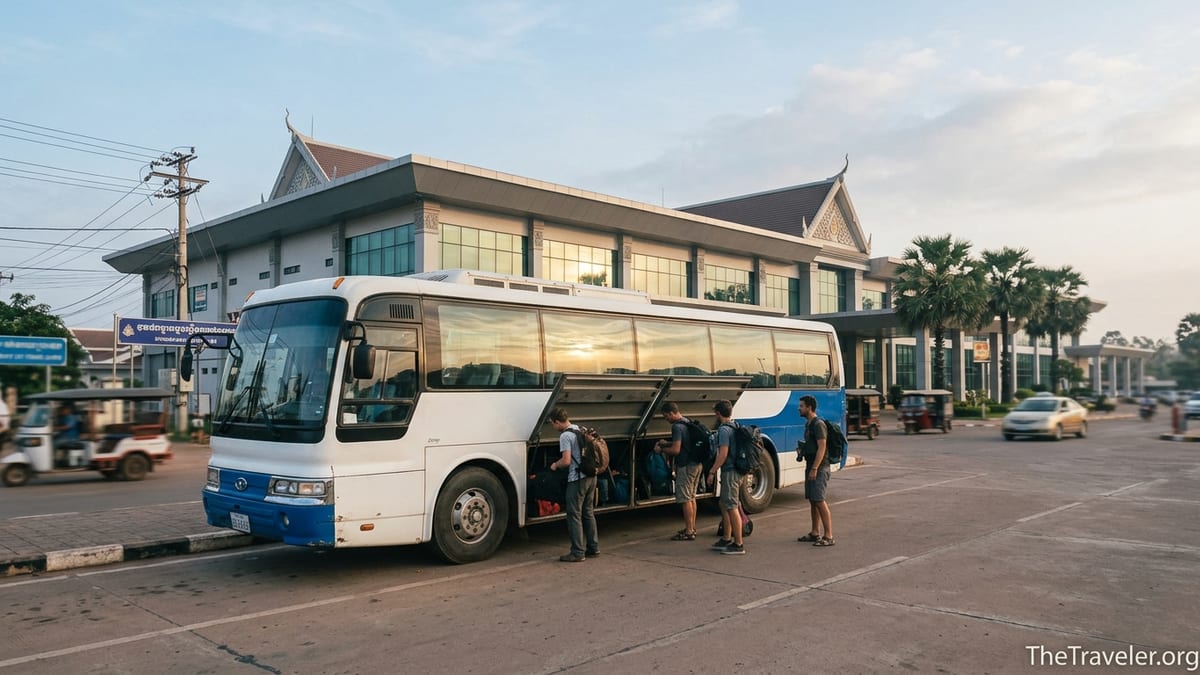
In 2026, the most common pattern is a shuttle operating with small buses or minibuses, typically with around 20 to 30 seats and space underneath or at the back for checked luggage. Services generally run from shortly after the first morning arrivals until the evening wave of flights has landed. In high season there are often more departures, sometimes timed to specific flights, while in low season the service can thin out, particularly in the middle of the day.
Tickets are sold on a per person basis. Recent examples from travellers and booking platforms suggest one way prices from the airport to town in the range of roughly 8 to 10 US dollars per adult, sometimes quoted in Cambodian riel at an equivalent amount. Children may pay a reduced fare or travel free below a certain age, but policies vary by operator, so families should check at the counter. Compared with a 25 to 30 US dollar taxi, the savings for solo travellers and couples are immediately obvious.
Unlike shared vans that drive around dropping passengers at each hotel, the official shuttle focuses on fixed routes and times. That means fewer detours and a clearer journey time, usually about 60 minutes from the terminal to the central stop in normal traffic. If your guesthouse or hostel is reasonably central, a short tuk tuk ride from the final shuttle stop will typically cost only a few dollars more, keeping your total door to door cost still far below a private car.
Stops and Drop Off Points in Siem Reap
On the airport side, the shuttle stop is straightforward. After you clear immigration, collect your bags, and walk out of customs, you enter the public arrivals hall. Shuttle bus counters and staff are usually located near the main exit doors, often alongside taxi and private transfer desks. Staff typically hold signs that mention “Airport Shuttle Bus” or the operating company name. Once you have a ticket, they direct you out to the parking lanes where the shuttle buses wait.
Into the city, the classic pattern is a central drop off around the old market and Pub Street area, or near the main post office and city bus stops north of the tourist core. One commonly used area in recent years has been near the central post office, which works well because it is close to riverside hotels, affordable guesthouses east of the river, and the small streets leading toward Pub Street and the Night Market. Travellers have reported shuttle vans dropping them within an easy 5 to 10 minute walk of many budget properties.
If your hotel is a little further out, for example near National Road 6 east of town or on the road toward Angkor Wat, drivers sometimes offer to continue a little beyond the official stop for a small extra fee, or they can help you arrange a connecting tuk tuk. As an example, a couple staying near Sok San Road might ride the shuttle to the central stop, then pay 2 to 3 US dollars for a tuk tuk to their guesthouse. Even with that add on, they will usually spend under 25 dollars in total, compared with 28 to 30 dollars for a direct taxi.
Because exact drop off points and routes can shift over time as the city grows and construction changes traffic flows, it is worth asking before you buy a ticket: “Where exactly in town does this bus stop?” Most operators can show you a small map or point out the area on your phone. If you already have a booking at a well known hostel or hotel, taking a moment to compare its location to the shuttle stop will help you judge whether the shuttle plus a short tuk tuk ride makes sense.
Timetable, Frequency, and How to Buy Tickets
The airport shuttle timetable is designed around typical flight patterns, but it is not truly 24 hours. In broad terms, shuttles tend to run every 60 to 90 minutes in the daytime, with extra departures added in the late afternoon and evening during busy travel months. Travellers arriving on late night flights, especially after around 22:00, often find that the final shuttle of the day has already left, and they need to switch to a taxi. Airlines sometimes publish reference information about first and last shuttle departures on their travel info pages, but treat these as indicative rather than guaranteed.
To buy a ticket on arrival, you simply walk up to the shuttle counter in the arrivals hall and ask for the next departure to Siem Reap city. You pay in cash, usually in US dollars or riel, and receive either a small paper ticket or a printed voucher. Card payments may be possible if the desk is equipped, but do not rely on it, as power cuts and connectivity issues are not uncommon. Having at least 10 to 20 US dollars in small notes when you land makes life easier if you choose the shuttle.
Some operators and booking platforms allow advance reservations online, especially during the high season months from November to February. A typical example would be pre booking a seat on a minibus scheduled 60 to 90 minutes after your flight’s scheduled arrival, with a confirmation voucher you can show on your phone at the counter. This can be helpful if you are arriving at a particularly busy time of day, traveling with children, or carrying oversized luggage like a bicycle box.
It is worth factoring in Cambodian realities when looking at the timetable. Buses often wait a few extra minutes for passengers who are still clearing immigration or collecting bags from the same flight. They can also leave late if passenger numbers are low and staff hope to fill a few more seats. If your schedule is tight, for example you are aiming for an onward intercity bus shortly after you reach town, building in an extra buffer will reduce stress and may tilt you toward booking a private taxi instead.
Ticket Prices, Luggage Rules, and Onboard Experience
Shuttle bus prices from SAI to Siem Reap city centre in 2026 cluster around the high single digits in US dollars. Many travellers report paying about 9 or 10 US dollars per adult one way when buying directly from the operator or through a major bus booking site. Local currency prices are sometimes advertised in riel at an equivalent amount, with exchange rates adjusted periodically as the dollar fluctuates. Compared with the 25 to 35 US dollars that most visitors now pay for a taxi at the airport counter, the shuttle is clearly aimed at price sensitive travellers.
Luggage policies are generally relaxed. A normal arrangement is one suitcase or backpack plus one small cabin bag per person included in the fare. On a typical minibus, larger items are stacked at the back or under the seats, while smaller bags come up top. Passengers with bulkier gear, such as hard shell suitcases, dive equipment, or large musical instruments, are sometimes asked to pay a small supplement or may be advised to book a private transfer instead if the bus is heavily loaded.
Onboard comfort is basic but decent for a one hour ride. Vehicles are usually air conditioned, though temperatures can fluctuate between pleasantly cool and uncomfortably cold depending on the driver. Seats are upright coach style, and seat belts may or may not be present at every seat, something to bear in mind if you are traveling with young children. Roads between the airport and town are mostly smooth new highway, but the final approach into the city can feel bumpy when traffic is heavy or construction is underway.
For a concrete example, consider a solo traveller arriving from Singapore around midday with a 15 kilogram suitcase and a daypack. At the airport counter, they are quoted 27 US dollars for a taxi into the Pub Street area. They instead pay around 9 US dollars for a shuttle bus ticket, place their suitcase in the luggage compartment, and ride an hour into town. From the central stop they pay 3 US dollars for a tuk tuk to their riverside guesthouse. Total cost: roughly 12 US dollars, less than half the taxi quote, at the expense of one slightly slower, more communal journey.
Shuttle vs Taxi: When Each Option Makes Sense
Deciding between the shuttle and a taxi in Siem Reap is mostly a question of group size, time of day, and how much you value door to door convenience. As a rule of thumb, the shuttle is best for solo travellers and couples arriving during normal daytime hours who are staying within or close to the central city. A private taxi usually makes more sense for families, small groups, late night arrivals, or travellers with heavy or awkward luggage.
Take the case of a single backpacker landing on an afternoon low cost flight from Kuala Lumpur. They plan to stay in a budget hostel within walking distance of Pub Street and are not in a rush. For them, paying around 9 or 10 US dollars for the shuttle plus a possible 2 or 3 dollar tuk tuk ride beats spending 25 to 30 dollars on a taxi. They share the bus ride with other travellers, get a feel for the area at the central drop off, and enjoy the savings over a few nights of street food and temple passes.
Now imagine a family of four arriving in the early evening with two large suitcases, two cabin bags, and a stroller, booked into a mid range resort slightly north of town. If each adult pays around 9 or 10 dollars on the shuttle and the children are either discounted or charged a smaller fare, the total might come to 30 to 36 dollars, plus another 4 to 6 dollars in tuk tuk transfers to the resort. That brings the effective cost close to, or even above, the 30 to 35 dollars often quoted for a door to door taxi, with more hassle at the end of a long travel day. In this scenario, a pre booked private car or minivan is usually the better choice.
Late flights are another tipping point. If your plane is scheduled to land after about 22:00, you cannot count on finding a shuttle departure waiting. Some operators do run services tied to specific incoming flights, but these are vulnerable to delays and schedule changes. Many travellers on late arrivals simply factor a taxi into their budget and appreciate the security of walking straight to the official taxi counter, paying a fixed fare, and driving directly to their hotel even after midnight.
Practical Tips, Safety, and Common Pitfalls
Whether you choose the shuttle or a taxi, a few practical steps can make your first hour in Siem Reap smoother. First, ignore unofficial touts who approach you as soon as you leave customs and encourage you to follow them to a car park. Instead, look for clearly branded desks or staff with ID badges inside the terminal. The official shuttle counter and the airport taxi desk are both signposted and operate on fixed price systems, which reduces the chance of disputes or inflated fares.
Second, have your hotel’s address written down in both English and, if possible, Khmer script, or at least saved on your phone. If you take the shuttle, you can show this to the driver when you board so they understand where most passengers are headed and can confirm whether the central drop point will be convenient for you. If you plan to connect by tuk tuk, showing them the address or a map pin on your phone at the shuttle’s final stop avoids confusion in the dark or in busy traffic.
Third, manage your expectations on timing. While the advertised journey from the airport to town is usually 45 to 60 minutes, it is wise to assume up to 90 minutes door to door when you factor in waiting time at the airport, possible delays in departure, and the last hop by tuk tuk. If you are landing in Siem Reap and planning to catch a long distance bus to Phnom Penh or the Thai border later the same day, consider leaving at least three hours between your flight’s scheduled arrival and the bus departure or booking a taxi for more reliable timing.
Finally, treat safety in the same way you would in any other Southeast Asian destination. Keep your valuables in a small bag that stays with you on the bus, not in the luggage compartment. Avoid flashing large amounts of cash when buying your ticket. If you arrive late at night and feel uncomfortable arranging onward transport from the central drop off, it may be worth pre booking a taxi directly to your hotel instead of relying on ad hoc transfers.
The Takeaway
Siem Reap’s move to the new Angkor International Airport fundamentally changed the arrival equation for visitors. The city is no longer a quick tuk tuk hop from the runway, and transfer costs now make up a noticeable slice of many travellers’ budgets. The official shuttle bus is an important tool for keeping those costs under control, particularly for solo adventurers and couples who are willing to trade some convenience for substantial savings.
Used wisely, the shuttle offers a predictable, fixed price route from the terminal to a central point in town, where a short tuk tuk ride or walk completes the journey. Understanding where it stops, how to buy tickets, and when the timetable may thin out helps you decide in advance whether it fits your plans. For families, groups, late arrivals, or travellers with heavy bags, a taxi or pre booked private transfer often remains the more comfortable and time efficient option.
Before you fly, take a moment to check your flight’s scheduled arrival time against typical shuttle operating hours, look up roughly where the central drop off is in relation to your hotel, and decide which combination of shuttle and tuk tuk or door to door taxi best suits your budget. With that small bit of planning, the 50 kilometre stretch from Siem Reap Angkor Airport into town becomes just another part of the journey, not an unwelcome surprise at the end of a long day.
FAQ
Q1. How much does the Siem Reap Angkor airport shuttle bus cost?
The shuttle fare is typically in the high single digits in US dollars per adult one way, for example around 8 to 10 US dollars, though exact prices can vary slightly by operator and season.
Q2. Where does the airport shuttle bus drop passengers in Siem Reap?
Most official shuttles terminate at a central point in town, often near the post office or the Old Market area, from where many hotels are a short tuk tuk ride or walk away.
Q3. Can I take large luggage or sports equipment on the shuttle?
Standard suitcases and backpacks are usually accepted without issue, but very bulky items such as bicycles or large sports gear may require prior confirmation or a small extra fee, and in some cases a private taxi is more practical.
Q4. How long does the shuttle bus take from the airport to the city?
The driving time is normally around 45 to 60 minutes, but including waiting time at the airport and final transfers in the city you should allow up to 90 minutes door to door.
Q5. Do I need to book the airport shuttle in advance?
Many travellers simply buy tickets on arrival at the shuttle counter, but in busy high season months or if you are arriving with a group or special luggage, pre booking a seat through an operator or travel platform can provide peace of mind.
Q6. Is the shuttle bus cheaper than taking a taxi from Siem Reap Angkor Airport?
For solo travellers and couples the shuttle is usually significantly cheaper, often costing less than half the price of a 25 to 35 US dollar taxi, while for families and groups the savings shrink and a taxi may be better value.
Q7. What happens if my flight is late and I miss the last shuttle?
If you land after the final shuttle departure, your realistic options are to use the official taxi counter at the airport, arrange a pre booked private transfer, or, in some cases, negotiate directly with a local driver for a fixed fare into town.
Q8. Are there toilets and air conditioning on the shuttle bus?
The shuttle buses are typically air conditioned but do not have onboard toilets, so plan to use the restrooms at the airport before boarding for the approximately one hour journey.
Q9. Is the shuttle safe for solo female travellers arriving in daylight?
For daytime arrivals, the official shuttle is generally considered a safe option, especially if you buy your ticket at the airport counter, keep your valuables with you, and have your hotel address ready for any onward tuk tuk ride.
Q10. Can I pay the shuttle fare by credit card?
Some operators may accept card payments, but connectivity and card machines are not guaranteed, so it is wise to carry enough cash in small US dollar notes or local currency to cover your ticket.