


More news on this day
Rail links between Dhaka and northern Bangladesh resumed after a six hour suspension when several coaches of the Dhaka bound Silk City Express derailed near the Jamuna Bridge, disrupting one of the country’s busiest intercity corridors.
Get the latest news straight to your inbox!
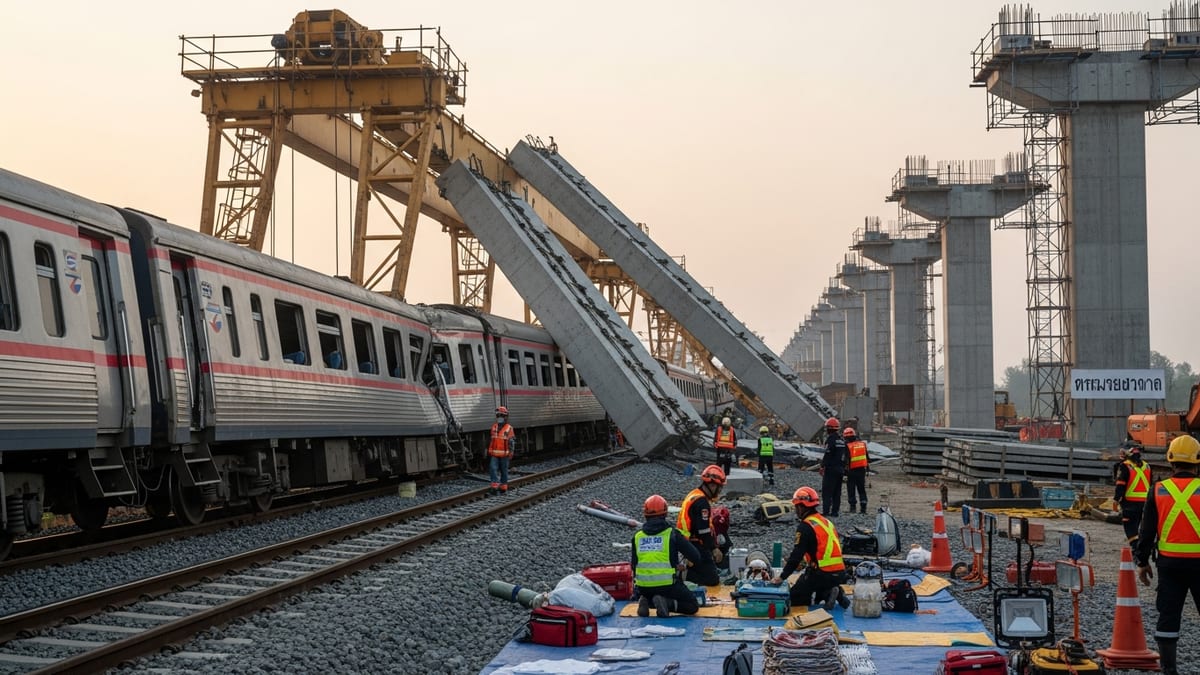
Derailment Near Key River Crossing Disrupts Busy Corridor
Initial reports indicate that the Silk City Express, operating on the Dhaka Rajshahi route, came off the tracks close to the eastern approach of the Jamuna Bridge, a section that carries heavy daily intercity traffic. The incident occurred during a scheduled run toward the capital, forcing the immediate suspension of movements on the line that funnels trains across the Jamuna River between Dhaka and the northwestern districts.
Publicly available information shows that several coaches of the intercity service left the rails, though they remained upright, limiting the scale of physical damage when compared with more severe recent derailments elsewhere in the region. Local media coverage suggests that the derailment happened at low to moderate speed, which likely helped prevent a greater number of injuries and damage to the rolling stock.
The affected stretch connects directly with the Jamuna Bridge, part of the strategic rail link that shortens journey times between Dhaka and major cities such as Rajshahi. The interruption quickly cascaded through the timetable, with trains scheduled to follow the Silk City Express either halted at preceding stations or held back at originating terminals to avoid congestion at the bridge approaches.
Passenger accounts published in domestic outlets describe a sudden jolt followed by an abrupt stop, after which on board staff began directing travelers to remain inside the carriages while checks were carried out. Photographs shared on social and news platforms appear to show at least one coach partially tilted off the track bed, surrounded by track workers and railway security personnel.
Six Hour Suspension as Emergency Teams Clear the Line
According to news reports, rail operations over the Jamuna Bridge were halted for roughly six hours while emergency teams, track engineers, and recovery crews worked to stabilize the Silk City Express coaches and inspect the bridge approaches. The shutdown affected both directions of traffic because of the operational dependence on the shared river crossing and its approach tracks.
During this window, intercity and mail trains scheduled through the bridge were either cancelled, rescheduled, or diverted where alternate routes were available. Bangladeshi media coverage points out that the corridor handles multiple flagship services each day, so even a short disruption can leave thousands of passengers stranded at intermediate stations.
Track workers used light cranes and maintenance vehicles to realign the derailed coaches and remove any damaged fittings from the line. Once the carriages were secured and moved to a safe siding, engineering teams reportedly conducted repeated passes over the section with inspection trolleys and light locomotives to ensure that sleepers, rails, and fishplates were fit for traffic.
Operational summaries carried by regional outlets note that rail traffic remained suspended until inspectors completed structural and geometric checks on the line. Only after test runs were completed at low speed was permission granted to reopen the route for limited service, gradually scaling back up to the usual throughput for the Jamuna crossing.
Passengers Face Delays and Rerouting Across Northern Network
Travelers heading to and from Dhaka experienced widespread knock on effects as the derailment rippled across the network. Reports from stations along the route describe crowded concourses and long queues for refunds and rebooking, particularly in hubs that funnel passengers between the northwestern districts and the capital.
Some passengers were moved onto alternative trains that could be turned short of the affected section, while others had to wait for special arrangements once the bridge route reopened. In the absence of immediate rail options, many turned to long distance buses and private vehicles, adding pressure to already busy highways connecting Dhaka with the northern districts.
Publicly available accounts mention that several afternoon and evening intercity services were forced to depart significantly behind schedule, even after the line reopened, as crews and rolling stock were repositioned. The backlog underscored the vulnerability of the corridor, where a single incident at a critical choke point can quickly unsettle carefully planned schedules.
For passengers already on board the Silk City Express, the interruption meant extended waits in and around the site while recovery work took place. Some were eventually transferred to onward trains once operations restarted, while others reportedly chose to complete their journeys by road after disembarking at nearby stations used as temporary transfer points.
Focus Turns to Track Conditions and Safety Protocols
Following the incident, attention has turned to the condition of the tracks and turnouts feeding the Jamuna Bridge, as well as the speed and handling protocols in place for intercity services approaching the river crossing. Coverage in national and regional outlets highlights questions over routine maintenance cycles and the resilience of key structures that experience heavy daily loads.
Rail specialists quoted in published analyses of recent South Asian derailments note that a blend of track wear, ballast problems, and rolling stock issues can combine to create risks on intensively used corridors. In the case of the Silk City Express, preliminary indications in local reporting point toward a localized track fault on the approach section, although a final determination is typically made only after a formal technical review.
Observers point out that the Jamuna crossing is a linchpin for both passenger and freight flows linking Dhaka with northern and western regions, making proactive inspections and conservative operating practices essential. Regular ultrasound rail testing, real time monitoring of track geometry, and strict adherence to speed restrictions near bridges are among the measures commonly cited in international practice to reduce derailment risks.
Public discourse following the disruption has also touched on passenger information procedures, with some travelers describing confusion over the extent of delays and onward options. Commentators in the domestic press argue that clearer communication, both on trains and in stations, can help reduce frustration when infrastructure incidents temporarily halt services.
Jamuna Bridge Route Restored, But Questions Remain
Once engineers cleared the obstructed line and completed test runs, train movements over the Jamuna Bridge gradually resumed, ending the six hour standstill. The first services to cross reportedly did so under reduced speed restrictions while crews observed track behavior and confirmed that the repaired section was stable.
Subsequent trains on the Dhaka Rajshahi axis continued to operate with adjusted timings as the backlog of delayed services was worked through. Timetables were expected to normalize over the following operating cycles as rakes returned to their usual rotations and stranded passengers were accommodated on later departures.
Despite the relatively quick restoration of service, the incident has renewed concerns about the capacity and robustness of the existing river crossing for Bangladesh’s growing intercity traffic. Analysts writing in transport focused columns suggest that recent derailments on busy regional corridors underline the importance of both new infrastructure projects and enhanced safety regimes on current lines.
As investigations into the Silk City Express derailment proceed, stakeholders in the rail sector are watching closely for recommendations that could shape future investments in track renewal, signaling upgrades, and rolling stock maintenance along the Jamuna route and beyond. For passengers, the rapid but disruptive six hour shutdown serves as another reminder of how dependent long distance travel remains on a handful of critical links across Bangladesh’s major rivers.