

More news on this day
New York’s LaGuardia Airport is operating at sharply reduced capacity after a sinkhole discovered near one of its two runways forced a shutdown that is rippling across airline networks just days before the Memorial Day rush.
Get the latest news straight to your inbox!
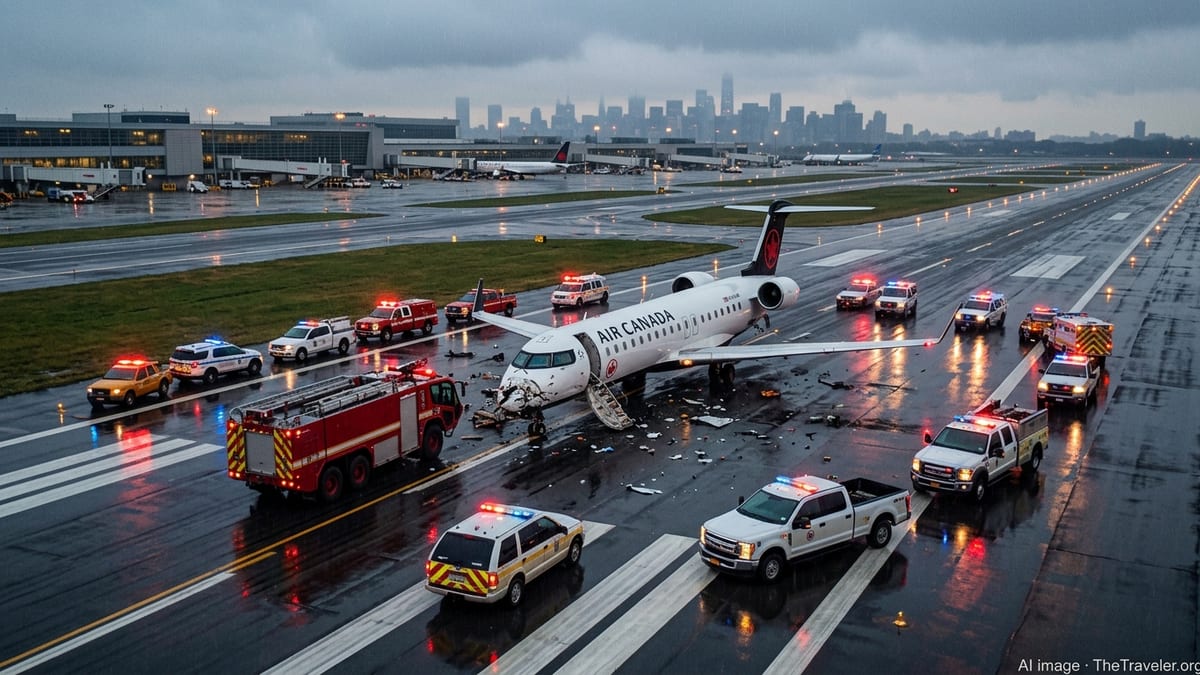
Runway 4/22 Closure Follows Routine Inspection
Publicly available information indicates that the disruption began late Wednesday morning, May 20, when airfield inspection crews identified a sinkhole near Runway 4/22, one of LaGuardia’s two primary runways. The depression was spotted during a daily safety check of the airfield, prompting an immediate halt to operations on the affected runway while engineers and construction teams moved in to assess the damage.
Runway 4/22 remains closed as of Friday, May 22, while emergency repairs and wider inspections continue. Reports indicate that heavy equipment has been deployed to excavate and stabilize the affected area, with crews removing pavement and subsoil to determine the full extent of the void and shore up the surrounding surface before any aircraft movements can resume.
According to published coverage from multiple outlets, the sinkhole is located adjacent to the runway and taxiway complex rather than directly under the primary landing surface. Even so, any structural uncertainty near an active runway is treated as a critical safety concern, effectively taking the strip out of rotation until specialists complete testing and sign-off.
Early estimates suggested that limited use of Runway 4/22 might resume within a day, but timelines were later extended as crews undertook more extensive inspections of nearby pavement and underlying fill. The evolving schedule has left airlines adjusting their operations in real time as the busy travel period approaches.
Hundreds of Flights Disrupted as Airport Runs at Half Capacity
LaGuardia operates with just two runways, 4/22 and 13/31, meaning the loss of a single strip immediately constrains capacity. With all traffic funneled onto Runway 13/31, arrivals and departures have been slowed, and spacing between flights has increased to maintain safe separation, particularly during periods of unsettled weather.
Published reports from aviation and travel outlets indicate that more than 400 flights have been affected since the closure began, including a mix of outright cancellations and long delays. The Federal Aviation Administration has also implemented flow restrictions into the New York airspace at times, citing both the runway outage and passing storms, which has compounded bottlenecks for carriers across the region.
Travelers have reported missed connections, extended tarmac waits and last-minute rebookings as airlines divert some flights to other New York–area airports and consolidate schedules out of LaGuardia. Because the airport serves a high volume of short-haul business routes, delays at the hub have also reverberated across smaller regional airports in the Northeast and Mid-Atlantic.
Data compiled in real time by flight-tracking services shows departure banks thinning during peak periods compared with a typical late-May weekday. With only one runway in use, airlines have had to prioritize certain routes and time-sensitive services, leaving some lower-demand flights pushed into off-peak windows or removed from schedules entirely.
Timing Raises Concerns Ahead of Memorial Day Travel
The incident comes at a particularly sensitive moment for the aviation system, with the Memorial Day holiday traditionally marking the unofficial start of the U.S. summer travel season. Forecasts from industry analysts had already pointed to record passenger volumes this year, and New York City’s airports were expected to handle some of the heaviest traffic.
LaGuardia plays an outsized role in short-haul connectivity along the U.S. East Coast and to key Canadian gateways. Publicly available schedules show dense shuttles to Boston and Washington, frequent service to Midwest business centers, and multiple daily links to Toronto and Montreal. Even a temporary capacity cut at LaGuardia can therefore reduce options for travelers across a broad swath of North America.
Travel publications note that carriers have begun offering flexible rebooking options for some affected passengers, encouraging those with nonessential trips to consider alternative dates or routings through John F. Kennedy International Airport or Newark Liberty International Airport. These larger hubs have additional runways that can absorb extra flights, although they too face congestion during holiday peaks.
For travelers who must pass through LaGuardia in the coming days, consumer advocacy groups recommend building in generous connection times, monitoring flight status frequently, and being prepared for gate or schedule changes as airlines adjust operations in response to the evolving repair timeline.
Infrastructure and Geology Under Renewed Scrutiny
The appearance of a sinkhole at one of the country’s most closely watched airports has renewed attention on the long-term resilience of aviation infrastructure, particularly at coastal facilities built on reclaimed land. Historic and technical references describe LaGuardia as sitting atop former shoreline and marsh areas filled in over decades to accommodate expanding runways, taxiways and terminals.
Engineering experts cited in published analyses note that sinkholes can develop when underground material is washed away through natural erosion, aging utility lines, or changes in groundwater, eventually undermining pavement above. In LaGuardia’s case, early commentary suggests that recent weather patterns do not point to an obvious trigger, prompting closer investigation of subsurface conditions and drainage.
The incident follows a series of high-profile infrastructure challenges at major airports worldwide, from runway surface failures to terminal power outages. Industry observers argue that the LaGuardia sinkhole underscores the importance of intensive inspection regimes and proactive maintenance, particularly in locations where legacy construction and modern traffic volumes intersect.
In the near term, the focus remains on stabilizing the affected area and confirming that adjacent pavement is structurally sound. Over the longer horizon, transportation planners and civic leaders are likely to weigh whether additional investment is needed to harden critical airfield assets against soil movement and other geotechnical risks.
What Passengers Should Expect in the Coming Days
Based on the latest publicly available information from local and national news coverage, work on Runway 4/22 is expected to continue into the weekend, with a potential reopening target set for Friday or later, depending on inspection results. That timeline remains subject to change if crews encounter more extensive subsurface issues or if weather interferes with construction activity.
Until the runway is fully restored to service, travelers using LaGuardia should anticipate longer-than-usual security and boarding lines, congested gate areas and the possibility of last-minute schedule shifts. Airlines are likely to keep some buffer in their operations, spacing flights more conservatively in order to avoid gridlock on the airport’s single active runway.
Passengers with imminent departures are advised by consumer travel resources to reconfirm their flights multiple times on the day of travel and to check whether their carrier is permitting free changes to itineraries touching LaGuardia. Those starting or ending trips in the New York region may benefit from considering rail or bus alternatives for shorter regional journeys, particularly along the busy Northeast Corridor.
For the broader aviation network, the incident serves as a live stress test of how quickly a major urban airport can adapt to an abrupt loss of capacity. As the summer travel season begins, the pace and safety of the ongoing repairs at LaGuardia will be closely watched by travelers, airlines and infrastructure planners alike.