


More news on this day
A sinkhole that opened near one of LaGuardia Airport’s primary runways on May 20 has kept the strip closed for a third consecutive day, prolonging disruptions for thousands of travelers and intensifying operational strain across the U.S. air network ahead of the busy summer season.
Get the latest news straight to your inbox!
Runway 4/22 Still Offline as Repairs Stretch Into Third Day
Publicly available airport and aviation tracking data indicate that Runway 4/22 at New York’s LaGuardia Airport remains out of service three days after a sinkhole was discovered during a routine morning inspection on May 20. The affected area is described in multiple reports as being near, rather than directly on, the runway, but the location has nonetheless forced an extended closure of the strip while crews work to stabilize the ground and complete pavement repairs.
Coverage from outlets including Reuters, ABC News and regional broadcasters notes that emergency construction teams were mobilized immediately after the anomaly was found late Wednesday morning. Initial expectations centered on a relatively swift repair, but continued closure into May 23 suggests that the work has proven more complex than an overnight resurfacing effort, likely requiring excavation, subgrade stabilization and fresh concrete or asphalt curing before aircraft operations can safely resume.
LaGuardia typically operates with two main runways, and the loss of one of them significantly reduces the airport’s capacity during peak arrival and departure banks. Even with air traffic control restrictions designed to meter inbound demand, the prolonged shutdown of Runway 4/22 has limited flexibility to recover from weather or downstream delays, keeping the disruption active for a third day.
Social media updates from passengers and aviation enthusiasts, along with flight-status dashboards, continue to show a substantial number of schedule changes tied to New York’s shortest-haul hub. While some traffic has been absorbed by LaGuardia’s remaining runway and by nearby airports, the concentration of domestic flights at the Queens facility has made a clean workaround difficult.
Delays and Cancellations Ripple Through Major U.S. Hubs
According to data compiled by flight-tracking services and summarized in travel-industry coverage, the runway closure has triggered waves of delays and cancellations not only at LaGuardia itself but also at key domestic hubs such as Chicago, Atlanta and Dallas. Airlines have been forced to trim frequencies, retime departures and, in some cases, switch aircraft types in an effort to keep their networks moving.
Earlier disruption tallies referenced by outlets including NBC New York and travel trade publications pointed to hundreds of cancellations and delays on May 21 and May 22 alone, with average ground delay programs to LaGuardia approaching or exceeding an hour and a half at times. With Runway 4/22 still offline into May 23, those knock-on effects have continued, though the volume has varied by carrier and time of day.
For travelers, the impacts range from relatively minor schedule shifts to missed connections and overnight misalignments. Passengers heading to or from smaller regional markets have faced particular vulnerability as airlines concentrate the reduced capacity on busier trunk routes that can be more easily consolidated. Some carriers appear to be steering customers toward John F. Kennedy International Airport or Newark Liberty International Airport where feasible, but those gateways have their own slot and congestion constraints.
Domestic business travelers and short-break leisure passengers, a core part of LaGuardia’s customer base, have turned to rail and intercity bus options on the Northeast Corridor in response to the uncertainty. Anecdotal reports on social platforms show last-minute switches to Amtrak and coach operators for city pairs such as New York to Boston, Washington and Philadelphia, underscoring how a single infrastructure failure at a key hub can shift demand across competing modes of transport.
Infrastructure Vulnerabilities at a Rebuilt but Challenged Airport
The incident has renewed scrutiny of LaGuardia’s long documented infrastructure challenges, even after a multibillion-dollar terminal and airfield modernization program. Background information from aviation histories and local reporting highlights that the airport was built on former shoreline infill and marshland in Queens, conditions that can make subsurface stability an ongoing concern despite extensive engineering safeguards.
Recent Federal Aviation Administration construction impact reports and Port Authority project documents show that LaGuardia’s runways and taxiways have undergone cycles of rehabilitation, with planned overnight and weekend closures for maintenance work. While the sinkhole near Runway 4/22 was not part of a scheduled project, the event underscores the complexity of maintaining aging pavements and underground utility systems under constant operational pressure at one of the country’s busiest short-haul airports.
Industry analysts quoted in previous coverage of LaGuardia’s redevelopment have often pointed to the tension between legacy site conditions and modern traffic demands. The airport’s location on constrained waterfront land limits options for significant runway extensions or rerouting, leaving engineers reliant on iterative improvements, drainage upgrades and targeted reinforcement rather than wholesale relocation of critical infrastructure.
The discovery of a sinkhole adjacent to an active runway highlights the importance of robust inspection regimes. Reports indicate that the anomaly was identified during a daily airfield check, reinforcing the value of routine surveying and pavement monitoring in catching problems before they result in a more serious incident involving an aircraft.
Advice for Travelers Navigating the Disruption
Travel-focused outlets are advising passengers with upcoming LaGuardia itineraries to monitor their flights closely, with particular attention to departures and arrivals scheduled during peak morning and late afternoon periods when remaining capacity is most constrained. Published guidance emphasizes checking directly with airlines before heading to the airport and being prepared for gate changes, rolling delays or last-minute cancellations as schedules are adjusted around the runway constraint.
Many carriers have introduced limited travel waivers for certain dates and routes involving LaGuardia, allowing customers to switch to alternative flights or airports without standard change fees in some cases. The details vary by airline, and some options have been capacity controlled, making early action advisable for those with time-sensitive plans or tight connections.
Experts who track airline operations note that travelers with flexibility may benefit from rebooking into mid-day or late-evening slots, when traffic at LaGuardia can be slightly lighter and recovery windows marginally larger. Others are recommending that passengers consider itineraries via JFK or Newark where practical, particularly for those connecting to or from long-haul services that do not operate from LaGuardia.
For those who must fly through the Queens airport while Runway 4/22 remains closed, extra time at both origin and destination is widely advised. Allowing additional buffers for security, potential re-screening and rebooking queues can help reduce stress if conditions deteriorate. Travelers with checked baggage should also anticipate longer waits in the event of diversions or aircraft swaps, as ground crews manage irregular operations across a constrained ramp.
Questions Remain Over Timeline and Long-Term Fix
As of May 23, publicly available information does not provide a firm timeline for when Runway 4/22 will reopen. Initial social media updates from the airport emphasized that work would proceed “as quickly and safely as possible,” and subsequent coverage has echoed that safety considerations will drive the schedule. The continued closure into a third day suggests that engineers are prioritizing a durable fix over a rapid but temporary patch.
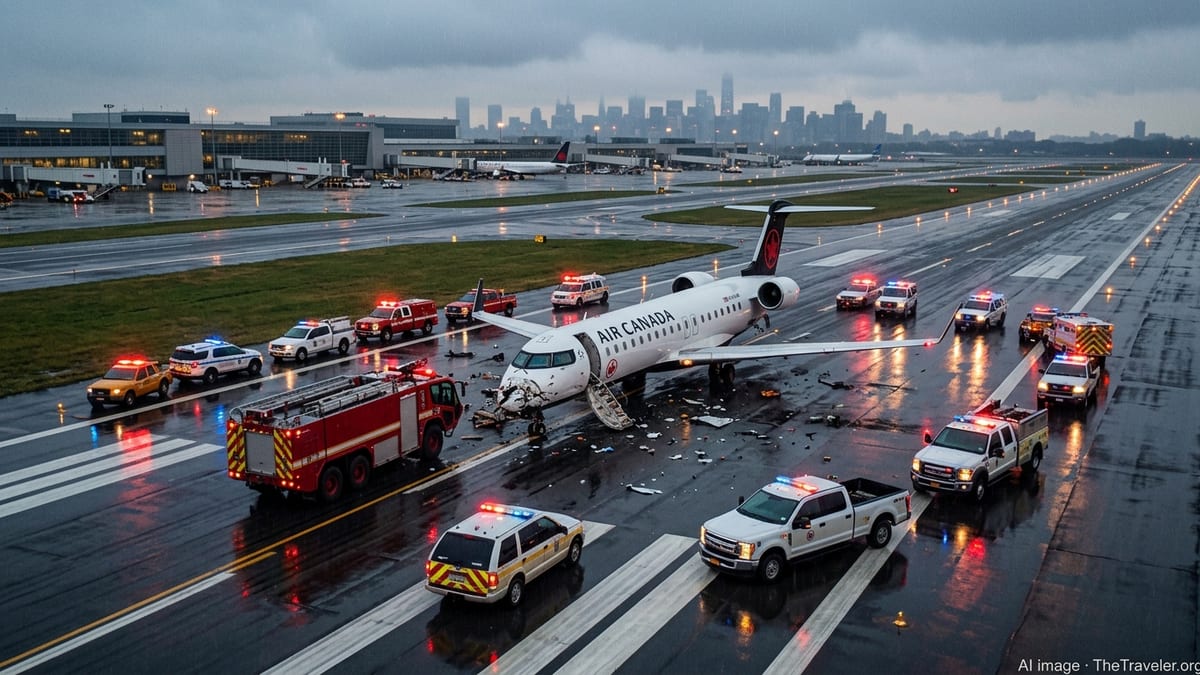
Once repairs are complete and the runway returns to service, attention is likely to shift to the underlying causes of the sinkhole and whether additional mitigation measures are needed elsewhere on the airfield. Past infrastructure incidents at LaGuardia, including a high-profile runway collision earlier this year that temporarily shut the airport, have already prompted calls for deeper reviews of safety margins, emergency response planning and asset management practices.
Urban planners and transportation advocates may also seize on the episode as another data point in the broader debate over New York’s airport system resilience. With LaGuardia handling a heavy share of domestic traffic, even a localized defect on a single runway can have national implications, particularly when combined with spring and summer thunderstorms that frequently disrupt East Coast operations.
For now, passengers and airlines alike are waiting on clear word that the ground beneath Runway 4/22 is stable and ready to support routine takeoffs and landings once more. Until that confirmation comes and the runway reopens, LaGuardia’s capacity will remain constrained, and the sinkhole discovered on May 20 will continue to shape travel plans far beyond New York City.