


More news on this day
A SkyWest Airlines regional service operating as Flight SKW4728 was forced to abandon its planned route after a mid-air technical alert triggered an emergency diversion, according to early operational data and flight-tracking reports. The unscheduled landing, which occurred amid an otherwise routine regional leg, caused knock-on delays across the carrier’s network and renewed attention on how quickly technical issues can ripple through already stretched U.S. regional flight schedules.
Get the latest news straight to your inbox!
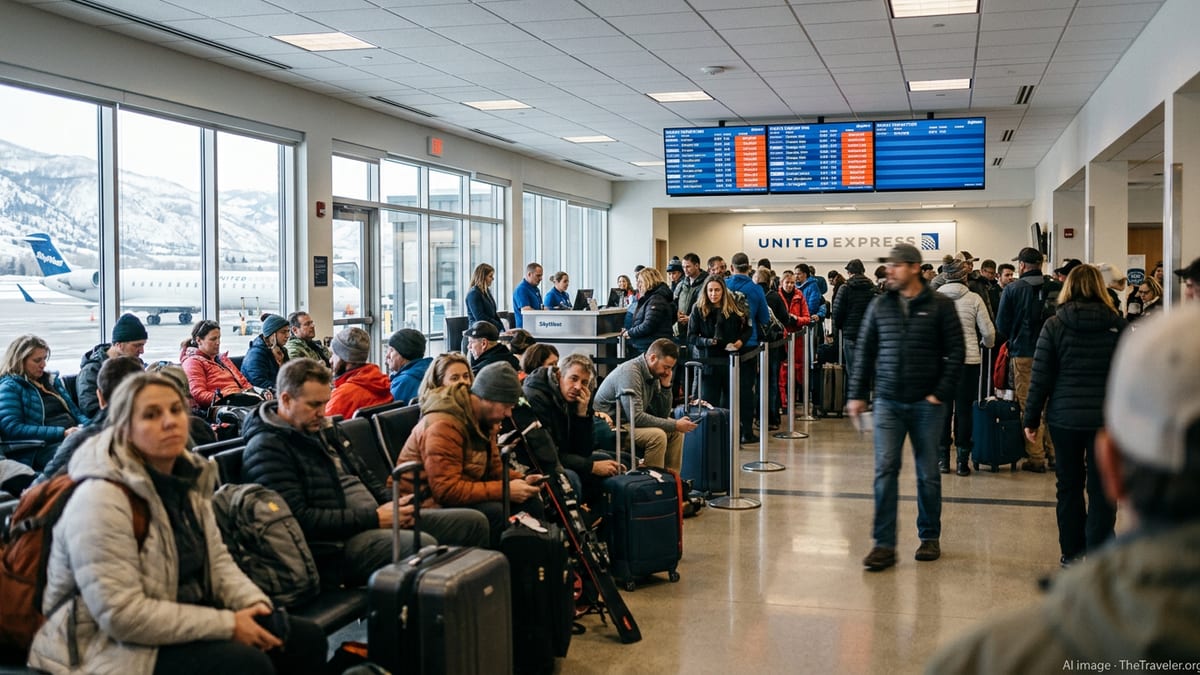
Mid-Air Alert Forces Abrupt Change of Course
Initial information drawn from flight-tracking platforms and public operational logs indicates that SkyWest Flight SKW4728 departed on schedule before the crew received an onboard technical alert during cruise. The nature of the alert has not been formally detailed, but data suggest it was significant enough to require a diversion rather than continuation to the original destination. The crew initiated a change of course toward a suitable diversion airport, where the aircraft landed without further incident.
Publicly available flight-path visualizations show a clear deviation from the expected routing, with the aircraft breaking off its planned track and descending steadily toward the diversion field. The change of course and rapid coordination on the ground led to a brief period of uncertainty for travelers monitoring arrivals and departures, as airport information boards and airline apps adjusted to the unplanned arrival.
While mid-air technical alerts can range from precautionary indications to more urgent system messages, diversion is widely regarded in the industry as a conservative safety choice. Crews are trained to treat unresolved or ambiguous alerts as grounds to seek the nearest practical airport with maintenance access and adequate runway length, especially when operating regional jets on relatively short legs with multiple turnarounds in a single day.
Passengers Describe Disruption and Confusion
Accounts shared on social media shortly after the diversion describe a tense but orderly situation on board as passengers noticed the aircraft changing direction and the cabin crew preparing for an unscheduled landing. Some travelers reported seeing the aircraft begin a gradual descent earlier than expected and receiving announcements about a technical issue that required the flight to divert as a precaution.
Despite the dramatic framing that often accompanies mid-air alerts, the landing itself appears to have been controlled and routine, with no immediate reports of injuries. Travelers, however, faced significant disruption to their plans. Many were rebooked onto later regional services or mainline connections, while others opted to complete their journeys by road after learning that onward flights were heavily delayed or operating at limited capacity.
The incident underscores the communication challenges that accompany sudden diversions. Real-time updates through airline apps, airport displays and third-party flight-tracking tools often lag behind cockpit decision-making by several minutes, leaving passengers, greeters and ground transportation providers briefly in the dark about the aircraft’s status and revised arrival time.
Regional Network Feels the Ripple Effect
Because SkyWest operates as a contract regional carrier feeding larger hub networks, the unplanned diversion of SKW4728 quickly cascaded into wider schedule disruptions. The aircraft involved was reportedly scheduled to operate additional sectors later in the day, and its unexpected grounding at a diversion airport required last-minute swaps and crew reassignments to keep other flights running.
Published scheduling data for U.S. regional airlines show how tightly aircraft and crews are rostered across multiple daily legs. When one aircraft is removed from its planned rotations, downstream departures can face rolling delays as dispatch teams scramble to reposition spare aircraft or consolidate lightly booked flights. At midsize hubs and spoke airports that rely heavily on regional traffic, a single grounded jet can translate into missed connections, extended layovers and longer queues at customer-service desks.
Travelers across the affected region reported delayed departures, revised gate assignments and, in some cases, cancellations on neighboring SkyWest-operated routes. For airports that depend on regional partners to connect smaller communities to national hubs, an incident such as the SKW4728 diversion can briefly amplify existing staffing shortages at security checkpoints and baggage operations as passenger flows clump around newly timed departures.
Technical Alerts and Safety Protocols Under Spotlight
Aviation safety specialists routinely emphasize that diversions triggered by technical alerts are evidence of conservative risk management rather than imminent catastrophe. Modern regional jets are equipped with layered monitoring systems that flag anomalies long before they compromise safe flight. In many cases, such alerts arise from sensor or software issues that can be resolved after maintenance inspection, but crews are trained to respond based on the indication, not on speculation about whether it might be a faulty warning.
Recent years have seen heightened scrutiny of runway incursions, close calls on approach and other high-visibility safety events across the U.S. airspace system. In that context, events like the SKW4728 diversion are being examined alongside a broader pattern of operational strain, including tight scheduling, severe-weather disruptions and air traffic control staffing gaps. Publicly available safety discussions frequently note that swift diversion decisions align with the wider push to reduce the risk of more serious incidents.
Regulators and industry groups continue to highlight the importance of recurrent training for flight crews, dispatchers and maintenance teams, particularly in the regional sector where aircraft cycle through more takeoffs and landings each day than many long-haul jets. Technical alerts, even when they turn out to be benign, are treated as data points that can inform future training scenarios and system upgrades.
What Travelers Should Know After a Diversion
For passengers caught in the middle of an emergency diversion such as the one involving SKW4728, the most immediate concern is usually practical rather than technical. Public guidance from airlines and consumer-advocacy groups generally advises travelers to focus first on rebooking options, either through airline apps or staffed counters at the diversion or final destination airport, once it is clear that the original itinerary will not be completed as planned.
Travel experts note that disruptions on regional routes can sometimes be harder to resolve quickly, because spare aircraft and open seats are limited compared with major trunk routes between big hubs. In these cases, passengers may be offered hotel vouchers, alternative flights on partner airlines or ground-transport arrangements, depending on timing, distance and the specifics of the disruption policy in place for the operating carrier.
Although emergent mid-air technical alerts can be unnerving, historical safety data and industry analysis consistently describe precautionary diversions as part of the normal functioning of a complex, safety-focused aviation system. For travelers across the region affected by the SKW4728 incident, the immediate impact came in the form of missed connections and frayed timetables, but the episode also served as a reminder that rapid, conservative decisions in the cockpit remain a central pillar of modern air travel.