

More news on this day
Thousands of airline passengers across the United States are facing disrupted travel plans after a new wave of cancellations and delays at Charlotte Douglas International Airport left flights to major hubs including New York, Los Angeles, Chicago, and Miami heavily backed up.
Get the latest news straight to your inbox!
Charlotte Hub Bottleneck Ripples Across the Country
Publicly available flight-tracking data on Sunday indicates that Charlotte Douglas International Airport has recorded 53 cancellations and roughly 290 delays affecting departures and arrivals on the latest day of disruption. The majority of the affected services are operated by American Airlines, with additional impacts reported on Delta Air Lines, Southwest Airlines, and Spirit Airlines.
The disruption at Charlotte, one of the nation’s busiest connecting hubs, is sending knock-on effects across the domestic network. Passengers traveling between the Northeast, West Coast, Midwest, and Southeast are encountering missed connections, rebookings on later services, and extended waits inside crowded concourses as schedules are repeatedly revised.
Charlotte Douglas serves as a critical junction for traffic flowing between smaller regional cities and larger coastal gateways. When operations slow at the North Carolina hub, limited spare gate capacity and dense scheduling patterns mean even a modest number of cancellations and rolling delays can quickly cascade, affecting travelers far beyond the airport itself.
Recent Department of Transportation reports have highlighted Charlotte among the country’s major airports where delays can generate widespread secondary disruptions, reflecting the airport’s role as a strategic link in national air travel patterns.
New York, Los Angeles, Chicago, and Miami Among the Hardest Hit
Published flight information shows that some of the most heavily affected routes connect Charlotte with New York–area airports, Los Angeles International Airport, Chicago O’Hare, and Miami. These corridors rank among Charlotte’s busiest city pairs by annual passenger volume, and service on them is primarily operated by American Airlines alongside select flights from Delta and Spirit.
On the New York routes, delays at Charlotte are feeding into already congested airspace along the Northeast corridor. Aircraft operating between Charlotte and New York have faced extended turnaround times, with later departures compounding scheduling challenges at both ends of the route. Travelers connecting onward to other domestic and transatlantic services from New York have reported missed connections and forced overnight stays, according to public social media posts and message board accounts.
Links between Charlotte and Los Angeles and Chicago are also affected, with westbound flights frequently departing late after arriving aircraft and crews turn around from delayed inbound segments. Publicly available data and passenger accounts show that some travelers heading to the West Coast have been rerouted through alternative hubs such as Dallas–Fort Worth or Phoenix, adding hours to total journey times.
Miami, another key gateway in American’s network, has seen a build-up of late-arriving flights and rebooked passengers. This has been particularly disruptive for travelers with onward connections to Latin America and the Caribbean, who rely on tightly timed transfer windows at Miami International Airport.
Weather, Network Recovery, and Crew Positioning Challenges
Recent winter weather systems across parts of the United States have continued to challenge airline operations into March, following on from major January and February storms that led to mass disruptions and large waves of cancellations. Official meteorological bulletins and news coverage document repeated periods of snow, freezing rain, and strong winds affecting key hubs in the Midwest and Northeast earlier in the season, creating a backlog of displaced aircraft and crews.
While current conditions at Charlotte have periodically improved, publicly available information suggests that airlines are still working through residual recovery. Network recovery operations involve repositioning planes and flight crews that were previously stranded or out of sequence during earlier storms. When those repositioning efforts intersect with normal daily schedules, minor delays can quickly accumulate, particularly at a constrained hub.
Industry analyses and consumer reports have also pointed to tight staffing margins and high aircraft utilization across major U.S. carriers as contributing factors. With limited spare crews and backup aircraft available, even short-lived operational interruptions can force airlines to make difficult decisions to cancel specific flights in order to preserve the rest of the schedule.
Charlotte’s role as a connecting hub further magnifies these challenges. A single delayed inbound flight can jeopardize dozens of onward connections, prompting airlines to consolidate passengers onto fewer departures and cancel underperforming or logistically complex services, especially on routes into already congested airspace around New York and Chicago.
Stranded Passengers Face Long Lines and Limited Options
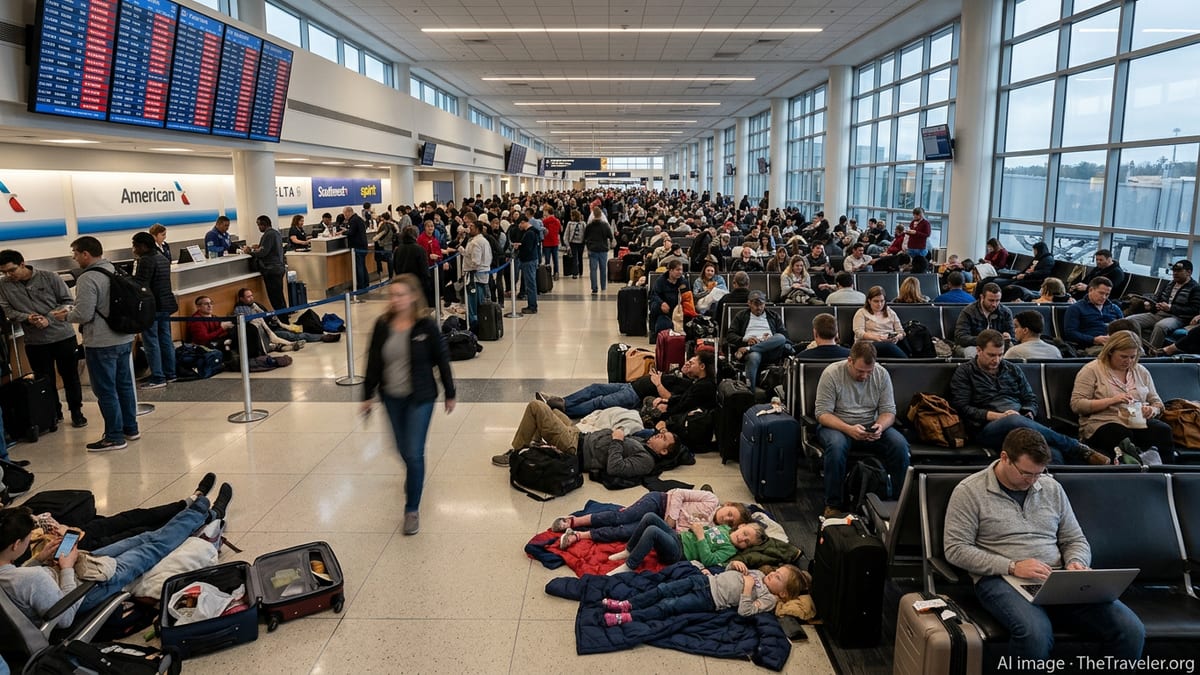
Images and accounts shared on social platforms show crowded gate areas and long customer service queues at Charlotte Douglas, as travelers seek rebooking assistance, hotel vouchers, or updated information on departure times. With significant portions of some airlines’ daily schedules disrupted, same-day alternatives are often limited, particularly for travelers heading to constrained destinations such as New York and Los Angeles during peak periods.
Passengers stranded overnight at Charlotte and downline airports including New York, Chicago, and Miami have described sleeping in terminal seating and on terminal floors while waiting for rebooked flights. In some cases, hotels near major airports have filled quickly, leaving late-arriving travelers with few nearby lodging options.
Consumer advocacy information circulated online emphasizes that travelers affected by cancellations and substantial delays should review airline policies and Department of Transportation guidance on refunds, rebooking rights, and amenity provisions. Publicly available summaries explain that when a flight is canceled, passengers are generally entitled to a refund if they choose not to travel, even when the ticket was sold as nonrefundable.
However, the level of support for meals, hotels, or ground transportation can vary depending on whether the disruption is categorized as within the airline’s control or caused primarily by weather and air traffic constraints. Many passengers have reported turning to mobile apps and third-party tools to monitor seat availability and track alternative routing options as they navigate evolving schedules.
Ongoing Impact and What Travelers Can Expect Next
Operational data and industry commentary suggest that while the number of outright cancellations at Charlotte has moderated compared with peak winter storm days earlier in the season, the current pattern of elevated delays is likely to continue in the short term as airlines work to normalize schedules. Recovery operations often take several days, especially when disruptions affect multiple hubs simultaneously.
Travel analysts note that heavily banked hub operations, such as those at Charlotte, can remain fragile during recovery periods. With departure and arrival waves scheduled closely together, a relatively small disruption early in the day can echo through the remaining banks, particularly on high-demand routes to New York, Los Angeles, Chicago, and Miami.
Passengers traveling through Charlotte over the coming days are being advised in public guidance and media coverage to allow extra connection time, monitor flight status frequently, and be prepared for potential gate or schedule changes. Flexibility in routing, including willingness to connect through alternative hubs or accept different carriers on select segments, can improve the odds of reaching a destination on the planned travel day.
As airlines continue to adjust, attention from regulators, consumer advocates, and data analysts remains focused on how carriers manage large-scale disruptions, communicate with affected passengers, and structure their networks to withstand increasingly frequent episodes of severe weather and operational strain.