

More news on this day
Travelers across the United States faced an unsettling start to the week as disruption at Palm Beach International Airport led to 108 new flight delays and 88 cancellations, leaving hundreds of passengers stranded and confused from New York and Boston to Chicago, Philadelphia, Dallas, and other major hubs.
Get the latest news straight to your inbox!
Stormy Weather and System Strain Converge
Publicly available aviation tracking data and weather reports indicate that a band of unsettled conditions across the Eastern United States, combined with broader system pressures, played a central role in the latest disruption centered on Palm Beach International Airport. Periods of thunderstorms and shifting winds in parts of Florida and along the East Coast added complexity to already busy air corridors, complicating takeoff and landing windows.
The timing has proved especially challenging for carriers still recalibrating schedules after an intense winter season that brought multiple major storms to the Northeast and Mid-Atlantic. Earlier blizzards and nor’easters in 2026 created lingering crew and aircraft imbalances, and the latest operational squeeze at Palm Beach has exposed how quickly those residual vulnerabilities can resurface when weather turns unsettled again.
While aviation systems are designed with buffers to absorb a certain level of disruption, the volume of delayed and canceled flights at a single regional airport underscores how thinner staffing and tight aircraft rotations can leave limited margin for error. Once a handful of departures were pushed back or scrubbed in West Palm Beach, knock-on schedule changes began to appear on route maps across the country.
Nationwide Ripple Effects From a Regional Hub
Flight-status dashboards on major travel platforms showed the consequences radiating far beyond South Florida. Routes connecting Palm Beach International with New York, Boston, Chicago, Philadelphia, and Dallas appeared among the most affected, reflecting the heavy traffic that normally flows between these metropolitan centers and South Florida in early spring.
Airlines commonly use aircraft based in Florida to operate multi-city rotations in a single day. When an early departure from Palm Beach is delayed or canceled, the same plane may fail to reach its next scheduled leg on time, often at a large hub such as Chicago or Dallas. As the day progresses, those missed connections can cascade into additional schedule adjustments, leaving passengers stranded far from the original point of disruption.
Travel platforms and airport information boards showed clusters of pending departure times and rolling delays across the affected network, a sign that crews were being repositioned and aircraft reassigned where possible. Even minor schedule tweaks, such as 30- or 45-minute delays, contributed to crowding around gates and service counters, as travelers tried to understand their options in real time.
Stranded Passengers Confront Confusion and Limited Options
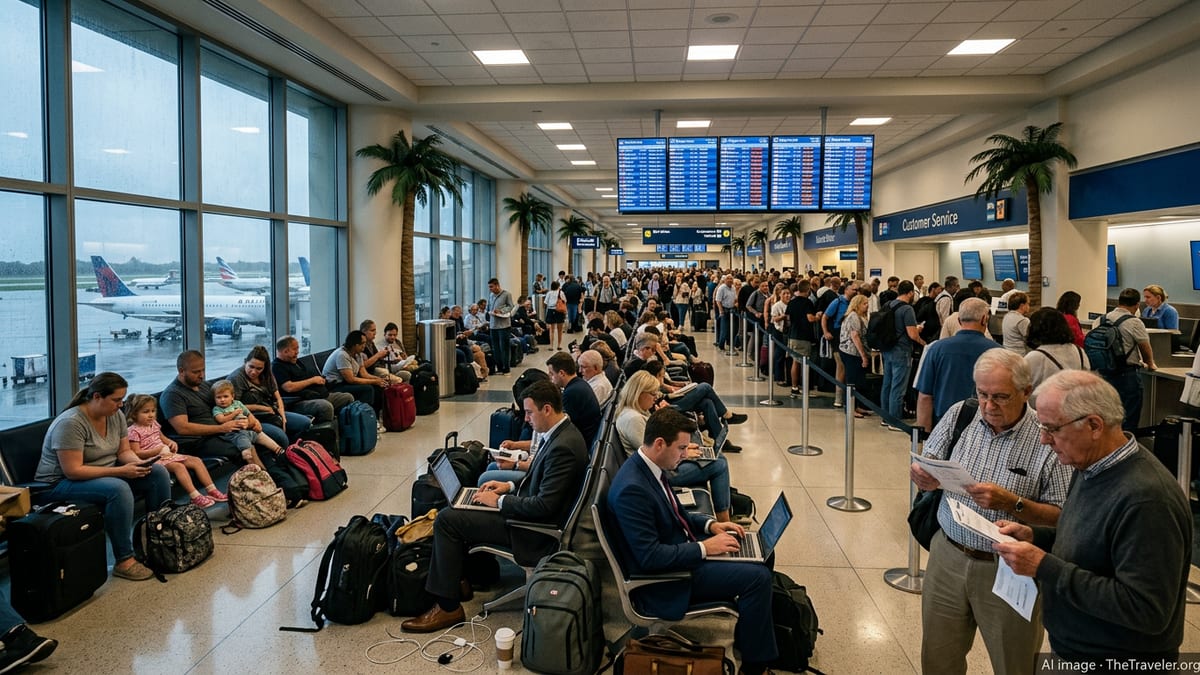
Reports from social media and travel forums described crowded concourses, long lines at customer-service desks, and a general sense of uncertainty among those stuck in New York, Boston, Chicago, Philadelphia, Dallas, and other connection points. Many passengers indicated difficulty securing same-day alternatives, particularly on popular Florida routes that were already running close to capacity.
Travelers whose flights were canceled outright often faced a choice between accepting rebooking on later dates or navigating complex combinations of standby lists and multi-stop routings. For those connecting to international services via larger hubs, the disruption in Palm Beach and along the East Coast risked missed onward flights, additional overnight stays, and unexpected expenses for lodging and meals.
Publicly available guidance from airlines and consumer advocates advises passengers in such situations to monitor mobile apps for automatic rebooking, document expenses, and remain alert to eligibility for meal vouchers or hotel accommodations under each carrier’s published policies. However, the pace and scale of Monday’s disruption meant that automated systems sometimes lagged behind real-world conditions, further heightening frustration.
Broader Context of U.S. Airline Reliability
The events at Palm Beach International come against a national backdrop of ongoing scrutiny of airline reliability and the resilience of the U.S. air travel system. Government data and independent analyses in recent years have highlighted how staffing gaps, tight schedules, and aging infrastructure can amplify the impact of storms, ground stops, or air traffic control constraints.
Industry observers note that certain major hubs, including those serving New York, Boston, Chicago, Philadelphia, and Dallas, are particularly vulnerable to disruptions because they operate near capacity during peak travel periods. When weather issues or operational bottlenecks arise at one airport, the interconnected nature of airline networks can turn a local problem into a nationwide challenge, as evidenced by Monday’s wave of delays and cancellations linked to Palm Beach.
Travel advocates have urged passengers to build more flexibility into their plans, especially during seasons known for volatile weather. Recommendations commonly include booking earlier flights in the day, allowing longer layovers for connections, and considering travel insurance or credit-card protections that can help offset costs when schedules unravel unexpectedly.
What Travelers Can Expect Next
Airline operations teams typically work through the remainder of the day and into the night to realign aircraft and crews after a disruption of this magnitude. That process can involve repositioning planes, adjusting crew pairings, and selectively consolidating lightly booked flights in order to restore schedules as efficiently as possible. Passengers may continue to see minor delays and schedule changes into the following day as the system resets.
Public dashboards provided by airlines and flight-tracking services remain the most immediate way for travelers to assess whether their specific routes remain at risk. For those set to fly into or out of Palm Beach International, as well as major hubs like New York, Boston, Chicago, Philadelphia, and Dallas, experts recommend checking flight status frequently, arriving early at the airport, and being prepared with backup options such as alternate routings or nearby airports.
While the latest disruption has left many travelers frustrated and temporarily grounded, it also serves as a reminder of the fragile balance that underpins modern air travel. A combination of unstable weather, tight schedules, and finite staffing can swiftly turn a routine morning at a regional airport into a nationwide test of patience for passengers across the United States.