


More news on this day
The residential cruise ship Odyssey has departed the Cambodian port of Sihanoukville with crew aboard but no passengers, marking a stark turning point for the ambitious “endless” voyage that unraveled amid financial strain and rising fuel costs.
Get the latest news straight to your inbox!
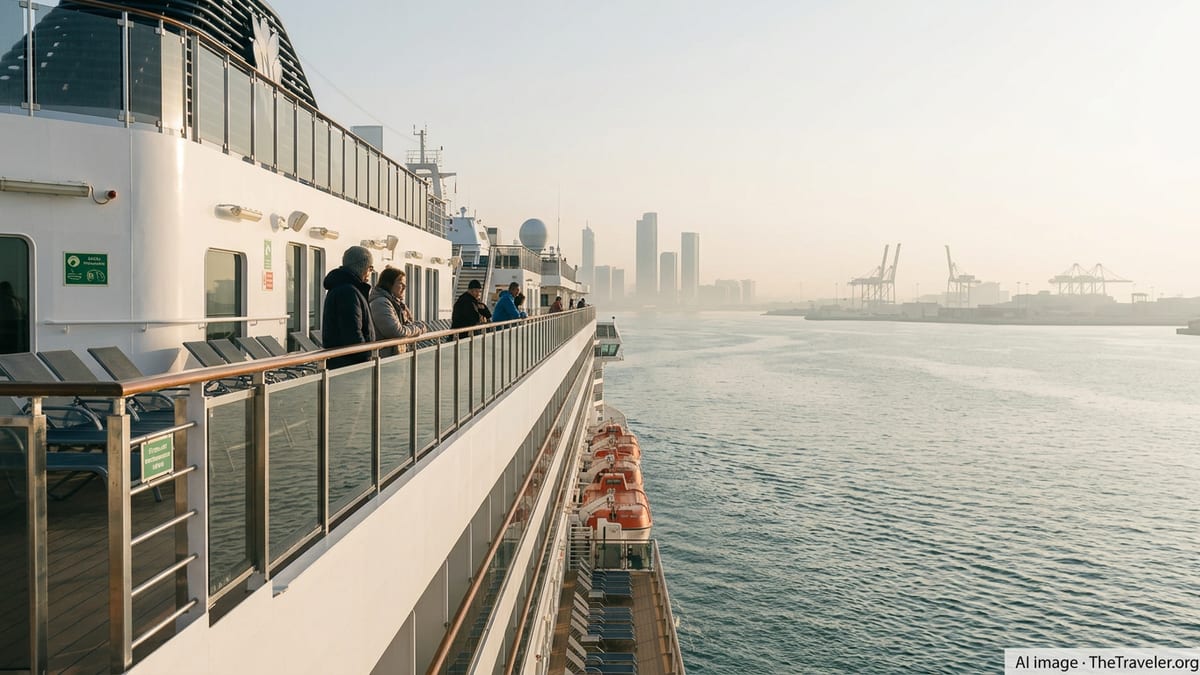
Ship departs Sihanoukville with only crew on board
Publicly available information indicates that the MV Odyssey left Sihanoukville on Wednesday, November 4, after spending several days alongside at the Sihanoukville Autonomous Port on Cambodia’s southern coast. News outlets describe the vessel sailing with its crew but without any of the paying residents who had previously treated the ship as a floating home.
The departure follows a chaotic sequence that began during a scheduled call at Sihanoukville on October 28. Reports indicate that about 203 passengers were instructed with only a few hours’ notice to gather their belongings and disembark, ending their voyage far from home and far earlier than planned. The ship remained in port while its operator assessed options for its future.
Coverage from international and Cambodian media notes that the Odyssey’s departure came after a period of uncertainty over fuel and operating expenses. The vessel’s owners had already announced a suspension of operations, and the decision to sail without residents on board appears to reflect a shift from residential cruising toward repositioning or lay-up while financial and legal issues are addressed.
Images carried by broadcasters and news agencies show crew members preparing the vessel for sea at Sihanoukville, while former residents moved luggage down the gangway and into waiting vehicles earlier in the week. With the Odyssey now gone from the pier, attention has turned to where the ship is heading and what will happen next for both the vessel and its displaced community.
End of a “never-ending” residential cruise experiment
The Odyssey, operated by Villa Vie Residences and now widely referred to as the Villa Vie Odyssey, was marketed as a residential cruise ship offering multi-year, around-the-world itineraries. According to public promotional material and prior coverage, residents bought cabins or long-term leases, planning to live at sea while sailing between global ports over more than three years.
Reports over recent days suggest that the business model came under intense pressure from mounting fuel prices and operating costs. In late October, the company publicly announced that it was suspending the voyage, citing fuel expenses that it said had become unsustainable. Prospective additional investors and financing arrangements do not appear to have materialized in time to keep the ship sailing with its original concept.
Articles in international media describe how residents had expected an almost continuous global itinerary but instead saw itineraries adjusted and fundraising appeals made in an attempt to keep the ship moving. Some coverage notes that passengers were asked to contribute additional funds for fuel and other costs, highlighting the fragile finances behind the grand concept of an “endless” cruise.
Analysts tracking the situation point to the Odyssey as one of the first large-scale tests of a fully residential world cruise model based on long-term stays rather than short holiday segments. The sudden halt in Cambodia underscores how exposed such ventures can be to fluctuations in fuel prices, financing conditions, and the complexity of managing a ship that is both a residence and a cruise product.
Passengers stranded in Cambodia face scramble for options
With the ship now gone, the focus for former residents has shifted to practicalities such as housing, flights, and refunds. News reports from Sihanoukville depict passengers wheeling suitcases down the dock and boarding buses and taxis, many facing immediate questions about where they would sleep and how they would finance a return to their home countries or onward travel.
According to published coverage, some passengers reported securing hotel rooms in Sihanoukville or in Phnom Penh, while others looked for flights from Cambodia to regional hubs including Bangkok, Singapore, and Seoul. The sudden timing of the disembarkation, coupled with peak-season demand on some routes, created a challenging environment for finding reasonably priced tickets on short notice.
Public information released by the operator indicated that efforts were being made to assist residents with temporary arrangements and onward travel. However, accounts gathered in media reports suggest that support levels varied and that some travelers felt they were largely on their own to manage accommodation costs and logistics. Many residents had already committed substantial funds to multi-year stays on the ship and did not necessarily have a fallback budget for an unexpected relocation.
Travel industry observers note that the Odyssey episode has highlighted the limited consumer-protection framework around novel long-term cruise products. Standard package-tour safeguards and traditional cruise contract provisions may not fully anticipate a scenario in which customers are living on board for months or years and then suddenly find themselves disembarking in a foreign country mid-journey.
Regulatory and financial questions for the operator
The Odyssey sails under the flag of the Bahamas and was operating globally, connecting ports across several regions over the past two years. That international footprint, combined with residents hailing from multiple countries, raises complex questions about jurisdiction, refunds, and dispute resolution in the wake of the suspension.
Media reports indicate that the company behind the ship had been working to restructure its operations and explore potential asset sales or new financing. Statements cited in news coverage mention possibilities that range from resuming some form of service to selling the vessel to settle outstanding obligations, with no final outcome yet announced.
Financial and maritime experts quoted in previous analyses of similar cases have noted that once a ship is laid up or repositioned without passengers, the cost of maintaining it, insuring it, and keeping it in class can be significant. If revenue from passengers stops entirely, owners often face a narrow window in which to find new investors or buyers before operational costs and creditor claims accumulate.
Publicly available background information on the ship’s history shows that the vessel entered service in the 1990s under different names and owners before being converted for residential cruising. Such older tonnage can remain viable for many years, but its market value depends heavily on regulatory compliance, mechanical condition, and the overall health of the cruise sector. Those factors are likely to influence what ultimately happens to the Odyssey following its quiet departure from Cambodia.
Implications for future residential cruising ventures
The Odyssey’s troubles arrive at a time when interest in long-duration and residential cruising has been increasing, with several companies promoting multi-year world voyages or permanent life-at-sea concepts. The events in Cambodia now serve as a high-profile case study for both potential customers and regulators evaluating the risks behind such projects.
Travel industry commentators suggest that future residential cruise ventures may face closer scrutiny of their financial reserves, fuel hedging strategies, and contingency plans. Prospective residents may also look more carefully at refund policies, legal jurisdictions listed in contracts, and what would happen if a voyage were cut short far from home.
The episode also underlines the importance of port-state relationships. Cambodia previously gained attention in 2020 when Sihanoukville accepted a different cruise ship that had been turned away from several ports during the early phase of the COVID-19 pandemic. With the Odyssey, Cambodia again became the unexpected endpoint for a troubled cruise, this time driven by financial and operational pressures rather than public health restrictions.
For now, the Odyssey is at sea without its former residents, and those who once called it home are dispersed across Cambodia and onward destinations. Their experience is likely to shape consumer expectations and regulatory discussions as the cruise industry experiments with new, long-duration travel models that promise to turn life at sea into a permanent address.