


Strasbourg calls itself the Capital of Christmas, and during advent the city lives up to the name. Half-timbered houses glow with fairy lights, church bells ring over the Ill River, and more than ten Christmas villages spill across the historic Grande Île. With confirmed 2026 dates, strong rail connections and a compact old town, Strasbourg is one of Europe’s most practical and atmospheric festive bases, especially if you want to add Colmar and the wine‑route villages as day trips.
Get the latest updates straight to your inbox!
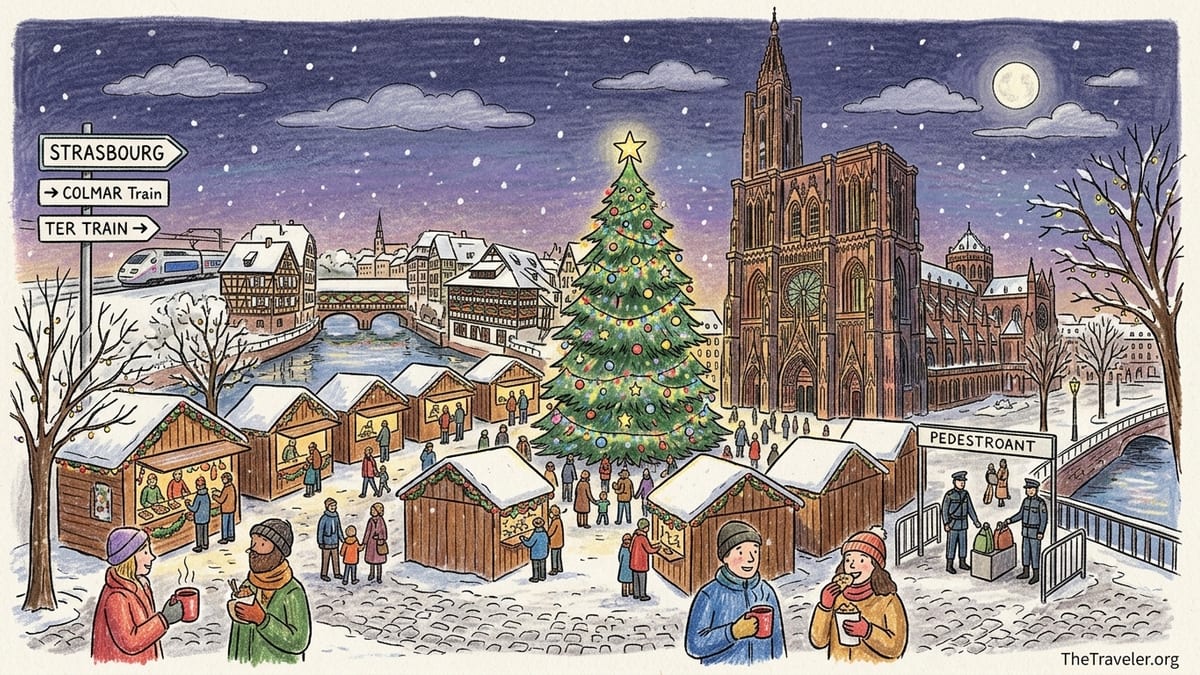
Key 2026 dates and what to expect in Strasbourg
In 2026, the official Strasbourg Christmas market season runs from Friday 27 November to Thursday 24 December. According to the city’s Noël à Strasbourg information, the chalets open at 14:00 on the first day, then operate daily from 11:00 to 21:00, with an earlier closing at 18:00 on 24 December when the market ends for the season. There is no trading on 25 December, so visitors planning to be in town on Christmas Day should not expect active market stalls, although decorations and the big tree remain in place.
The markets stretch across the UNESCO‑listed Grande Île, centred on Strasbourg Cathedral and Place Kléber. In recent editions there have been around a dozen distinct “villages,” including the historic Christkindelsmärik on Place Broglie, an Alsatian crafts market near Place de la Cathédrale, and a food‑focused cluster around Place du Marché‑aux‑Poissons. Entry is free, and you pay only for what you eat, drink or buy. Most chalets take cash and cards, but having some euros in small denominations is useful when crowds are thick and terminal connections are slow.
Security has been tightened in recent years, especially at weekends and in the evenings. Expect pedestrian checkpoints at main access points to the Grande Île, with bag inspections and occasional one‑way flows around the busiest squares. It is common for stroller access to be slower through these controls, so families should allow extra time if arriving for specific events such as early‑evening concerts or choral performances inside the cathedral.
Weather in late November and December is cold and damp, often just a few degrees above freezing in the evening. Packed timber houses can shield the wind, but your enjoyment will depend heavily on warm layers, waterproof footwear and gloves you can still hold a mug with. A practical example: travellers arriving on a 17:00 TGV from Paris often head straight from the station to the old town to catch the lights; packing a hat and scarf in your day bag makes that first night feel festive rather than frigid.
Where to stay in Strasbourg during the Christmas season
Demand for beds in Strasbourg is intense throughout the market period. Local tourism officials and long‑time residents report that central hotels for peak Saturdays often sell out months in advance, and rates in late November and early December can be significantly higher than in spring. Booking by late summer is wise if you want to be walking distance from the cathedral, especially for the opening weekend or the final days before Christmas.
For a classic experience, many visitors target properties in or around the Grande Île. Mid‑range chain hotels near Place Kléber or Homme de Fer tram stop give you easy access to most villages, while independent guesthouses in the narrow lanes southeast of the cathedral offer more character. A couple arriving on a Friday evening, for example, might choose a three‑star hotel near Rue des Grandes Arcades to be able to drop luggage and be sampling vin chaud in less than ten minutes on foot.
If central rates are out of reach, looking just across the river can help. Neighbourhoods like Krutenau and the streets around Parc de l’Étoile often offer slightly lower prices while remaining one or two tram stops from the action. Another strategy is to stay near Strasbourg‑Ville station. Hotels in this area are convenient for day trips and often have better availability midweek; from the station it is roughly a 15–20 minute walk to the cathedral, or a short tram ride if you prefer to avoid walking back late at night.
Families and small groups sometimes base themselves outside Strasbourg and commute in by train. Towns such as Obernai or Saverne, reachable on regional TER services, can have calmer evenings and easier parking for those renting a car. However, for a first visit focused on the Christmas markets, staying in Strasbourg itself removes the need to watch train timetables after dark and lets you wander freely between the illuminated squares.
Exploring Strasbourg’s markets, food and festive traditions
Strasbourg’s Christmas experience is more than a single market square. The Christkindelsmärik on Place Broglie is among the oldest markets in Europe, with rows of wooden chalets selling ornaments, hand‑carved nativity figures and local textiles. Nearby, Place de la Cathédrale hosts artisans offering blown‑glass baubles, carved wooden stars and delicate lace, all against the backdrop of the cathedral’s intricate façade, often highlighted by subtle evening lighting.
Food and drink are at the heart of the visit. Throughout the markets you will find vin chaud in white or red varieties, typically served in collectible mugs for a small deposit. Expect to pay somewhere in the region of 3 to 4 euros per mug, depending on the stall and whether you keep the cup. Regional specialties appear everywhere: flammekueche (thin pizza‑style tarts topped with cream, onions and lardons) served by the slice, thick slices of kougelhopf cake dusted with sugar, and bredele biscuits flavoured with cinnamon, hazelnut or anise.
Many visitors also explore the city beyond the chalets. Petite France, with its canals and half‑timbered houses, is especially atmospheric at dusk when garlands reflect in the water. Crossing the covered bridges and climbing the Vauban dam terrace gives a panoramic view of the illuminated quarter. Cultural programming usually includes evening organ recitals in the cathedral, choirs in parish churches, and exhibitions at institutions such as the Alsatian Museum, so it is worth checking the city’s seasonal programme once your travel dates are fixed.
To manage crowds, consider timing your strolls outside the peak evening window. A practical pattern for a December weekend could be to visit markets from late morning until early afternoon, retreat to a café or your hotel for a rest, then head back out around 19:30 when some day‑trip groups have already left. If you prefer photography, early weekday afternoons often offer the best compromise between daylight and manageable foot traffic.
Planning Colmar as a key Alsace day trip
Colmar is Strasbourg’s most popular Christmas side trip and, for some travellers, reason enough to extend their stay in Alsace. In 2026 the official tourist information for Colmar indicates that its main Christmas markets run from 23 November to 23 December, with some festive installations and attractions, such as the Rapp Square fairground and Ferris wheel, continuing into the very end of December and early January. There are six main markets spread across the old town, including the Place des Dominicains, Place Jeanne d’Arc and the Petite Venise children’s market.
The town’s compact size makes it ideal for a day visit. From Colmar station it is around a 15‑minute walk along signposted streets into the medieval centre. Visitors can follow the mapped Christmas trail that links the six market areas, passing pastel‑painted houses and timber‑framed façades decorated with giant baubles and illuminated stars. The Petite Venise quarter, with its canals and small wooden boats, is particularly picturesque at dusk, when house fronts glow and reflections shimmer in the water.
Budget around six to eight hours on the ground to see Colmar comfortably. A common schedule from Strasbourg is to catch a late‑morning train, arrive around lunchtime, sample Alsatian specialties in the markets or at a winstub near Place de la Cathédrale, then wander the markets through the afternoon before experiencing the full effect of the evening lighting. Many travellers then return to Strasbourg on an evening train, arriving back before 22:00.
Colmar can be extremely crowded on December weekends, especially in the late afternoon when coach tours converge. If your Strasbourg stay spans several days, consider choosing a weekday for Colmar. For example, couples staying in Strasbourg from Thursday to Sunday in early December might pick the Friday for Colmar, keeping Saturday for exploring Strasbourg when local events and concerts are in full swing.
Trains, transport and moving around Alsace
Rail is the most convenient way to travel between Strasbourg and Colmar in the Christmas period. Regional TER trains typically run at least twice an hour during the day, with journey times of around 30 minutes on the fastest services and slightly longer on others. Recent traveller reports and regional timetables suggest one‑way standard fares in the ballpark of 12 euros when bought on the day through SNCF Connect or at station ticket machines, with occasional advance or off‑peak discounts available.
Strasbourg‑Ville station is a short tram or 15–20 minute walk from the historic centre. Taxis and app‑based ride services queue outside the glass‑domed entrance, though lines can lengthen on Friday evenings and Sunday afternoons. For Colmar, the station lies west of the old town and is connected by well‑lit streets; visitors arriving after dark usually find a steady stream of other travellers heading the same way during the market season, which can feel reassuring if you are unfamiliar with the town.
For wider Alsace, regional trains and buses link Strasbourg and Colmar to smaller wine‑route towns such as Obernai, Ribeauvillé, Riquewihr, Kaysersberg and Eguisheim. In past seasons the Haut‑Rhin department has coordinated special Christmas shuttle buses along the wine route, linking Colmar with villages like Kaysersberg and Riquewihr on market days. For 2026 you should check the latest timetable closer to departure, but as a planning example, previous versions of these shuttles have run roughly every hour on Saturdays and Sundays in Advent, allowing visitors to spend two to three hours in each village.
Driving is an option, especially if your accommodation includes parking outside central restricted zones. However, Strasbourg’s Grande Île is pedestrianised during market hours and several surrounding streets operate under temporary traffic controls, so you will likely park in outer garages and walk or take trams. In Colmar and the wine‑route villages, dedicated Christmas parking zones and park‑and‑ride systems are often set up on busy weekends, sometimes with small flat‑rate fees. Always factor in extra time for parking and shuttle transfers if you intend to visit multiple towns in a single day.
Alsace day trips beyond Colmar: villages, wine and scenery
Strasbourg makes a strong base for exploring the broader Alsace region, even if you rely entirely on public transport. South of Colmar, colourful villages along the Route des Vins d’Alsace host their own markets in atmospheric medieval squares. Kaysersberg, Riquewihr, Ribeauvillé and Eguisheim are among the best known, each with steep streets, old stone ramparts and richly decorated facades. Their markets often run mainly on Advent weekends, with smaller selections of stalls compared with the big cities but a more intimate feel.
One realistic day‑trip pattern is to combine Colmar with a single village. For instance, you might travel from Strasbourg to Colmar in the morning, spend three to four hours at the town’s markets, then board a Christmas shuttle bus to Kaysersberg for late afternoon and evening. After wandering the village streets under lanterns and trying a plate of spaetzle or a slice of onion tart in a winstub, you could catch a return shuttle and train, arriving back in Strasbourg before midnight.
Another option from Strasbourg is to head north to small towns such as Obernai or Haguenau. Obernai’s market clusters around the central square and ramparts, with timbered houses and a tall belfry overlooking the stalls. It is reachable in roughly 20–30 minutes by regional train and makes an easy half‑day excursion. Haguenau, a little further, runs a family‑friendly Advent programme around its church and pedestrian streets. While these markets are more modest than Strasbourg or Colmar, they can be calmer alternatives if your main goal is to soak up local traditions without shoulder‑to‑shoulder crowds.
Wine is also woven into the season. Many domaines along the Route des Vins maintain winter opening hours, offering tastings of Riesling, Gewürztraminer and Pinot Gris in cellars scented with old oak. Some pair their wines with bredele biscuits or Christmas stollen. If you plan to taste, build in time for a proper meal and consider relying on trains, buses or organised excursions rather than driving yourself between wineries.
Practical tips for crowds, budgets and booking
Strasbourg’s Christmas markets are among the most visited in Europe, and crowd levels reflect that reputation. Saturdays in December often see the Grande Île feel near capacity from mid‑afternoon until closing. For a smoother experience, structure your visit to include at least one weekday, when you can expect easier movement between squares and shorter queues for food. Families with small children may find weekday late mornings particularly manageable, with more space around rides and children’s activities.
Accommodation and train costs vary, but you can expect higher‑than‑usual prices in the core season. For instance, recent searches in similar years show mid‑range hotels near the cathedral often charging noticeably more for Friday and Saturday nights between early and mid‑December than for equivalent dates in March. Rail fares into Strasbourg on peak Fridays can also be higher than midweek services. To stay within budget, consider travelling Monday to Thursday, or staying three nights in Strasbourg and shifting to a slightly cheaper base such as Colmar or a wine‑route village for additional nights.
Food spending is another area to plan. A practical daily pattern might include a bakery breakfast with coffee, a warm sit‑down lunch in a winstub or brasserie, and then market snacks in the evening. While exact prices shift each year, a simple sit‑down lunch for one person in central Strasbourg or Colmar often falls somewhere in the mid‑teens in euros before drinks, compared with a few euros for a generous market snack such as sausage in a baguette or a large pretzel.
For bookings, it is safer to secure cancellable rates for hotels and longer‑distance trains several months in advance, particularly if you are targeting weekends or specific dates such as the opening day on 27 November 2026. Regional TER tickets between Alsace towns, by contrast, are usually flexible and can be bought closer to departure. Keep an eye on official city and regional tourism sites for any last‑minute adjustments to opening hours, security rules or shuttle‑bus operations, especially in the weeks before your trip.
Making the most of a Strasbourg‑based Christmas escape
Strasbourg offers one of Europe’s richest Christmas atmospheres, combining centuries of market tradition with the convenience of a well‑connected modern city. With confirmed 2026 dates from 27 November to 24 December, it fits neatly into late‑autumn and pre‑holiday travel plans, whether you arrive on a Friday TGV from Paris, a weekend flight into nearby airports, or an international train from Germany or Switzerland. By basing yourself in Strasbourg for at least three nights, you can enjoy the markets at different times of day, explore quieter corners like Krutenau, and still have time for a full‑day excursion.
Building Colmar and selected Alsace villages into your itinerary deepens the experience. A sample five‑day trip might include two full days in Strasbourg, a day in Colmar, a village‑hopping excursion along the wine route, and a final flexible day to revisit favourite markets or simply watch the lights from a café terrace. Well‑timed regional trains and, where available, Christmas shuttle buses make this feasible even without a car.
Ultimately, what makes Strasbourg and Alsace such a strong festive destination is the combination of scale and intimacy. Grand trees and elaborate light displays frame moments as simple as sharing a mug of mulled wine under a timbered balcony or watching children’s faces light up at the Petite Venise carousel. With some advance planning around dates, hotels and transport, you can step into that scene with confidence and savour one of Europe’s most atmospheric Christmas seasons.