


More news on this day
A power substation fire has triggered widespread rail disruption, with hundreds of trains affected, crowding at key hubs and longer journey times as engineers race to restore power and signalling equipment.
Get the latest news straight to your inbox!
Fire damages critical power and signalling infrastructure
According to published coverage, the incident began when a fault at a rail-side power substation led to a fire that damaged electrical and signalling equipment feeding several busy lines. Images and video shared by local media show heavy smoke and visible flames at the installation, followed by a prolonged outage affecting nearby tracks.
Initial technical reports indicate that the blaze damaged high-voltage equipment and cable routes supplying both traction power and signalling systems. In modern rail networks, these substations distribute electricity to overhead lines or third-rail systems and also support interlockings and control circuits. Damage at a single node can therefore interrupt multiple routes simultaneously.
Publicly available information shows that engineers isolated the affected substation and shut down adjacent sections of track as a precaution, cutting power to trains in the area. Safety checks on neighbouring equipment added further delays, as infrastructure managers sought to confirm there was no additional risk to passengers or staff from residual faults or heat damage.
Specialist teams have been deployed to inspect transformers, switchgear and cable ducts, with early assessments describing a complex repair that is likely to involve replacing substantial lengths of cabling and testing signalling logic before full services can resume.
Commuters face cancellations, diversions and crowding
Rail operators have warned passengers to expect a full day of disruption, with some sources suggesting that knock-on effects could continue into subsequent days. Timetables are being heavily revised, particularly during the morning and evening peaks, as capacity through the affected corridor remains sharply reduced.
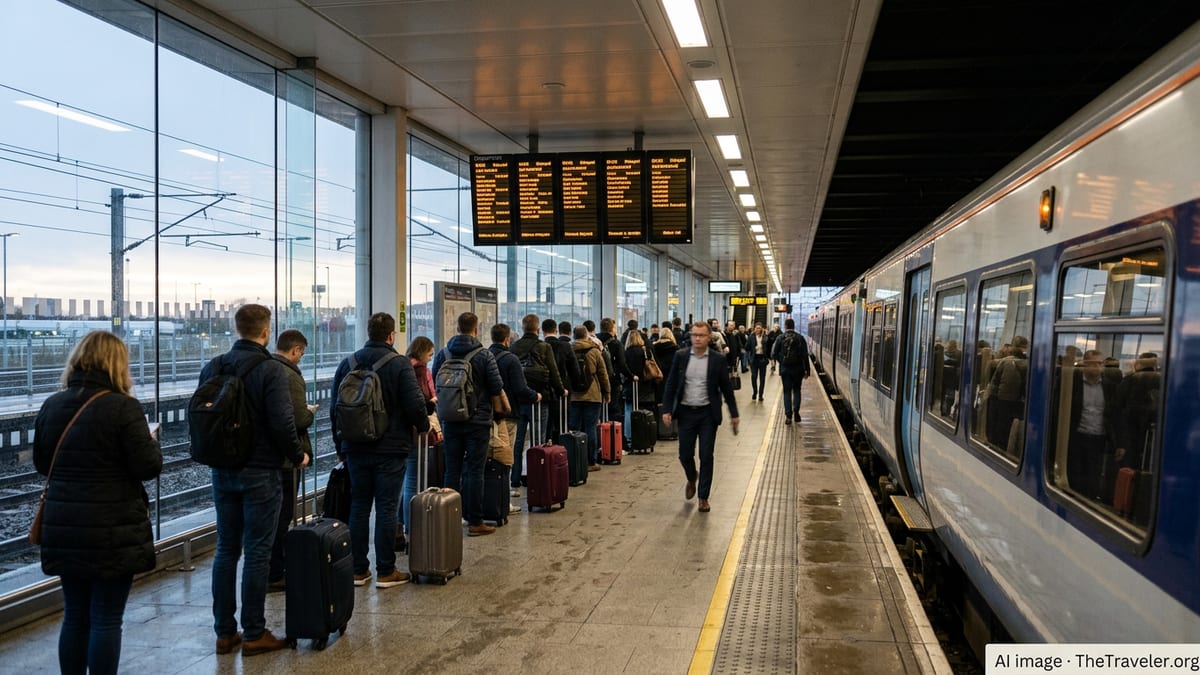
Reports from stations on the impacted routes describe busy concourses, with departure boards dominated by cancellations, short-notice platform changes and extended journey times. Some trains that are able to run are being diverted over alternative lines, often adding significant distance and time. Others are terminating short of their usual destinations where power supplies remain stable.
Replacement buses have been arranged on certain sections, but demand is high and journey times are substantially longer than normal. Travellers are being advised through public updates to check live information before setting out, allow extra time and consider postponing non-essential trips where possible.
Passengers who do travel are encountering crowding on the portions of the network still in operation, as capacity is funneled through fewer routes. Rail operators are recommending that travellers avoid boarding very full services where possible and remain aware of staff instructions at busy stations.
Infrastructure repairs expected to be complex and time-consuming
Substation incidents of this kind are technically demanding to resolve, and industry experts cited in recent coverage suggest that the repair effort is likely to be measured in days rather than hours. Before any damaged equipment can be replaced, engineers must complete detailed forensic inspections to understand the origin of the fault and confirm that any underlying issues have been addressed.
Once the area is declared safe, teams can begin removing burnt components, re-cabling affected ducts and replacing high-voltage switchgear, transformers and protection systems as required. Each element must then be tested individually and in combination, with particular attention paid to the interaction between traction power and signalling circuits.
Signalling systems require rigorous validation before they are returned to service, including checks that points, signals and level crossings respond correctly to control commands and fail-safe conditions. Even after power is restored, rail operators typically reintroduce services gradually, monitoring performance under load before returning to a full timetable.
Publicly available statements from infrastructure managers in previous substation incidents show that access constraints, specialist parts and the need to coordinate with wider network operations can all prolong recovery efforts, particularly in dense urban areas or at busy junctions.
Knock-on impacts felt across wider transport networks
The substation fire is not only affecting rail passengers on the immediate corridor but is also placing pressure on the wider transport system. Urban bus networks, road routes and, where applicable, metro and tram systems are experiencing higher demand as commuters seek alternatives.
Traffic monitoring data cited in local reports indicates heavier congestion on key arterial roads running parallel to the disrupted rail lines, particularly during the morning rush. Park-and-ride facilities and car parks near unaffected stations are also reported to be busier than usual, as travellers drive to locations where rail services are still operating.
Airports served by the affected rail corridor are adjusting passenger information, advising travellers to allow extra time for transfers and to consider backup options in case of further disruption. For longer-distance rail connections, such as intercity and international services, operators are revising connections and in some cases temporarily reducing frequencies to accommodate altered paths around the outage.
Travel industry analysts note that such cascading impacts underline the dependence of regional mobility on a relatively small number of critical power and signalling nodes. When one of these fails, the consequences can spread quickly beyond the rail network itself.
Focus on resilience as extreme weather and demand grow
The incident has renewed discussion about the resilience of rail power infrastructure at a time of increasing stress on electricity networks from extreme weather and rising demand. Recent reports on power system performance in multiple regions highlight growing concerns about equipment operating close to its limits during heatwaves, cold snaps or periods of high consumption.
In many countries, regulators and infrastructure managers have been reviewing protection settings, asset inspection regimes and investment plans for substations and cable routes that support both railways and the wider grid. Attention has focused on aging transformers, insulation systems and cable ducts that may be more vulnerable to faults, especially when combined with higher operating temperatures.
Transport planners argue that strengthening power supplies for rail can deliver benefits beyond day-to-day reliability, supporting decarbonisation goals as more passengers shift from road and air to electric rail. Measures under consideration in various markets include constructing additional substations for redundancy, installing advanced monitoring to detect early signs of failure, and improving emergency access for repair teams.
For now, however, the priority for those affected by the current substation fire remains restoring safe, reliable service. Until that work is complete, rail users are being advised to stay alert to changing schedules, expect longer journey times and be prepared to adjust their travel plans at short notice.