


More news on this day
A late itinerary change by the Sun Princess, which bypassed a scheduled Greek island call and continued directly to Italy due to congestion concerns, is drawing fresh attention to the strain peak-season cruise traffic places on popular Mediterranean ports.
Get the latest news straight to your inbox!
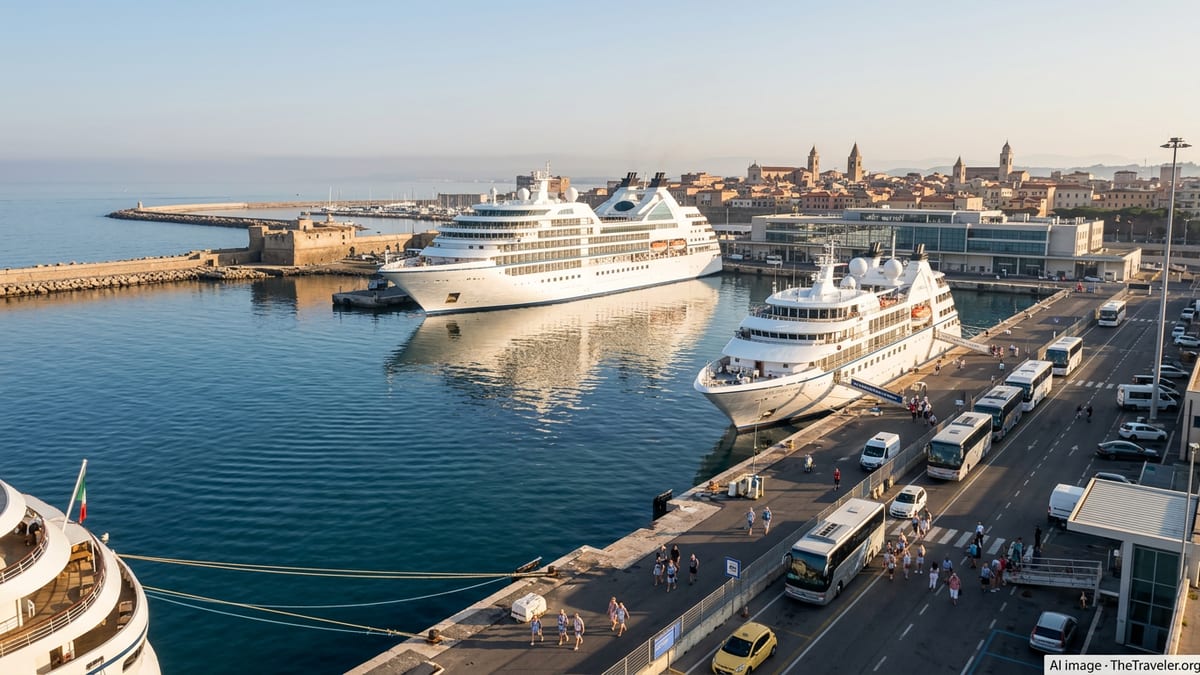
Last-Minute Itinerary Shift In The Eastern Mediterranean
According to cruise-tracking platforms and publicly available itinerary data, the Sun Princess was scheduled to call at a Greek island port on a Mediterranean sailing that combines Greece, Italy and Turkey. Instead, the ship altered course and sailed on toward its next stop in Italy after reports pointed to an unusually high concentration of vessels and limited berthing space at the Greek port.
Voyage summaries for the ship’s current Mediterranean program show a dense pattern of calls at marquee destinations such as Santorini, Mykonos and Crete, alongside Italian stops including Messina, Civitavecchia for Rome and ports in southern Italy. The affected call formed part of one of these Greek segments, but the ship ultimately followed an adjusted route that kept the overall cruise length and sequence of major countries visited intact.
The decision meant guests spent an additional sea day before reaching Italy, where the Sun Princess resumed its planned schedule. Passenger accounts shared on social platforms in recent days describe announcements about a port change tied to congestion and operational limitations ashore, rather than weather or technical issues at sea.
Operationally, the alteration fits a broader pattern in which cruise lines prioritize keeping ships on time for turnaround and key major-city calls, even if that means occasionally trimming or replacing more capacity-constrained island stops when conditions become challenging.
Crowding Pressures At Popular Greek Ports
The episode comes amid mounting concern over crowding at some of Greece’s most popular cruise destinations. Data collated from booking engines and cruise planning sites for the 2025 and 2026 seasons show multiple days when several large vessels are scheduled to anchor off islands such as Santorini and Mykonos, compressing thousands of passengers into small harbors and narrow lanes within hours.
Local authorities in Greece have been working on various measures to manage peak arrivals, including daily caps on ship calls at some islands and discussions about new fee structures. Publicly available policy documents and media coverage over the past year indicate that regulators are seeking to balance cruise tourism revenues with mounting pressure on infrastructure, transport and residential life.
On days when several ships converge on a compact island port, tender operations between ship and shore can become slow and complex, particularly if wind or swell picks up. Travel advisories and port reviews frequently note that delays in getting passengers back on board may ripple through an entire itinerary, especially when the next scheduled port lies across open water and requires tight timekeeping.
Against this backdrop, itinerary changes such as the one experienced by the Sun Princess underline the degree to which crowding on land can shape decisions at sea. Cruise lines are increasingly weighing the practicalities of disembarking thousands of passengers into already saturated destinations against the risk of schedule disruption further along a voyage.
Italy Benefits As Mediterranean Routes Flex
Italy’s extensive network of cruise ports provides cruise planners with added flexibility when conditions become difficult elsewhere in the region. Schedules for the Sun Princess in 2026 highlight frequent calls at Italian gateways such as Civitavecchia for Rome, Genoa for the Ligurian coast, Messina in Sicily and Naples for access to Capri and the Amalfi Coast.
When a Greek call is shortened or skipped, ships on multi-country Mediterranean routes can often make up time by proceeding directly to the next Italian port, sometimes arriving earlier than scheduled and offering guests a longer day ashore. Port calendars for major Italian cruise hubs show the capacity to absorb schedule adjustments, particularly outside of the highest-pressure days in July and August.
For coastal Italian cities, these unplanned shifts can translate into incremental tourism spending, even if only modestly. Visitors stepping off a ship that has just missed a previous stop may be more inclined to book last-minute tours, dine ashore or extend their time exploring before returning on board.
At the same time, port authorities in Italy have been monitoring their own growth in cruise calls. Industry reports note a steady rise in ship traffic at several Italian ports in the post-pandemic period, though most have larger harbor facilities and more established transport links than the smaller island destinations of the Aegean.
What The Change Means For Passengers
For passengers, a missed port can be disappointing, particularly when bucket-list islands or historic sites are involved. However, standard cruise contract terms emphasize that itineraries are not guaranteed and may be altered for operational, safety or external reasons. Travel forums and consumer guidance materials routinely advise travelers to treat port calls as planned rather than promised.
Guests on the Sun Princess sailing affected by the Greek port change reported receiving information on board about updated arrival times in Italy and guidance on how the line would handle prebooked excursions. In many documented cases across the industry, when a call is cancelled outright rather than swapped, cruise operators typically process automatic refunds for ship-run tours connected to the missed port.
Independent arrangements, such as private guides or third-party experiences, are more vulnerable in such situations. Travel advisers often recommend choosing flexible cancellation options when booking independently in ports known for congestion or weather-related disruptions, and they highlight the value of comprehensive travel insurance that can cover certain nonrefundable costs.
Some travelers say the extra sea time can also be a welcome pause on port-intensive itineraries. Large resort-style ships such as the Sun Princess are designed with multiple pools, dining venues and entertainment spaces, giving guests more opportunity to take advantage of facilities that are often underused on busy sightseeing days.
Growing Debate Over Mediterranean Cruise Capacity
The diversion of the Sun Princess away from an overcrowded Greek harbor feeds into a wider discussion about how much cruise traffic the Mediterranean can comfortably sustain at its most in-demand stops. Tourism researchers and urban planners in Europe have raised questions about the cumulative impact of simultaneous ship calls on heritage sites, small communities and coastal ecosystems.
Several Mediterranean destinations, including ports in Spain, France and Croatia, have already moved to limit certain types of cruise activity or cap the number of daily berths. Public consultations and policy papers indicate that Greek authorities are considering similar steps for some islands, seeking to smooth out visitor flows without undermining the economic benefits that cruise tourism brings.
Industry groups representing cruise lines argue in public statements that modern ships are becoming more efficient and that operators are willing to adapt itineraries, schedules and passenger management practices in response to local concerns. The Sun Princess cancellation of a crowded Greek call in favor of continuing to Italy offers a practical example of how those adjustments may look in real time.
As Mediterranean cruise volumes continue to recover and grow, observers expect more itineraries that combine marquee ports with lesser-known alternatives capable of absorbing demand. For travelers, that could mean a greater chance of last-minute route changes, but also more opportunities to discover under-the-radar Italian and Greek destinations that benefit from a share of the region’s cruising boom.