


More news on this day
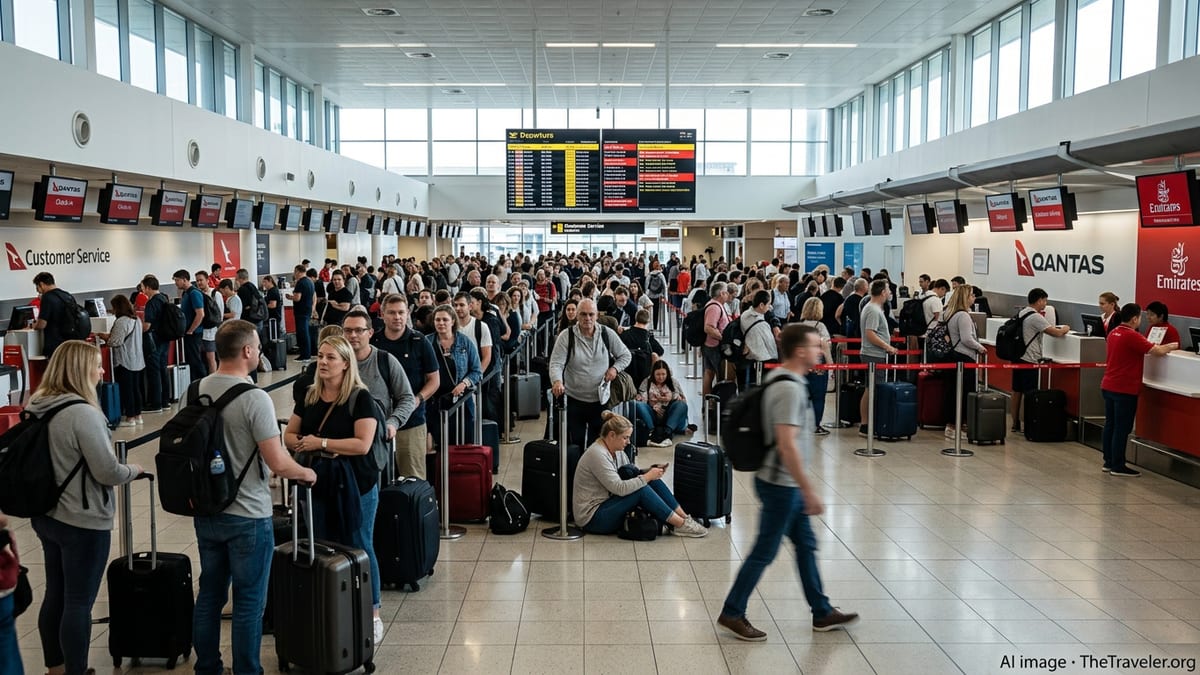
Prolonged flight delays and disruption at Sydney Airport in recent weeks are sharpening focus on Australia’s limited passenger protections, intensifying a policy debate over whether airlines should be required to pay automatic compensation when travel plans unravel.
Get the latest news straight to your inbox!
Congestion, Weather and Caps Keep Planes on the Ground
Recent disruption at Sydney Airport has been linked in public reporting to a familiar mix of factors, including low cloud, strong winds and air traffic control constraints that can sharply reduce the number of planes allowed to land and take off each hour. Sydney Airport’s published information on operations notes that Airservices Australia manages movements based on conditions and safety requirements, while a long standing hourly movement cap limits how quickly backlogs can be cleared once delays build.
Once a delay pattern sets in, the impact often cascades through the domestic and international networks. Flights arriving late into Sydney can miss their next scheduled departure slots, aircraft and crew end up out of position, and knock on effects are felt for hours or days on connecting services across Australia and overseas. Publicly available information from government reviews of airport regulation suggests that these structural constraints, combined with rising travel demand, have made the gateway particularly vulnerable to system wide disruption.
For passengers, the practical result is familiar: long queues, missed connections, unexpected overnight stays and mounting out of pocket costs for meals and accommodation. Social media posts and consumer advocacy coverage after recent delay events have highlighted frustration with limited information at the gate and difficulty securing timely rebooking, especially during peak holiday periods when spare seats are scarce.
Spotlight on Australia’s Light Touch Passenger Protections
Unlike regions such as the European Union and Canada, Australia does not have a dedicated national regime that guarantees cash compensation when flights are significantly delayed or cancelled for reasons within an airline’s control. Instead, passenger rights are primarily grounded in Australian Consumer Law and airline specific conditions of carriage, which focus on remedies such as refunds or alternative transport rather than set payments for inconvenience.
Guidance from Australian consumer agencies explains that travellers may be entitled to a remedy if a flight service fails to meet consumer guarantees, for example if a delay causes reasonably foreseeable extra costs. In practice, consumer advocates report that compensation is often negotiated case by case, and many travellers receive vouchers or goodwill credits rather than direct reimbursement for accommodation, meals or missed events.
Analysis by local consumer organisations has contrasted this approach with Europe’s EC261 framework, where travellers on eligible routes can receive fixed cash payments once delays cross defined thresholds. Coverage by Australian broadcasters and newspapers has also pointed to Canada’s Air Passenger Protection Regulations and recent rulemaking in the United States, which aim to clarify rebooking and refund obligations when flights are disrupted.
‘Pay on Delay’ Bill Puts Sydney at the Center of Reform Push
Debate over how far Australia should go in tightening airline obligations has intensified since the introduction of the Airline Passenger Protections (Pay on Delay) Bill 2024 to federal parliament. The private senator’s bill proposes mandatory compensation where an airline chooses to cancel or significantly delay a flight, denies boarding despite a valid booking, or loses or damages checked baggage.
Public submissions to a Senate inquiry on the bill show sharply divided views. Consumer advocates and some legal experts argue that predictable, cash based compensation would better align Australia with overseas standards and give airlines stronger incentives to minimise controllable delays. They note that passengers flying from cities such as London or Paris to Sydney may already qualify for compensation under European rules, while Australians on comparable domestic routes receive far less protection.
Airlines and some industry bodies caution that rigid compensation schemes could add substantial cost, particularly in a geographically large market with thin routes and weather sensitive operations. Several submissions argue that disruptions at Sydney Airport are often triggered by factors like severe weather or air traffic restrictions that would fall outside any compensation regime, while still creating significant financial liability and operational complexity for carriers.
Sydney Airport’s own contributions to policy reviews have highlighted structural issues such as slot misuse and the impact of the movement cap on recovery from disruptions. The operator has pointed to international examples but has also urged that any changes to consumer protections be carefully balanced against the need to maintain network resilience and investment in capacity.
International Models Offer Competing Lessons
The push for stronger passenger protections in Australia is unfolding against a backdrop of evolving rules overseas. In Europe, the long standing EC261 regulation entitles passengers on qualifying flights to assistance and, in many cases, fixed cash compensation when flights are cancelled or arrive more than three hours late, provided the disruption is not due to extraordinary circumstances such as severe weather or security events.
Canada’s Air Passenger Protection Regulations create a tiered framework where compensation for delay and cancellation varies according to the size of the airline and the length of the arrival delay. Public updates from the Canadian transportation authority indicate, however, that the system has generated a large backlog of consumer complaints and disputes, prompting discussion over enforcement capacity and industry burden.
In the United States, federal regulators have recently advanced new rules that will require airlines to provide automatic refunds when flights are cancelled or significantly changed, alongside a broader effort to clarify when carriers must offer rebooking and care such as meal vouchers and hotel stays. Commentaries in Australian media note that, even with these changes, the United States still does not mandate cash compensation for delays in the same way as Europe.
Policy analysts observing these models suggest there is no single blueprint. European style compensation provides clear upfront entitlements but can be complex to administer. North American approaches focus more on refunds, transparency and service guarantees. For lawmakers weighing changes that would apply to Sydney Airport and the wider Australian network, the challenge is to adapt lessons from these systems to local conditions and regulatory settings.
Travellers Caught in the Middle Weigh Insurance and Risk
While the policy debate continues, travellers transiting Sydney Airport are left to navigate disruption under the current patchwork of rights. Consumer advice published by government agencies encourages passengers to read fare conditions carefully, monitor airline communications and retain receipts for any accommodation, meals or alternative transport arranged as a result of delays.
Travel insurance providers typically offer cover for specified delay related expenses, subject to exclusions and waiting periods. Financial comparison services and insurance guides recommend that passengers check policy wording closely, particularly for domestic trips where travellers may assume, incorrectly, that airline obligations mirror those in overseas jurisdictions. Some reports indicate that claims can be declined where delays are attributed to weather or operational decisions deemed outside the airline’s direct control.
For now, repeated disruption episodes at Sydney Airport are serving as a high profile test case that keeps the issue of passenger protections in the headlines. Each wave of delays reinforces the practical stakes of what might otherwise appear to be an abstract regulatory discussion, and adds pressure on policymakers to decide whether Australia will remain a relatively light touch jurisdiction or move toward a more prescriptive model of airline accountability.