


Thailand and Portugal are two of the most discussed destinations for people seeking a lower cost base, warmer climates, and a change in lifestyle. This briefing compares them strictly on three decision-critical dimensions for potential relocators: cost of living, day-to-day lifestyle structures, and personal income tax treatment. The objective is to provide a concise, data-informed framework to assess which jurisdiction better aligns with an individual’s financial profile and preferred way of living.
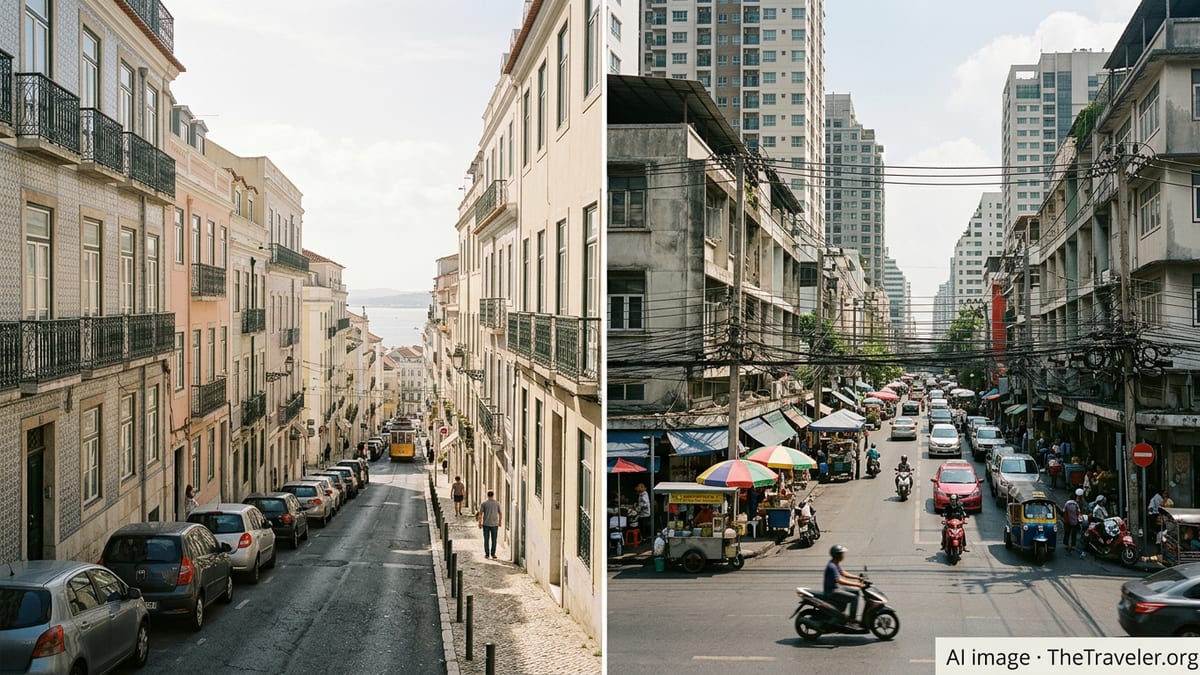
Overall Cost of Living Benchmarks
On aggregate, Thailand remains less expensive than Portugal, especially in terms of daily expenses and entry-level housing, though the gap is narrowing in prime Thai cities. For a modest but comfortable single expat lifestyle, recent budgeting examples indicate that many foreigners in Bangkok or Chiang Mai operate between the equivalent of 1,200 and 2,000 US dollars per month, including rent for a mid-range one-bedroom apartment. In Portugal, comparable urban living in Lisbon or Porto more typically ranges from approximately 1,800 to 2,800 euros per month for a similar standard, with lower costs available in interior regions.
Purchasing-power comparisons suggest that consumer prices in Portugal are generally higher than in Thailand for dining out, personal services, and many locally provided services, while imported goods and branded items can be similarly priced or higher in Thailand. In practice, households that rely heavily on local products and services will see a more pronounced savings differential in Thailand, while those with a consumption basket skewed to imported goods and European brands may see the difference narrow.
The cost-of-living trade-off can be summarized as follows: Thailand offers a lower monthly outlay for most spending profiles, especially for local-centric lifestyles, whereas Portugal offers somewhat higher costs but with Western European infrastructure, wage levels, and consumer protections that some long-term relocators may value.
Housing and Accommodation Costs
Housing is often the largest budget line and shows some of the clearest contrasts. In Portugal, national data from early 2026 indicate median advertised rents around 16 euros per square meter per month, with Lisbon closer to 21 to 22 euros and Porto around 17 euros per square meter. This implies that a typical 60 square meter one-bedroom apartment in Lisbon often falls in the 1,200 to 1,400 euro range, with higher figures in premium central districts, while similar properties in Porto are marginally cheaper. Outside the main metropolitan areas and along parts of the interior, rents can drop significantly, sometimes to half or less of Lisbon prime levels for similar floor areas.
In Thailand, recent market snapshots for Bangkok suggest that a one-bedroom apartment outside the central business districts can often be found in the 10,000 to 15,000 baht range per month, with more modern or centrally located units closer to 20,000 to 30,000 baht. Equivalent mid-range apartments in Chiang Mai and other secondary cities are often slightly cheaper, though rapid post-pandemic rent increases have narrowed the traditional gap between Bangkok and northern cities. Budget-conscious residents can still find basic local housing in both cities below these levels, but with substantial compromises on quality, space, and amenities.
For family-size housing, Portugal’s costs scale up sharply in major cities. A three-bedroom apartment in Lisbon or along popular coastal belts can easily require 2,000 to 3,500 euros per month, while inland cities may offer three-bedroom units from roughly 800 to 1,500 euros. In Thailand, three-bedroom condos in central Bangkok in modern buildings often fall in the 40,000 to 80,000 baht band, with more economical larger houses available in suburban areas or in secondary provinces at lower price points.
Everyday Expenses and Lifestyle Structure
Day-to-day expenditure patterns in Thailand differ noticeably from Portugal, driven mainly by food pricing, transport systems, and how people structure their daily lives. In Thailand, eating at local restaurants and markets is relatively inexpensive: a basic local meal can cost the equivalent of just a few US dollars, and many long-term residents build their budget on frequent, low-cost outside dining. However, imported groceries, wine, and Western-style specialty foods can be relatively expensive, so households replicating a Western supermarket basket may see less savings than expected.
In Portugal, grocery baskets for basic staples are typically higher in nominal terms than local Thai markets, but remain moderate by Western European standards. Eating out in Portugal tends to cost more per meal than in Thailand, yet regular but not extravagant restaurant usage still fits within moderate monthly budgets. The more European-style consumer environment, with structured retail chains and regulated product standards, is often perceived as more predictable, though not as low-cost as Thai street and market options.
Transport patterns also diverge. Thailand’s large cities, especially Bangkok, combine mass transit lines with extensive motorcycle taxi and ride-hailing networks, enabling low- to mid-budget urban mobility with limited car ownership. Fuel is relatively affordable, but congestion can impose time costs. In Portugal, reliable public transport networks in major cities and intercity trains allow many residents to avoid car ownership, though running a private vehicle typically involves higher upfront and operating costs than in Thailand. For relocators, this means Thailand can enable a car-free yet highly mobile lifestyle at lower cash outlay, whereas Portugal often rewards structured commuting and may involve higher fixed transport costs outside urban cores.
Utility costs are another distinguishing factor. Electricity in Thailand can become a significant budget item for air-conditioned apartments, particularly in hotter regions and for larger spaces. In Portugal, heating and insulation become more relevant, especially in older buildings without modern climate control. Aggregate monthly utilities for a modest apartment are often similar in absolute terms, but seasonal peaks differ: Thailand skewed to extended air-conditioning use, Portugal to winter heating or electric usage.
Cost Profiles by Lifestyle Segment
Thailand tends to favor lower-budget or flexible-income relocators who can adapt to a local-centric consumption pattern. Digital professionals or retirees who are comfortable in mid-range Thai condominiums, use public transport, and rely on local markets and mid-range eateries can often maintain a comfortable lifestyle at a relatively low cost base compared to both Western Europe and Portugal. However, pricing in central Bangkok, Chiang Mai, and some island locations has risen meaningfully, particularly for renovated or international-standard housing, which means that premium Thai urban lifestyles can approach or exceed mid-market costs in Portugal.
Portugal, on the other hand, often appeals to those seeking a European social and regulatory environment, even at a higher monthly cost. Couples or families settling in medium Portuguese cities or interior towns can often strike a balance between cost and quality, with total monthly outlays somewhat above the Thai equivalent for local-centric living but below many Western European capitals. For those insisting on coastal or Lisbon-centric lifestyles, the cost premium can become substantial, particularly when schooling, higher-end housing, and private healthcare or insurance are layered in.
For families, both countries can be affordable or expensive depending on preferred education, housing size, and location. International schools in Bangkok and other Thai cities can be a major budget driver, with fees that can rival or exceed those in Western Europe. In Portugal, international and private schools also carry significant fees, but public education is available without tuition, making it possible for cost-conscious families to moderate outlays if they are comfortable integrating into the local system.
Personal Income Tax: Thailand
Thailand operates a progressive personal income tax system, with marginal rates in the approximate band of 0 to 35 percent. As of the tax years beginning 2024 and 2025, the key brackets for residents typically start with a tax-free allowance up to around 150,000 baht of annual taxable income, gradually stepping through multiple bands before reaching the top marginal rate in the mid-single-digit millions of baht. This structure results in relatively light taxation on low incomes and a moderate effective rate for many middle-income residents.
A crucial recent development is the treatment of foreign-sourced income for Thai tax residents. From 1 January 2024, residents are generally subject to Thai tax on foreign-sourced income that is brought into Thailand, regardless of when the income was earned. This represents a shift from earlier practice where some foreign income remitted after the year it was earned could escape Thai taxation. For mobile professionals and retirees who rely on overseas income or investment returns, this change materially affects tax planning and may require more sophisticated structuring or professional advice to avoid double taxation.
In practice, many foreign residents in Thailand with locally sourced employment income face an effective tax rate in the low to mid-teens once standard allowances and deductions are considered, provided their incomes fall in the middle brackets. Those with high global incomes remitted into Thailand may see their effective rate approach the statutory top marginal rate, especially if they lack access to treaty relief or structured planning. The compliance environment is tightening, with increased emphasis on proper reporting of foreign income flows.
Personal Income Tax: Portugal
Portugal also applies a progressive personal income tax system, with more brackets and a higher top marginal rate than Thailand. For recent tax years, the marginal rates span roughly from the low teens at the bottom to above 45 percent at the top, with social contributions and local surcharges potentially increasing the total burden on higher incomes. The taxable base is worldwide income for residents, subject to reliefs under double tax treaties and specific incentive regimes.
Historically, Portugal’s non-habitual resident regime provided favorable tax treatment for certain foreign-sourced income and specific professions. In recent years, this framework has been revised, narrowed, or replaced with successor programs that are more targeted and less generous than earlier versions. As a result, new arrivals can no longer assume very low or zero tax on foreign pension or professional income without detailed review of current rules and their personal circumstances.
For typical employees or retirees without special regimes, effective tax rates in Portugal tend to be significantly higher than in Thailand at comparable income levels, especially once mandatory social security contributions are added. For high earners, the combination of upper-tier income tax rates and surcharges results in a meaningfully heavier fiscal load than in Thailand. Nevertheless, for moderate incomes and when balanced against social benefits and public services, many residents view the overall fiscal package as acceptable, though not low.
Comparative Tax Burden Scenarios
When comparing Thailand and Portugal strictly on personal income taxes, Thailand is generally the lower-tax jurisdiction for most income levels. A mid-career professional with a globally mobile income who becomes tax resident in Portugal should expect a higher combined marginal and effective tax rate than a similar professional resident and paying tax in Thailand, assuming comparable declared income levels and no unusually favorable special regimes in either country.
However, the recent tightening of Thailand’s rules on foreign-sourced income means that some of the previously perceived advantages for offshore earners have reduced. Individuals who rely heavily on foreign dividends, interest, capital gains, or business income and who need to remit funds into Thailand now face closer alignment between their global economic income and their Thai tax base. By contrast, Portugal’s long-standing practice of taxing worldwide income has been more consistent, albeit with evolving exemptions and special cases.
At lower income levels, both systems provide relief through tax-free bands and reduced rates, but Thailand’s combination of lower nominal brackets and lower top marginal rate generally leads to a lower overall tax bill. At high income levels, especially above the thresholds where Portugal’s top marginal rates apply, the divergence becomes more pronounced, with Portugal becoming clearly more expensive from a pure income tax perspective. Relocators with significant employment or professional income therefore need to weigh Portugal’s higher taxation against its European legal environment and social systems.
The Takeaway
Viewed through the combined lenses of cost of living, lifestyle structure, and personal income taxation, Thailand and Portugal offer distinct value propositions for potential relocators. Thailand typically delivers a materially lower cost base for local-centric living, especially in food, services, and mid-range accommodation, alongside a relatively moderate income tax system that, even after recent reforms to foreign income rules, remains lighter than that of Portugal for most profiles.
Portugal, while more expensive in housing and day-to-day costs, especially in Lisbon and coastal corridors, offers a European regulatory, social, and consumer environment that some relocators prioritize over minimization of monthly expenses or tax. Its personal income tax system is clearly more burdensome than Thailand’s at most income levels, but is coupled with more extensive formal social protections and integration into the broader European economic space.
Decision-makers should therefore anchor their choice on three core questions: the level and structure of their income, their tolerance for and interest in a very low-cost but more variable market environment (Thailand) versus a higher-cost but more regulated European context (Portugal), and the degree to which personal tax efficiency versus institutional environment matters in their long-term plans. For those with high mobile incomes or substantial foreign-sourced earnings, targeted tax advice in both jurisdictions is advisable before committing to either destination.
FAQ
Q1. Which country is cheaper overall for daily living, Thailand or Portugal?
Thailand is generally cheaper for daily living, especially for food, local services, and mid-range housing, though premium Thai urban areas can approach Portuguese costs.
Q2. How do typical monthly budgets compare for a single person?
Many single expats report living comfortably in Thai cities on the equivalent of 1,200 to 2,000 US dollars per month, while comparable lifestyles in Lisbon or Porto often require around 1,800 to 2,800 euros.
Q3. Is housing more affordable in Thailand or Portugal?
Thailand usually offers lower rents for similar-quality apartments, particularly outside the most expensive Bangkok districts, while prime areas of Lisbon and coastal Portugal are significantly more expensive.
Q4. How do personal income tax rates compare between the two countries?
Thailand’s progressive personal income tax tops out at around 35 percent, whereas Portugal’s top marginal rates exceed 45 percent, making Portugal generally higher tax for comparable incomes.
Q5. What changed in Thailand’s taxation of foreign income from 2024?
From 1 January 2024, Thai tax residents are generally taxed on foreign-sourced income that they remit into Thailand, tightening rules for those relying on offshore earnings.
Q6. Does Portugal still offer very low tax on foreign pensions and income?
Portugal has revised and narrowed its preferential regimes, so new arrivals should not assume very low tax on foreign pensions or professional income without checking up-to-date rules.
Q7. For high earners, which jurisdiction is more tax efficient?
For high employment or professional incomes, Thailand is usually more tax efficient due to lower top marginal rates and lower overall effective tax burdens.
Q8. How do everyday food and grocery costs compare?
Local food and street dining are noticeably cheaper in Thailand, while grocery and restaurant prices in Portugal are higher in nominal terms but still moderate by Western European standards.
Q9. Are utility and transport costs significantly different?
Both countries offer relatively affordable public transport in major cities; utilities can be comparable overall, with Thailand skewed to air-conditioning costs and Portugal to seasonal heating.
Q10. Which country is better purely from a cost and tax perspective?
Purely on cost and personal income tax, Thailand is typically more advantageous, but Portugal may appeal to those who prioritize a European environment over maximum financial efficiency.