


Thailand and Vietnam are two of Southeast Asia’s most established bases for digital nomads and location‑independent expats. Both offer competitive connectivity, dense cafe networks and growing coworking ecosystems, but the quality, consistency and maturity of work infrastructure differ in important ways. This briefing compares the two countries strictly from the perspective of digital work viability, focusing on internet performance, reliability, workspace availability and everyday working conditions.
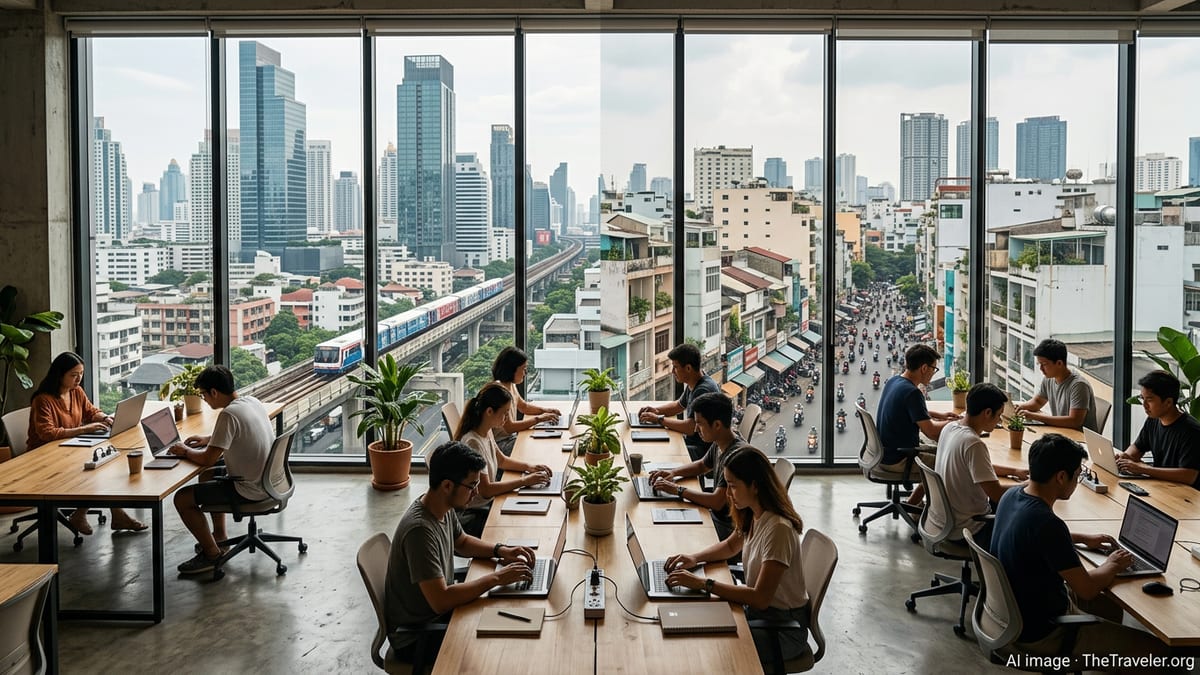
Overall Digital Work Environment: Strategic Comparison
For digital nomads and expats, Thailand and Vietnam both provide sufficient digital infrastructure in major cities for full‑time remote work. However, the maturity, depth and predictability of that infrastructure vary. Thailand has a longer history as a regional hub for foreigners working remotely, especially in Bangkok and Chiang Mai, which translates into a denser ecosystem of coworking spaces, laptop‑friendly cafes and service providers accustomed to international clients. Vietnam, while a later entrant, has rapidly modernised its telecom networks and now ranks among the global leaders in fixed and mobile internet performance, particularly in Ho Chi Minh City, Hanoi and Da Nang.
At a high level, Thailand offers a more established remote work culture with highly polished coworking products and internationalised services, whereas Vietnam increasingly outperforms on raw connectivity indicators and is catching up in workspace supply. The practical difference for professionals tends to be marginal in core urban centres, but becomes more pronounced when working from secondary cities, smaller towns or more residential neighbourhoods.
Both countries present a clear urban bias in infrastructure quality. Digital workers who intend to operate primarily from tier‑one cities will generally find both Thailand and Vietnam workable. Those who plan to explore smaller destinations while maintaining demanding workloads may find Thailand’s broader coverage and Thailand’s history of investment in fixed broadband slightly more forgiving, while Vietnam’s rapid recent upgrades create strong conditions in a smaller number of urban hubs.
The choice between the two therefore depends less on headline internet speed and more on reliability, backup options and the availability of professional environments that match specific work styles and collaboration needs.
Internet Speed and Network Performance
On headline performance indicators, both countries now sit well above the global average for fixed broadband and mobile data. Thailand has been recognised for high fixed broadband capacity, with median download speeds above 200 Mbps reported in recent global rankings, placing it among the top tier of countries for home and office connections. Vietnam has made especially rapid gains since 2024. Recent Speedtest Global Index data indicate that by 2025 Vietnam had entered roughly the global top 15 for mobile download speeds and top 15 for fixed broadband, with average mobile speeds above 130 Mbps and fixed broadband exceeding 150 Mbps in many urban areas.
In practice, digital nomads in Thai and Vietnamese major cities commonly report download speeds in the 50 to 200 Mbps range in coworking spaces and modern apartments, depending on provider and building infrastructure. In Vietnam, telecom operators have raised minimum advertised broadband speeds into the 150 to 300 Mbps range in some urban packages, reflecting a policy emphasis on high‑capacity fibre networks. In Thailand, competition among fixed‑line providers in Bangkok, Chiang Mai and other cities has led to widespread availability of fibre‑to‑the‑home services in multi‑unit buildings.
Latency and upload speeds are generally adequate for video calls and cloud‑based workflows in both markets. Professionals conducting frequent large file transfers or real‑time collaboration will notice that premium coworking facilities and serviced offices in both countries often offer better upstream bandwidth and traffic management than typical consumer home plans. For most remote employees and freelancers, either country’s top‑tier urban infrastructure is technically sufficient, with Vietnam increasingly competitive or superior on speed tests and Thailand offering extensive fixed fibre penetration.
Where differences emerge is at the margin: Vietnam’s fastest connections today are highly competitive by global standards, but performance can vary sharply between central districts and older neighbourhoods or smaller towns. Thailand offers slightly more uniform fixed‑line availability across a broader geography, although very rural areas in both countries still rely heavily on 4G or developing 5G networks with more variable performance.
Reliability, Redundancy and Outage Risk
Speed alone does not determine suitability for remote work. Reliability and the ability to maintain connectivity during disruptions are critical. Both Thailand and Vietnam experience occasional outages due to undersea cable incidents, infrastructure maintenance or weather‑related faults. These events typically cause slowdowns or intermittent connectivity rather than complete nationwide blackouts, but they can impact latency, especially for connections to Europe or North America.
Vietnam has historically been more exposed to disruptions from damage to major submarine cables serving the region. Periodic incidents have reduced international bandwidth or increased latency for several days or weeks. However, authorities and telecom operators have been adding alternative routes and redundancy, and recent reports highlight significant improvement in resilience compared with earlier years. Thailand also depends on similar undersea cable systems but has multiple landing points and diversified routes, which helps spread the risk.
At the local level, power stability is generally better in central districts of Bangkok, Chiang Mai, Ho Chi Minh City, Hanoi and Da Nang than in smaller cities or rural areas. Brief power cuts can still occur in both countries, particularly during storms. Most modern coworking spaces in both markets now advertise backup power and network redundancy, such as battery systems, generators and multiple ISP connections, to ensure continuity for business clients.
For risk‑sensitive professionals, practical redundancy strategies are comparable in both countries: maintaining mobile data on at least two different SIM cards, keeping offline work capabilities, and identifying at least one backup coworking facility or hotel with verified high‑speed internet. In everyday use, many digital workers in core Thai and Vietnamese cities experience uptime levels sufficient for full‑time remote employment, but Vietnam’s residual exposure to regional cable outages and more rapid infrastructure change may lead to a slightly more volatile experience than Thailand’s more mature network.
Coworking Ecosystem and Workspace Options
Thailand offers one of the most mature coworking ecosystems in Asia for foreign remote workers. Bangkok hosts a dense network of international and local coworking brands, including large multi‑site operators as well as niche spaces targeting specific sectors such as startups, creative industries and corporate satellite teams. Chiang Mai has long positioned itself as a digital nomad hub, with numerous coworking venues and cafes explicitly designed for laptop work, pooled meeting rooms and event spaces. Other Thai cities such as Phuket and Pattaya also offer multiple coworking and serviced office options, though on a smaller scale.
Vietnam’s coworking market is newer but rapidly expanding. Ho Chi Minh City and Hanoi now host a range of large regional coworking chains and domestic brands, some of which operate multiple locations across both cities. Da Nang has emerged as a mid‑sized hub with modern beachfront or city‑centre coworking spaces tailored to freelancers and remote workers. In Vietnam, many coworking providers still derive a substantial share of revenue from local companies and teams, but a growing number are explicitly marketing to international nomads with flexible day passes, English‑language community events and on‑site support.
In terms of ergonomics and professional amenities, high‑end coworking facilities in both Thailand and Vietnam now mirror global standards, with adjustable chairs, focus booths, meeting rooms equipped for hybrid calls and reliable climate control. Thailand has an advantage in the diversity and density of such spaces in city centres, making it easier to switch between venues or choose locations close to accommodation. Vietnam is more concentrated, with strong offerings in core districts but clearly fewer options once outside those zones.
For expats planning longer stays, serviced offices and corporate‑grade coworking solutions are abundant in Bangkok and increasingly common in Ho Chi Minh City and Hanoi. However, the choice set for medium‑sized remote teams tends to be broader in Thailand, while Vietnam currently suits either solo workers or larger companies that can commit to multi‑month leases in modern office towers.
Cafe Culture and Informal Workspaces
Both Thailand and Vietnam feature extensive cafe cultures that are highly relevant to digital nomads who prefer flexible, informal work settings. In Thailand, especially in Bangkok and Chiang Mai, many cafes intentionally cater to laptop workers with numerous power outlets, stable Wi‑Fi and spacious tables. Some venues implement minimum order policies or time limits during peak hours, but overall the environment is permissive of extended work sessions.
Vietnam’s major cities, particularly Ho Chi Minh City, Hanoi and Da Nang, also exhibit a dense concentration of cafes with reliable Wi‑Fi and strong coffee culture. Many provide fibre connections capable of supporting video calls, though acoustics can vary, and some locations become noisy during peak times. Compared with Thailand, fewer Vietnamese cafes explicitly brand themselves as remote work spaces, but in practice many nomads report being able to work for multiple hours with a modest spend as long as they remain considerate of customers and staff.
From a productivity standpoint, Thailand offers a slightly more structured ecosystem of cafe‑style work venues, including hybrid cafe‑coworking models that charge by the hour or day while still feeling informal. Vietnam’s cafe environment is extremely conducive to solo work and asynchronous tasks, but professionals who depend on high‑stakes calls may prefer to use coworking facilities or private offices during critical meetings to avoid background noise or unpredictable seating availability.
In both countries, nomads should assume that not every cafe will be suitable for extended work. A trial‑and‑error approach, supported by local recommendations and workspace review platforms, remains advisable. Over time, digital workers in either destination can typically assemble a personal circuit of reliable venues combining cafes, coworking spaces and home connections.
Urban vs Secondary City Conditions
The viability of Thailand and Vietnam for digital nomads and expats changes significantly outside the main metropolitan areas. In Thailand, fixed broadband penetration and 4G/5G coverage have expanded into many provincial cities and popular secondary destinations. While speeds may not match Bangkok’s peak performance, a substantial proportion of mid‑sized cities provide fibre‑based home connections and at least one coworking or shared office venue. This makes it realistic for remote workers to base themselves in quieter locations while maintaining regular online work, albeit with slightly greater variability.
Vietnam shows a more pronounced concentration of high‑quality digital infrastructure in Ho Chi Minh City, Hanoi and Da Nang. Other coastal or highland destinations may offer decent hotel Wi‑Fi and some fibre connections, but the availability of dedicated coworking spaces remains patchy. In smaller Vietnamese cities, many digital workers rely on a combination of mobile hotspots and cafes rather than purpose‑built workspaces. This can be sufficient for light workloads but may be risky for professionals with strict uptime requirements.
Road and transport infrastructure can indirectly affect remote work viability. In Thailand, the ability to commute relatively quickly across a metropolitan area to reach a reliable coworking hub mitigates the risk of local outages or poor connectivity at home. In Vietnam, traffic conditions in Ho Chi Minh City and Hanoi can make cross‑town travel time‑consuming during peak hours, so proximity between accommodation and primary workspace is more critical for daily productivity.
Overall, digital nomads prioritising flexible exploration of secondary cities and smaller towns while working full‑time may find Thailand somewhat more forgiving due to wider fixed‑line coverage and more established coworking options beyond the capital. Those content to remain within a limited number of Vietnamese hubs can benefit from very high‑performance connections in those specific locations but should plan moves carefully to avoid connectivity gaps.
Professional Suitability by Work Profile
The relative strengths of Thailand and Vietnam align differently with specific digital work profiles. High‑bandwidth technical roles, such as software development teams dealing with large repositories or creative professionals handling substantial media files, can operate effectively in both countries’ major cities. Vietnam’s fast‑improving fixed and mobile networks are particularly attractive for these workloads when combined with modern coworking infrastructure in central districts. Thailand’s advantage lies in the predictability of connections and the broader selection of enterprise‑oriented facilities catering to international firms.
Client‑facing professionals who depend on frequent, high‑quality video calls and a polished business environment may prioritise Bangkok or centrally located coworking spaces in Ho Chi Minh City and Hanoi. Thailand’s established remote work ecosystem, multilingual support staff and abundance of meeting rooms create fewer frictions when hosting clients, including regional visitors. Vietnam can offer equally high‑quality setups in top‑tier spaces, but options are more geographically concentrated and often require pre‑planning.
Freelancers and solo consultants who prefer a mix of home, cafe and occasional coworking are well served in both countries. Thailand offers greater choice and ease of finding new venues on short notice, while Vietnam’s rapid telecom improvements translate into excellent speeds wherever modern fibre has been installed. For these workers, the main operational difference lies in the need for slightly more redundancy planning in Vietnam, particularly around potential undersea cable disruptions and neighbourhood‑level variability.
Remote teams choosing a base for multi‑month operations should assess not only the technical infrastructure but also the availability of scalable office solutions. Thailand currently has an edge in that respect, with mature serviced office providers and global coworking brands offering ready‑to‑use space for teams of varying sizes, especially in Bangkok. Vietnam is progressing quickly, and large city‑centre developments increasingly integrate coworking and flexible office floors, but the ecosystem is less saturated.
The Takeaway
From a strictly digital‑work perspective, both Thailand and Vietnam now qualify as viable long‑term bases for digital nomads and expats, provided remote workers anchor themselves in major urban centres. Vietnam has closed much of the historical gap in connectivity and now often outperforms on measured mobile and fixed broadband speeds, making it highly attractive for bandwidth‑intensive professionals within cities such as Ho Chi Minh City, Hanoi and Da Nang.
Thailand remains stronger in ecosystem maturity, with more extensive coworking networks, a broader spread of fixed fibre into secondary cities and a service environment long accustomed to foreign remote workers. This can translate into smoother day‑to‑day operations, easier access to backup workspaces and more predictable infrastructure performance outside the densest urban cores.
Decision‑grade evaluation should therefore focus less on country‑level rankings and more on specific city‑level conditions, building‑level connectivity and redundancy plans. For nomads valuing maximum choice of work venues and the flexibility to move between multiple cities without significant connectivity research, Thailand currently offers a modest advantage. For those content to remain in a handful of rapidly modernising Vietnamese hubs and who value very high headline speeds, Vietnam has become a compelling alternative.
In practice, many digital professionals treat the two destinations as complementary, using Thailand as a flexible, infrastructure‑rich base and Vietnam as a high‑performance hub for focused work periods. A careful assessment of individual work patterns, tolerance for occasional disruption and preference for urban scale will determine which country offers the more practical long‑term solution.
FAQ
Q1. Is Thailand or Vietnam better for stable, high‑speed internet for remote work?
Both countries provide stable, high‑speed internet in major cities. Thailand offers more uniformly available fixed fibre across a wider area, while Vietnam now often records higher average speeds in its main hubs. For most remote workers, either country’s top‑tier urban districts are adequate for full‑time online work.
Q2. Which country has more coworking spaces suitable for digital nomads?
Thailand currently has a denser coworking ecosystem, especially in Bangkok and Chiang Mai, with many spaces designed specifically for international remote workers. Vietnam is expanding quickly but its coworking supply remains more concentrated in Ho Chi Minh City, Hanoi and Da Nang.
Q3. Are internet outages a serious concern in Thailand or Vietnam?
Occasional outages occur in both countries, often linked to regional submarine cable issues or local infrastructure works. Vietnam has historically seen more pronounced slowdowns from cable damage, although redundancy has improved. In both destinations, maintaining mobile data backups and access to at least one reliable coworking space reduces operational risk.
Q4. Can video calls and online meetings be conducted reliably from cafes?
In both Thailand and Vietnam, many cafes in major cities offer sufficient bandwidth for video calls, but noise and crowding can affect call quality. For important meetings, professionals usually prefer private rooms in coworking spaces or serviced offices, where acoustic conditions and upload speeds are more controlled.
Q5. How do secondary cities compare for digital nomad work in Thailand vs Vietnam?
Thailand generally offers better conditions in secondary cities, with more widespread fibre connections and an increasing number of coworking venues beyond the capital. In Vietnam, consistent high‑quality infrastructure is more tightly concentrated in a few hubs, so working from smaller cities often requires greater reliance on mobile data and cafes.
Q6. Are 5G networks relevant yet for digital nomads in these countries?
Both Thailand and Vietnam have rolled out 5G in major urban areas, and coverage is expanding. For most typical remote work activities, 4G and fixed broadband already provide sufficient performance. 5G can be useful as a high‑capacity backup connection or for professionals with particularly demanding data needs.
Q7. Do coworking spaces in Thailand and Vietnam offer business‑grade facilities?
Yes. In both countries, higher‑end coworking centres offer business‑grade features such as meeting rooms with video conferencing equipment, dedicated desks, private offices and reception services. Thailand currently has a larger number of such facilities, while Vietnam’s premium spaces are concentrated in central business districts.
Q8. Is it realistic to rely only on mobile data for remote work in either country?
In core urban areas, mobile networks in both Thailand and Vietnam are fast enough to support typical remote work tasks, including video calls. However, long‑term reliance solely on mobile data is less predictable than using fixed broadband supplemented by mobile hotspots, especially during peak usage periods or regional network incidents.
Q9. How important is location within a city for digital nomads in these countries?
Location is important in both destinations. In Thailand, proximity to transit and coworking clusters improves access to alternative workspaces. In Vietnam, being in central districts of Ho Chi Minh City, Hanoi or Da Nang significantly increases the likelihood of high‑quality fibre connections and short travel times to modern coworking facilities.
Q10. For a long‑term expat remote worker, which country offers a more predictable digital work environment?
Thailand currently offers a slightly more predictable environment due to its longer experience with foreign remote workers, broader coworking network and widely deployed fixed broadband. Vietnam has made major strides and can offer excellent performance in specific hubs, but conditions outside those zones remain more variable, so careful city and neighbourhood selection is essential.