


The first time I landed in Mexico City, it was because of a photograph. A hazy shot of jacaranda trees in bloom over a pastel street in Roma Norte slid across my social feed one March afternoon, promising cheap rent, perfect cappuccinos, and a life lived largely outdoors. It looked like a city designed for remote workers and casual city-breakers, the kind of place where you could float in for a week, snack on tacos al pastor, answer a few emails from a leafy café, and leave feeling like you had “done” CDMX. Within 24 hours of arriving, I realized how wrong that image was. The city was gorgeous. It just was not built for the kind of traveler the internet has been relentlessly selling it to.
The City Instagram Sells You
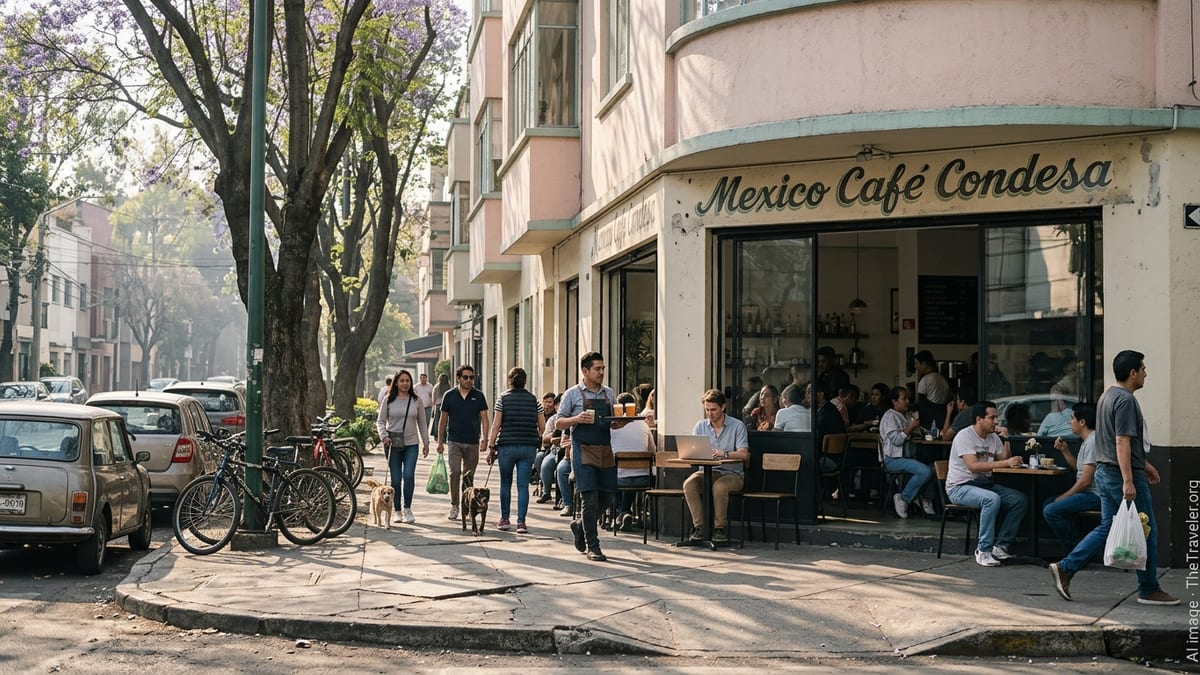
Mexico City has become one of the most photographed urban backdrops in the world. In spring, jacaranda blossoms turn avenues like Avenida Álvaro Obregón into lilac tunnels, and every second photo seems to feature a mid-century apartment balcony in Condesa framed by bougainvillea. Travel magazines and lifestyle influencers have helped craft a very specific fantasy: CDMX as an easy, affordable, design-forward playground for digital nomads and long-weekend city trippers.
The pitch is consistent. You have Roma Norte and Condesa, spoken of as “village-like” neighborhoods with European-style sidewalks, specialty coffee on every corner, and co-working spaces tucked above mezcalerías. Guides aimed at remote workers highlight fast internet, chic Airbnbs, and an endless rotation of natural wine bars. One recent digital nomad guide described Roma Norte as “ground zero” for remote workers, a neighborhood where laptop-friendly cafés and third-wave roasters are as common as corner tortillerías.
It is not that this picture is entirely false. On a typical Tuesday you really can watch groups of remote workers spill out of a café on Calle Orizaba, discussing fintech start-ups in accents from three continents. But that version of the city is a curated slice, a surface-level experience that tells you more about the kind of visitor it attracts than about Mexico City itself. It is this mismatch that makes CDMX both dazzling and, for some, deeply disorienting.
I arrived with that curated image in my head. I booked a small studio near Parque México at a nightly rate that felt reasonable compared to New York. My plan was simple: mornings in cafés, afternoons exploring museums, evenings in taquerías. By the end of my first day, the gap between the marketing and the reality had started to show.
When Paradise Starts Pushing Back
The first sign that Mexico City might not want to be anyone’s casual backdrop came in the form of a handwritten note stuck to a lamppost in Roma Sur. In Spanish, it read: “This is a neighborhood, not a set. Respect our homes.” Next to it, a stencil sprayed on a wall said simply: “Gringo, go home.” The words were jarring after a morning of filtered espresso and English-language menus, but they were not isolated. In the last few years, locals have been voicing growing frustration with gentrification and overtourism in central neighborhoods, mirroring protests seen in Lisbon, Barcelona, and other digital nomad hubs.
Rents in areas like Condesa and Roma have risen sharply compared with pre-pandemic years, and short-term rentals have multiplied. Urban policy researchers have warned that the expansion of short-term rentals and the influx of higher-earning foreigners are reshaping the housing market faster than regulations can keep up, even if the exact scale of the impact is still being debated. On weekend marches through the historic center in 2025, protest banners against gentrification and Airbnb-style rentals echoed similar anger heard in cities from Venice to the Cinque Terre: locals feeling priced out of their own streets.
Even small, everyday interactions reflect the tension. In early 2026, local media and travel outlets reported cafés in both Lisbon and Mexico City quietly limiting laptop use or asking remote workers not to camp out for hours on a single drink. Café owners explained that a table held by one nomad with a flat white for half a day meant turning away several local customers who might come to chat, eat, and actually use the space as a social hub. In Condesa, I watched a barista gently ask a group of foreigners to wrap up their video call because the café was “para convivir,” a space for being together rather than a de facto shared office.
For the traveler expecting a frictionless urban playground, this pushback can feel like a rude awakening. But it is also a clue: this destination is far better suited to travelers interested in understanding their impact and learning how to travel more thoughtfully than to those looking for the next cheap, easy lifestyle prop.
The Reality Behind the Pretty Facades
Beyond the tensions around gentrification, Mexico City itself is inherently more complex than the carefree imagery suggests. It sits at more than 2,200 meters above sea level, and for the first few days my heart rate climbed on even modest walks. I watched another visitor step out of a rideshare in Roma, comment on how “cool and dry” the air felt compared with Houston, and then admit that they had slept terribly and felt oddly breathless. Altitude is not extreme here, but it is real, and it compounds other urban stresses like pollution and traffic.
Air quality, for instance, can swing from crisp post-rain clarity to a brownish haze in a matter of hours. On some winter mornings, the mountains that frame the city vanish behind smog. Even when levels are within what local authorities consider acceptable, sensitive travelers may notice headaches or fatigue. Long-term residents learn to read the sky, plan runs in nearby Chapultepec Park early, and keep windows closed on bad days. Visitors who come strictly for an Instagram-perfect city break often do not expect to think about particulate matter.
The sheer physical scale of the city also trips up first-timers. Greater Mexico City is one of the largest metropolitan areas in the world, and a cab ride that looks “close” on a map can turn into an hour-long crawl at rush hour. A friend who flew in for a three-day weekend insisted on staying in the Centro Histórico because it was “the real city,” then spent most of his time sitting in traffic to reach eateries and galleries he had bookmarked in Condesa and San Miguel Chapultepec. By departure day, he told me he felt like he had barely scratched the surface and had spent his budget mostly on transportation.
Then there is the matter of language and safety expectations. Although English is increasingly common in tourist-facing businesses, much of daily life still unfolds in Spanish. Outside the well-trodden neighborhoods, menus are untranslated, ride-share drivers may speak little English, and you navigate more by context than by signage. Meanwhile, responsible travel in CDMX means taking basic precautions: using registered taxis or ride-hailing apps, being cautious with phones at night, and understanding which areas locals advise you to avoid. None of this makes the city unsafe to visit; it makes it a serious, functioning capital that asks you to show up as an engaged adult, not as a customer in an all-inclusive resort.
The Traveler This City Is Not For
Some destinations are forgiving. They are designed to absorb spur-of-the-moment weekenders and distracted digital nomads with minimal friction. Mexico City is not one of them. The traveler who comes here mainly to replicate their life in Brooklyn or Berlin, just with cheaper rent and better weather, will likely leave disappointed and, increasingly, unwelcome.
If you expect to float through a city of nearly 22 million residents without brushing up against local realities, this may not be your destination. Travelers who see themselves primarily as consumers of place, chasing the latest “hot” neighborhood compiled by influencers, can unintentionally amplify the very problems locals are protesting: rising rents, hollowed-out communities, and the quiet replacement of long-term tenants with transient visitors.
I met one such visitor in a co-working space in Juárez. He had a month-long rental in Condesa, was paying a rent that would be eye-watering for most local families, and complained loudly that the area was “already over” because too many English speakers had arrived. He had no idea that protests had taken place a short metro ride away over exactly the changes that allowed his lifestyle. For travelers unwilling to engage with that contradiction or to adapt their habits, this city will always feel like a beautiful but slightly hostile backdrop.
Mexico City is also not ideal for travelers who want everything prepackaged. Sidewalks can be uneven, weather can shift quickly during the rainy season, and last-minute changes are common. The metro is efficient but crowded, and the city’s best surprises often hide behind unmarked doors. If your idea of a good time is a predictable, resort-style experience where you never have to think about where your money goes or who lives next door, CDMX’s beauty will feel like hard work.
The Traveler This City Rewards
Yet for another kind of traveler, the same qualities that make Mexico City challenging are precisely what make it extraordinary. This is a city that rewards curiosity, slowness, and a willingness to decenter yourself. If you can arrive without the expectation that the city exists to serve your remote job or your social feed, you will find a depth that no influencer reel can capture.
Start with time. Instead of a three-day blitz through the “must-sees,” stay a week or more and pick a base outside the most discussed enclaves. Neighborhoods like Santa María la Ribera, Escandón, or Portales offer handsome architecture, thriving markets, and a more mixed demographic of residents and visitors. They also tend to have more locally owned guesthouses and smaller hotels, which spread tourism income beyond the short-term rental market.
Then, adjust how you spend. Rather than booking an entire stay in an international-chain hotel or a highly optimized Airbnb, consider a family-run hotel or a simple guesthouse. Eat breakfast at the same corner fonda a few mornings in a row and let the staff get to know you. Join a locally led walking tour of the Centro Histórico that frames the architecture within Mexico’s layered political history, instead of a content-creator tour focused primarily on photo spots. Choose a cooking class taught in a home kitchen, where the conversation meanders from salsas to school systems.
Most importantly, pay attention to how people use public space. In plazas, you will see teenagers practicing dance routines, vendors wheeling carts piled with tamales, older couples sharing benches, and families letting children run across fountains. Step back from treating those scenes as mere backdrops. When you move through the city as a guest in a shared home instead of an owner of fleeting moments, you begin to understand why locals are fighting to keep Mexico City livable first and beautiful second.
Traveling Lightly in Places Under Pressure
Mexico City is not unique in this tension. Around the world, destinations that photograph beautifully for social media are rethinking what kind of visitors they can sustainably accommodate. In Italy’s Cinque Terre, for example, local authorities have experimented with crowd-control measures on the most famous coastal paths and even limited kayaks in tiny bays to keep marinas from clogging with day-trippers. In Lisbon and Barcelona, anti-gentrification slogans cover walls in once-quiet neighborhoods turned into short-term rental corridors.
What ties these stories together is not anti-tourist sentiment so much as exhaustion with a certain style of tourism: fast, extractive, and primarily visual. Cities and villages alike are learning the cost of being treated as infinite backdrops. Travelers who arrive expecting a place to look like their feeds often seem surprised that it also needs to function as a home for people who will still be there when the high season ends.
For individual travelers, the question becomes: how do you still visit beautiful, globally known places without adding to the pressure? The answer is rarely about never visiting at all. It is about changing what you demand from a destination. Choosing longer stays over quick hits, favoring locally owned accommodation, travelling outside peak months, and resisting the urge to cluster in the same three hyper-marketed neighborhoods are all small but real adjustments.
In practice, that might mean basing yourself in a less-hyped district of Mexico City and learning to love a neighborhood market instead of flying in for a weekend in Condesa. It might look like trading a tightly scheduled checklist for one museum, one park, and an unhurried afternoon in a café that does not advertise on remote-work forums. These are modest shifts, but they align your experience more closely with the realities of the places you are visiting.
The Takeaway
When I think back to that first photograph of Mexico City, what strikes me is not that it was inaccurate but that it was incomplete. The jacarandas really do bloom, the light really does pool like honey in late afternoon across Parque México, and the coffee in Roma Norte might genuinely ruin you for your local chain back home. The city is as gorgeous as advertised. It is just not simple, and it is not a lifestyle accessory.
This is not a destination for travelers who want to parachute in, extract a sequence of beautiful moments, and leave before the bill comes due. It is for people willing to sit with discomfort, to recognize themselves as part of broader patterns like gentrification and overtourism, and to adjust their behavior accordingly. It is for those who understand that loving a place means wanting it to remain livable for the people who built it.
In the end, Mexico City quietly demands that you choose what kind of traveler you want to be. If you are prepared to show up with curiosity instead of entitlement, patience instead of urgency, and a sense of responsibility rather than pure consumption, the city opens itself in layers. If not, its beauty may still dazzle you for a weekend, but it will never really let you in.
FAQ
Q1. Is Mexico City safe for first-time visitors?
Mexico City can be safe for first-time visitors who take common-sense precautions, such as using registered taxis or ride-hailing apps, avoiding flashing valuables, and asking locals or hotel staff which areas to avoid at night.
Q2. Which neighborhoods should thoughtful travelers consider staying in?
Beyond Roma and Condesa, consider neighborhoods like Santa María la Ribera, Escandón, or Portales, which offer local markets, pleasant streets, and fewer short-term rentals dominating the housing stock.
Q3. How long should I stay in Mexico City to experience it well?
A week is a good minimum for a first visit, giving you time to adjust to the altitude, explore several neighborhoods, and see major museums without rushing through the city.
Q4. Is Mexico City still affordable for travelers?
Mexico City can feel affordable compared with many North American and European capitals, but central rents and some restaurants in trendy areas have become significantly more expensive in recent years.
Q5. How can I avoid contributing to gentrification when I visit?
Choose locally owned hotels or guesthouses over entire-home short-term rentals, spend money at neighborhood businesses, travel outside peak seasons, and remember that you are a guest in someone’s home city.
Q6. Do I need to speak Spanish to enjoy Mexico City?
It is possible to get by with limited Spanish in tourist areas, but learning basic phrases and using them respectfully will make everyday interactions smoother and show respect for local residents.
Q7. What should I know about air quality and altitude in Mexico City?
Mexico City sits at over 2,000 meters, which can cause mild altitude effects, and air quality varies by day, so travelers with respiratory or heart conditions should plan and pack accordingly.
Q8. Are digital nomads still welcome in Mexico City?
Digital nomads are not unwelcome as a group, but there is growing frustration when visitors treat residential neighborhoods as cheap offices and disregard their impact on housing and community life.
Q9. What is a more respectful way to work remotely from the city?
Limit long laptop sessions in busy cafés, join coworking spaces that expect remote workers, support local services, and engage with the city beyond the expat bubble instead of using it only as a backdrop.
Q10. When is the best time of year to visit Mexico City?
Generally, the months from late October to early May offer pleasant temperatures, with spring jacaranda blooms adding beauty, but checking current weather patterns before booking is always wise.