

More news on this day
Thousands of air passengers were stranded at airports across Europe today as a wave of cancellations and delays hit key hubs in England, France, Germany, the Netherlands and Switzerland, disrupting operations for British Airways, Emirates, Air France, KLM, Swiss and other major carriers.
Major Hubs Across Europe Grind to a Halt
Real-time data from flight-tracking and passenger-rights platforms showed a sharp spike in disruption on 4 March, with more than 200 flights cancelled and over 800 delayed across European airspace. Airports in London, Paris, Munich, Amsterdam and Zurich were among the hardest hit, creating bottlenecks that rippled throughout airline networks.
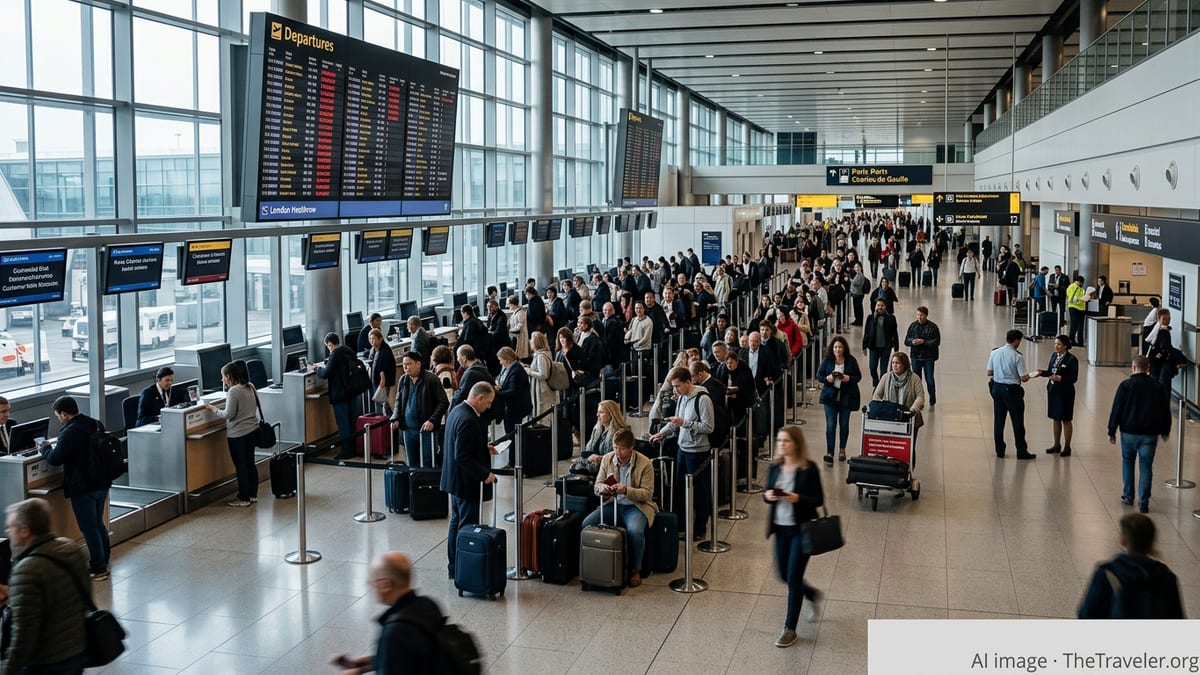
At London Heathrow and Gatwick, dozens of arrivals and departures were scrubbed from departure boards or pushed back by several hours. Similar scenes played out at Paris Charles de Gaulle and Orly, Amsterdam Schiphol, Munich and Zurich, where departure halls filled with queues at airline service desks as stranded travellers sought new routings, hotel vouchers and meal assistance.
The disruption affected a mix of short-haul and long-haul services, with knock-on effects for connecting traffic to the Middle East, Asia and North America. Missed connections compounded the chaos, as passengers arriving late into European hubs found onward legs already departed or cancelled, forcing unexpected overnight stays.
While the scale of today’s disruption fell short of pandemic-era shutdowns or historic weather events, aviation analysts described it as one of the most significant single-day hits to Europe’s flight schedule so far in 2026.
Flag Carriers and Global Giants Caught in the Turbulence
Among the worst affected today were Europe’s flag carriers and their international partners. British Airways saw a cluster of cancellations and substantial delays on departures from London to key European cities as well as to long-haul destinations, particularly those with routings intersecting disrupted air corridors. Its low-cost arm BA Euroflyer also reported multiple cancellations on intra-European services.
Air France and KLM recorded scores of delayed flights and a number of cancellations at their Paris and Amsterdam hubs, disrupting carefully timed banks of connections feeding traffic across Europe, Africa and the Americas. At Zurich, Swiss and regional partner Helvetic Airways trimmed schedules and absorbed delays as congestion and aircraft re-positioning issues reverberated through their networks.
Emirates, which relies heavily on European feeder traffic into its Dubai megahub, faced additional strain as its European departures contended with delayed inbound aircraft and crew. With many long-haul services already operating on extended routings to avoid conflict-affected airspace, even modest slippages in departure times translated into hours of extra journey time for passengers.
Low-cost operators were not spared. Carriers such as easyJet, Ryanair and Wizz Air reported scattered cancellations and extensive delays across bases in the UK and continental Europe, illustrating how even point-to-point networks are vulnerable when airport and air traffic systems come under stress.
Middle East Conflict and Network Knock-On Effects
Today’s European chaos cannot be viewed in isolation. It comes on the heels of widespread airspace closures across the Middle East following late-February strikes on Iran, which forced thousands of flights worldwide to be cancelled, rerouted or suspended. Key hubs including Dubai, Abu Dhabi and Doha drastically curtailed operations, sending shockwaves through global aviation.
Although limited services have since resumed and many long-haul routes between Europe, India and North America are now operating again, airlines continue to fly around large swathes of restricted or high-risk airspace. Detours over the Red Sea and Mediterranean add significant flight time, fuel burn and scheduling complexity, leaving carriers with slimmer margins for error when disruptions occur at European hubs.
Aircraft and crews remain out of position after days of rolling cancellations and ad-hoc diversions, which aviation experts say is a major factor behind today’s European disruption figures. A single delayed inbound widebody can cascade into multiple late departures, missed connections and, ultimately, cancelled rotations as duty-time limits for crews are reached.
Travel industry observers warn that as long as airspace restrictions in the Middle East remain in flux, European travellers should brace for intermittent days of heightened cancellations and delays, even when local weather and airport conditions appear normal.
Passengers Face Long Queues, Uncertain Rights
Across the continent, frustrated passengers reported long queues at check-in counters and transfer desks, crowded seating areas and scarce information about when or how they would reach their destinations. Families returning from school holidays, business travellers racing to meetings and tourists on tight itineraries all faced difficult choices about whether to wait for rebooked flights or abandon trips altogether.
Under European passenger-protection rules, travellers whose flights are cancelled or heavily delayed may be entitled to assistance, refunds or compensation, depending on the cause and length of disruption and the distance of their flight. In practice, however, asserting those rights often requires persistence, documentation and time, particularly when airlines attribute disruption to circumstances beyond their control.
Consumer advocates urged affected passengers to keep all receipts for food, accommodation and alternative transport, to obtain written confirmation of delays or cancellations where possible, and to use official airline or airport channels rather than third-party intermediaries making unsolicited offers. They also cautioned that processing times for refunds and claims are likely to lengthen if high levels of disruption persist.
With hotel demand rising near major airports such as London Heathrow, Paris Charles de Gaulle and Zurich, some travellers struggled to secure last-minute rooms at reasonable prices, prompting local tourism bodies and transport operators to coordinate additional support and information services.
Airlines Scramble to Restore Schedules
By late evening, carriers and airport operators across Europe were working to clear backlogs and realign aircraft and crews in the hope of stabilising operations over the next 24 to 48 hours. Extra staff were deployed at major hubs to help with rebooking, while social media channels and apps pushed out real-time updates on gate changes and schedule revisions.
Operational planners face a delicate balancing act: adding recovery flights to move stranded passengers risks overloading already stretched air traffic systems, while trimming schedules to restore reliability leaves fewer options for re-accommodating disrupted travellers. Some airlines signalled they would proactively thin out timetables in the coming days to create more breathing space in their networks.
Industry analysts noted that today’s events highlight the fragility of a system that operates close to capacity, especially during busy travel periods. With Europe’s major hubs acting as critical junctions between North America, Asia, Africa and the Middle East, any shock in one region can quickly propagate across continents.
For now, travel experts advise passengers due to fly in the coming days to monitor flight status closely, allow extra time for connections, and consider flexible booking options where available. While airlines insist that normal operations will gradually resume, the experience of thousands of stranded travellers today underlines that European air travel remains vulnerable to sudden, large-scale disruption.