


More news on this day
Passengers flying from Manchester Airport faced a fresh round of disruption today, with publicly available flight-tracking data showing three departures cancelled and more than 30 services delayed across the busy UK hub.
Get the latest news straight to your inbox!
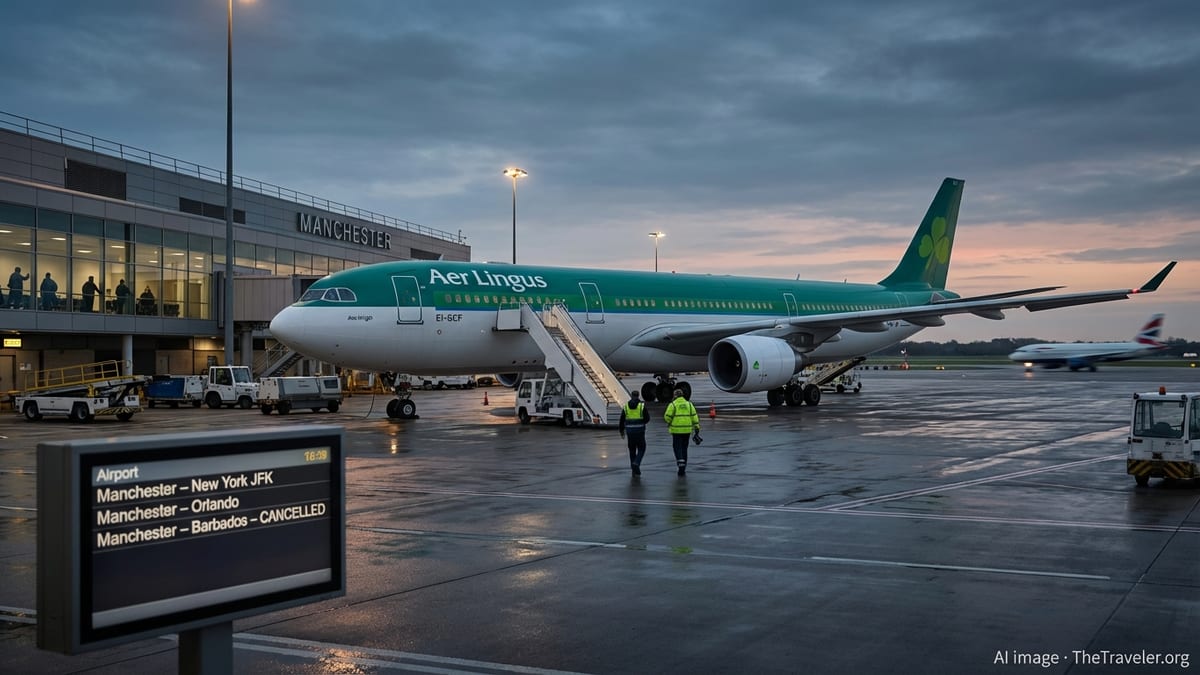
Morning disruption sets the tone for the day
Early-morning flight data indicated that today’s problems at Manchester Airport began building around the first wave of departures, when several services fell behind schedule and one rotation was removed from the timetable. As the day progressed, cancellations rose to three flights, while delays accumulated across short and medium-haul routes serving European and domestic destinations.
Published flight-status boards for Manchester showed delays varying from around 30 minutes to more than two hours on affected services. The pattern is consistent with a familiar scenario at major airports, where a relatively small number of early issues can ripple through the schedule and become far more visible by late morning and early afternoon.
Manchester Airport, the UK’s third-busiest passenger hub after London Heathrow and London Gatwick, routinely manages more than 100,000 travellers per day in peak periods. That volume means even a handful of out-of-slot departures can quickly translate into gate congestion, slower aircraft turnarounds and pressure on available take-off and landing slots, amplifying disruption as crews and aircraft miss their planned rotations.
Today’s disruption unfolded against the backdrop of a wider pattern. Industry analysis of 2025 operational performance ranked Manchester as the UK’s most delayed major airport, with roughly one in three departures leaving late and around 1 percent cancelled, underlining how sensitive the operation can be to relatively modest schedule shocks.
Weather, airspace and operational factors behind delays
While no single dramatic incident was reported at Manchester Airport today, a combination of operational and airspace factors appears to have contributed to the build-up of delays. Across the UK in recent months, thunderstorms, low cloud and fog have repeatedly forced air-traffic flow restrictions, curbing the number of aircraft that can safely depart or arrive during a given period. When that happens, airports such as Manchester, which rely heavily on tightly timed low-cost and leisure schedules, are particularly exposed to knock-on effects.
Recent examples at other major UK hubs show how quickly conditions can deteriorate even when local weather appears manageable. At London Heathrow earlier this summer, early-morning storms triggered extensive delays and cancellations that took days to unwind, as aircraft and crews were left out of position and flight sequences had to be rebuilt. Similar patterns have been documented when fog or low visibility settles over multiple UK airports, prompting carriers to prune domestic and regional flights so that scarce capacity can be reserved for long-haul services.
Operational constraints on the ground can amplify any disruption that begins in the air. Manchester’s runways and taxiways handle a mixture of short-haul leisure, business traffic and long-haul widebody services, all competing for limited peak-time capacity. Even minor hold-ups in baggage loading, refuelling or aircraft servicing can cascade when turnarounds are scheduled tightly. Today’s cluster of delayed flights fits into that broader picture of complex, interdependent operations where small disturbances have outsized impacts.
Publicly available planning documents for airports of Manchester’s scale emphasize the importance of contingency arrangements for irregular operations, including managing diverted aircraft, securing stands and coordinating passenger handling. When delays accumulate, the priority shifts from maintaining a perfectly punctual schedule to preserving safety, spacing flights appropriately and preventing gridlock on the ground.
Passenger experience: long queues and missed connections
For passengers, today’s figures translate into longer waits in departure lounges, busier gate areas and a heightened risk of missed connections at onward hubs. Travellers attempting to connect from Manchester to long-haul flights via European or Middle Eastern hubs are particularly vulnerable when departure slots slip by an hour or more, potentially causing them to miss carefully timed onward legs.
In recent months, travellers using Manchester have reported a mixture of long security queues, late gate changes and difficulty accessing up-to-date information during disruption. While today’s disruption level was relatively moderate in absolute terms, with only three flights cancelled, the clustering of more than 30 delayed services is enough to strain facilities such as seating, food outlets and customer-service desks during peak times.
Consumer-advocacy groups note that Manchester’s high overall delay rate in 2025 left many passengers arriving late at their destinations, and in some cases having to secure overnight accommodation or alternative transport at short notice. Today’s events fit the ongoing narrative of an airport where punctuality remains a significant concern despite major investment in terminal infrastructure and capacity expansion.
For travellers caught up in disruption, airline websites and mobile apps typically provide the most current information on individual flights. Passenger-rights organisations also encourage affected customers to document delays and cancellations carefully, which can be important when seeking compensation under UK and EU air-passenger regulations if the cause is assessed as within an airline’s control.
Manchester’s track record on punctuality under scrutiny
Today’s three cancellations and multiple delays come at a time when Manchester Airport’s reliability has been under sustained scrutiny. Recent analysis of UK flight-disruption data identified Manchester as the country’s most delayed airport in 2025, with only about two-thirds of departures leaving on time, compared with more than 80 percent at some regional competitors.
Those figures reflect a convergence of factors, including the airport’s role as a major base for low-cost and leisure airlines, its dense summer schedule and its constrained operating environment within busy UK airspace. Aviation commentators note that schedule intensity can be a double-edged sword: while it brings a wide range of destinations and frequent services, it also leaves limited slack in the system when weather, technical issues or air-traffic restrictions arise.
Manchester’s operators have highlighted ongoing investments in terminal upgrades, airfield improvements and digital systems designed to smooth passenger flows and improve on-time performance. However, the data suggest that progress on punctuality has been uneven, with periods of relative stability punctuated by days such as today, when a cluster of disruptions once again exposes the fragility of the timetable.
For airlines, persistent delay patterns at a home base affect crew scheduling, aircraft utilization and customer satisfaction scores. Some carriers have responded by building additional buffer time into schedules or shifting certain rotations away from the busiest peaks, but these measures can only partially offset structural constraints driven by airspace capacity and demand patterns.
What today’s disruption means for future travellers
Although three cancellations and more than 30 delays represent a small fraction of Manchester Airport’s total daily movements, today’s pattern offers a snapshot of the reliability challenges facing passengers who rely on the hub. Travellers planning journeys from Manchester in the coming weeks may wish to factor in the airport’s recent punctuality record when choosing departure times, connection windows and, where possible, routing options.
Industry data showing Manchester’s comparatively high delay rate suggest that early-morning and late-evening services can be particularly sensitive to wider operational problems. Early departures are at risk when the first wave of aircraft or crews is affected by overnight technical or weather issues elsewhere in the network, while late flights can suffer from cumulative delays built up over a day of operations.
For leisure travellers with fixed package holidays or cruise connections, and for business passengers on tight schedules, the implications of even modest delays can be significant. Travel advisers often recommend allowing extra connection time when routing long-haul journeys via Manchester or other busy hubs with known punctuality challenges, especially during peak holiday periods or seasons prone to adverse weather.
Today’s disruption at Manchester Airport underscores the importance of monitoring flight status throughout the day of travel, checking in online as soon as allowed and signing up for airline or airport notifications. While isolated cancellations and delays are an inevitable feature of modern air travel, the pattern at Manchester indicates that passengers who build additional flexibility into their plans may be better placed to cope when schedules change at short notice.
FlightStats Manchester Airport departures status
Flightradar24 live departures from Manchester Airport