


More news on this day
Europe’s new Entry/Exit System is reshaping passport control at the Schengen area’s external borders, and for some travellers the resulting queues are already turning into missed flights, extra hotel nights and unexpected rebooking fees.
Get the latest news straight to your inbox!
Understand when EES applies and when you can legally avoid it
The Entry/Exit System applies to most non-EU nationals entering or leaving the Schengen area and several other European countries for short stays of up to 90 days in any 180-day period. Biometric data and passport details are captured on first use, with later trips generally checking against the existing record. Official guidance highlights that the system is in force at air, land and sea borders designated as external Schengen crossings.
Not every European journey triggers an EES check. Travellers who hold EU or Schengen-associated citizenship, a valid residence permit or a national long-stay visa are processed under different rules and are not subject to short-stay registration. Some airports and ports also operate purely domestic or Schengen-to-Schengen flights and sailings where no external border control is required, meaning EES does not come into play.
For visitors planning multi-country itineraries, this distinction can be used to reduce exposure to long EES queues that may lead to missed departures and knock-on costs. Entering the Schengen area once at a major hub and then moving onward on Schengen-internal flights or trains avoids repeat external border checks during the same trip. Similarly, choosing departures that start inside the Schengen zone and connect onward outside Europe on a single ticket can consolidate EES checks into a single outbound process.
Publicly available information from airports and tourism boards shows that some border points have experienced far longer EES queues than others, particularly at peak holiday weekends. Where schedules allow, shifting arrival or departure to a less congested airport or crossing, even within the same metropolitan area, can reduce the risk that an EES bottleneck will force last-minute hotel stays or expensive same-day ticket changes.
Build in realistic buffers so delays do not become your expense
Reports from European travel bodies and recent media coverage indicate that EES-related border waits of two to four hours have already been recorded at some airports during peak periods, with industry groups warning they could climb higher at busy holiday times. When those queues push travellers past bag drop or boarding deadlines, airlines and ferry operators are frequently treating missed departures as the passenger’s responsibility, leaving individuals to pay for rebooking, overnight stays and re-routed journeys.
Several national travel associations now advise treating traditional airport arrival guidelines as a minimum rather than a target. For long-haul flights into or out of the Schengen area, some carriers and airports are recommending that non-EU passengers add an extra hour, or more at known bottlenecks, specifically to cover EES processing. Early-morning and late-evening peaks can be particularly pressured where staffing is tight or where multiple wide-body flights are scheduled within a short window.
Building a buffer is not only about departure times. It also affects how travellers plan connections and surface transfers that can become pricey if delays mount. Booking a same-day intercity train, cruise embarkation or event ticket too close to an EES-controlled arrival can turn a long queue into a costly cascade of non-refundable changes. By spacing key elements of the itinerary with a realistic margin, travellers can absorb slower-than-expected border processing without having to purchase last-minute alternatives.
Travel insurance can help, but policies vary widely on how they handle missed departures linked to immigration delays. Some products cover missed connections only when caused by a delay to an earlier flight, not by the time taken to clear border control. Reading the terms closely and, if necessary, opting for a policy that explicitly addresses missed departures and additional accommodation costs can prevent a long EES queue from becoming an entirely out-of-pocket problem.
Use official tools and smarter routing to minimise time at the border
European institutions and several member states have begun rolling out digital tools aimed at smoothing EES processing. An official Travel to Europe mobile application, highlighted in recent European Commission material and travel-industry reporting, allows eligible third-country nationals to pre-register certain data, including passport details and a biometric photo, up to 72 hours before crossing the border. While travellers must still appear in person for checks, early adopters report that pre-registration can shorten the interaction at kiosks or with officers.
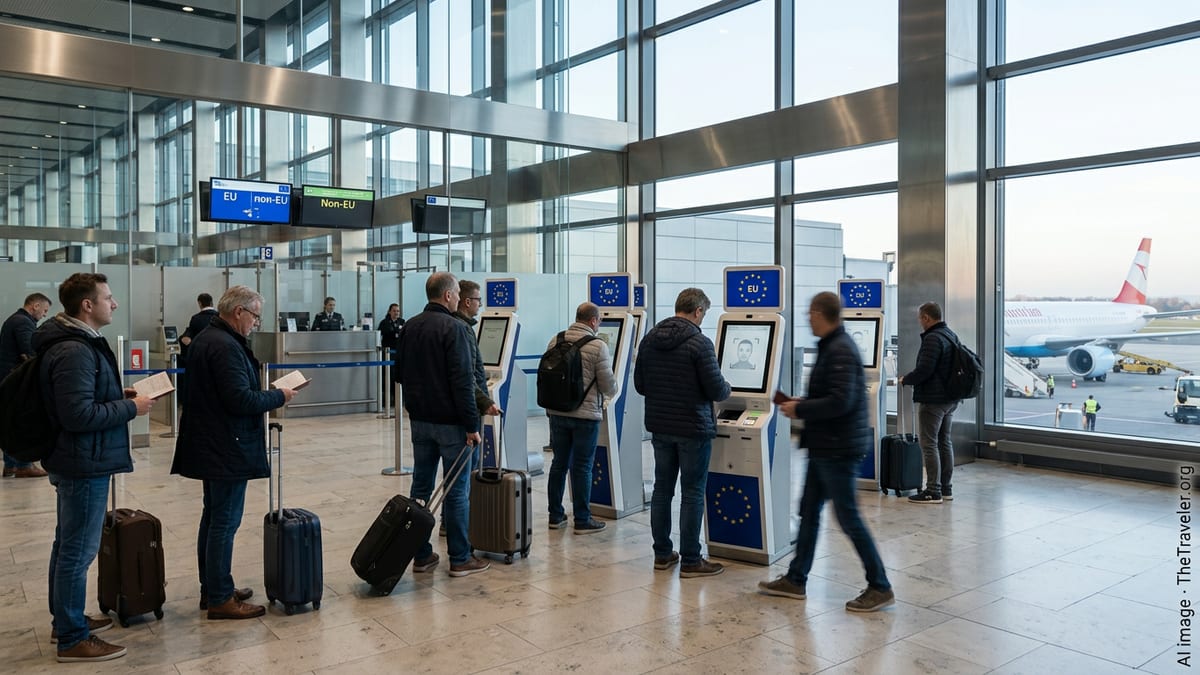
Airports and airlines are also deploying self-service kiosks, dedicated EES lanes and expanded e-gate capacity where infrastructure allows. Publicly available airport guidance encourages passengers to use these facilities whenever possible, as they are designed to standardise data capture and reduce per-passenger processing times. Choosing departure times when these systems are fully staffed and operational, rather than during overnight or off-peak windows when fewer lanes may be open, can further limit queuing.
Smarter routing within Europe can also help travellers avoid the costliest consequences of EES congestion. For example, choosing to clear Schengen entry at a hub that has invested heavily in pre-registration kiosks and high-capacity e-gates, then connecting onward on a single ticket, may be less risky than first arriving at a smaller airport that relies more heavily on manual processing. Similarly, avoiding tight self-arranged connections that require exiting and re-entering the Schengen area mid-journey can reduce the number of times a traveller is exposed to potential EES delays.
Finally, travellers can protect themselves financially by aligning their plans with carriers’ policies on check-in cut-off times and missed departures. Publicly available guidance from airlines, travel search platforms and consumer groups stresses that carriers are generally not obliged to compensate passengers who arrive late at the gate because of long queues at border control, even when those queues are driven by new systems such as EES. Understanding where responsibility lies, allowing extra time and leveraging digital pre-registration tools are emerging as the three most effective ways to prevent EES border checks from turning into an expensive surprise.