


Landing at Toronto Pearson International Airport with Niagara Falls already on your mind is common for first-time visitors and returning travelers alike. The challenge starts as soon as you step out of customs: do you head straight to the Falls or spend a night in Toronto first, and which route actually makes the most sense in terms of time, stress, and budget? This guide walks you through the real options that work in 2026, with concrete examples of travel times, typical price ranges, and when to choose each route.
Get the latest updates straight to your inbox!
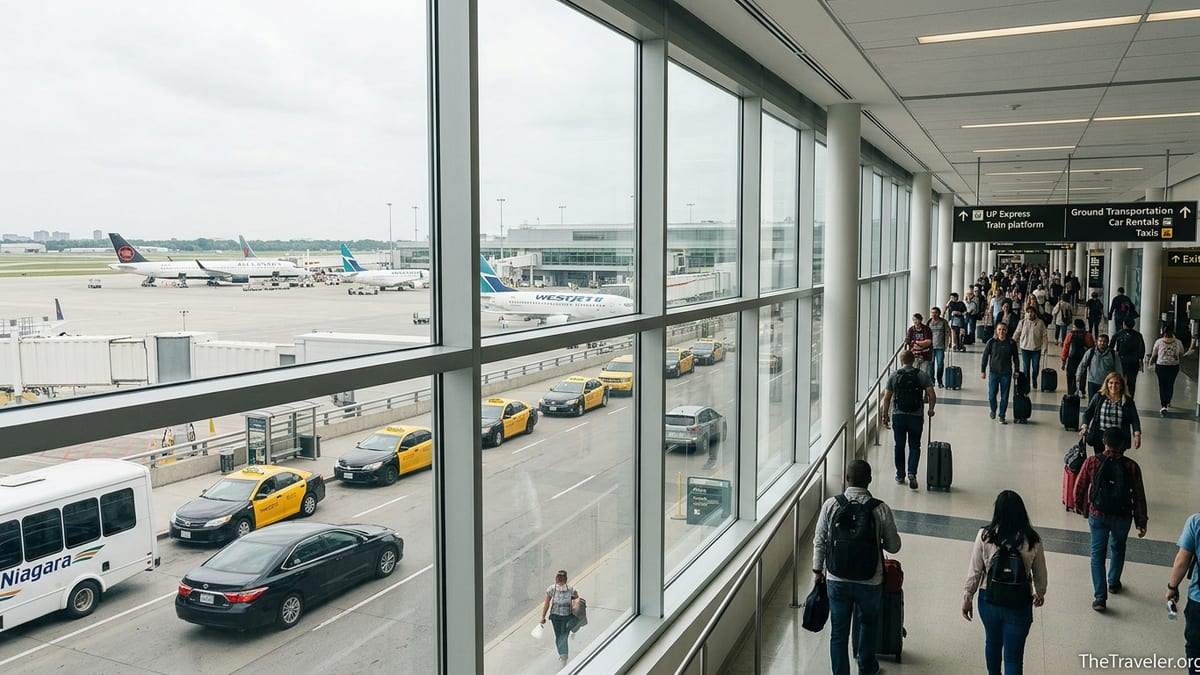
Should You Go Direct From Pearson or via Downtown Toronto?
The first decision after landing at Toronto Pearson is strategic: go directly to Niagara Falls, or route through downtown Toronto. There is no regularly scheduled public bus that runs straight from the terminals to Niagara Falls, so “direct” usually means a private transfer, taxi, limo, or pre-booked shuttle that meets you at the airport. These are the simplest if you land tired after a long-haul flight or are traveling with kids and several suitcases.
Routing via downtown uses the Union Pearson Express (UP Express) from Pearson to Union Station, then a GO Transit train or bus to Niagara Falls. In practice, this means about 25 minutes on the UP Express to Union, a short walk within the station complex, and around two hours on a GO train or GO bus to Niagara Falls GO Station, plus a final 10-minute taxi or rideshare to the hotels near the Horseshoe Falls. For budget-conscious travelers or solo visitors without much luggage, this is often the best value despite the transfers.
Your arrival time matters. If you land at Pearson at 10 in the morning on a summer Saturday, it is easy to ride UP Express, grab lunch at Union, then catch a mid-day GO train that runs all the way to Niagara Falls. If you land at 11 at night in February, GO service to Niagara will be limited and you may face long waits or partial routes that end in Burlington or Hamilton, which makes a direct private transfer from Pearson far more attractive.
Trip purpose also shapes the decision. If Niagara Falls is your main destination and you only plan a short Toronto stop, going straight from Pearson to your Niagara hotel avoids hauling luggage through downtown at rush hour. Conversely, if you want a day or two in Toronto’s core, it makes sense to follow the airport-to-downtown pattern, sleep near Union Station, and treat Niagara as a later day trip.
Using UP Express and GO Transit: The Main Public-Transit Route
For most independent travelers in 2026, the combination of UP Express and GO Transit is the standard public route from Pearson to Niagara Falls. From Terminal 1 you follow the “Train to City” signs to Pearson Station, while from Terminal 3 you ride the free Terminal Link train to Terminal 1 first. UP Express trains generally run every 15 minutes during the day and take about 25 minutes to reach Union Station in downtown Toronto, with an intermediate stop at Mount Dennis, which has become a new transfer hub but is less useful for Niagara-bound travelers.
At Union Station, you transfer to GO Transit. In peak seasons such as summer weekends and during major events like FIFA World Cup 2026, Metrolinx has added extra GO service to Niagara Falls, including more Route 12 GO buses and seasonal trains that run directly to Niagara Falls GO Station. On a typical weekend in summer, you can expect direct GO trains from Union to Niagara Falls in roughly two hours, while on some weekdays or shoulder seasons you may ride a train only as far as Burlington or Hamilton and then transfer to a GO bus for the final stretch.
Cost-wise, this route usually comes in far below a taxi or private car. A one-way UP Express ticket from Pearson to Union is often similar in price to an airport shuttle in other major cities, and GO Transit fares for the long run to Niagara Falls are structured as regional commuter pricing rather than premium tourist tickets. There are occasional promotions that package round-trip GO fares with local WEGO tourist buses in Niagara, giving you 48-hour bus access around the Falls area and the Falls Incline Railway included. These can be excellent value if you are staying two nights and do not plan to drive.
There are trade-offs. You will be managing your luggage through at least one transfer, sometimes two, and GO trains or buses to Niagara can be busy on Saturdays, especially the late-morning direct departures. Travelers on recent weekends report that the trains feel busy but rarely unbearable; heading to the rear of the train can secure more seats together for families. If you are comfortable reading station displays and following signage, this is a straightforward, budget-friendly route that works well for most able-bodied adults and older children.
Airport Shuttles and Shared Buses: When They Make Sense
For decades, one of the most visible options between Pearson and Niagara Falls has been shuttle bus services that you pre-book online. Companies typically operate shared vans or mid-size buses that leave Pearson at fixed intervals, gathering passengers whose flights arrive within a certain window. In practice, you might book a 3 p.m. shuttle, land around 2:15 p.m., and then spend 20 to 40 minutes clearing immigration and customs before finding your shuttle check-in desk in the arrivals hall.
In a typical shared shuttle scenario, your vehicle might leave Pearson with eight to twelve passengers and then follow a hotel drop-off sequence through Niagara Falls, stopping at large properties like the Sheraton Fallsview, Marriott on the Falls, or hotels along Fallsview Boulevard and Clifton Hill. This can be convenient because your hotel is often one of the regular stops, but it also means your scheduled 90-minute highway drive can stretch closer to two and a half hours if you are the last drop.
Prices for shared shuttles change regularly based on fuel and demand, but many travelers as of 2026 describe quotes that are competitive for couples or small groups compared with hiring a private car. For instance, a couple might pay less per person for a shared bus than they would for individual GO Transit plus a Niagara taxi, particularly if they land late in the evening when GO schedules thin out. However, solo travelers often find that the per-person cost of a shared shuttle is higher than simply riding UP Express and GO.
Shuttles are best for those who want to minimize decision-making after landing and are not in a rush. If your flight arrival time is uncertain, build in some buffer. Being delayed by an hour may mean missing your booked departure window and waiting for the next available bus. On the positive side, these services are experienced at tracking typical long-haul arrivals and are used to dealing with tired travelers finding them slowly after customs.
Rental Cars: Freedom on the QEW
Renting a car at Pearson is a popular choice for visitors who plan to explore beyond Niagara Falls, such as wineries in Niagara-on-the-Lake, the beaches around Lake Erie, or smaller towns like Jordan and Port Dalhousie. All major international rental brands operate desks at Toronto Pearson, with car pickup usually in the parking structures adjacent to Terminal 1 or reachable by the Terminal Link train.
The drive from Pearson to Niagara Falls is straightforward for most of the route. You typically join Highway 427 or 401 briefly, then take the Queen Elizabeth Way, known locally as the QEW, past Mississauga, Oakville, Burlington, Hamilton, and St. Catharines before turning south toward Niagara Falls. In free-flowing traffic this journey can take around 90 minutes, but real-world conditions often add time. On summer Fridays, holiday weekends, or during major events, it can easily stretch past two hours as you hit congestion near Oakville and around the Burlington Skyway bridge.
Costs vary widely, but a typical compact or mid-size rental might be relatively affordable per day when booked in advance, especially outside prime summer weeks. You will also need to factor in fuel and parking. Many Niagara Falls hotels charge nightly parking fees, particularly along Fallsview Boulevard where high-rise hotels cluster. If you stay at a property a little farther from the main tourist strip, you may find lower or even included parking, but you will trade convenience for savings.
Driving gives you maximum flexibility. You can stop at an outlet mall in Niagara-on-the-Lake, detour for a meal in Hamilton, or time your arrival at the Falls for sunset. However, it is not ideal for everyone. Drivers unused to multi-lane expressways, winter conditions, or North American road signage may feel stressed, especially after an overnight flight. In January and February, the QEW can be affected by snow squalls off Lake Ontario, reducing visibility and making the drive challenging. In those conditions, many visitors prefer to leave the driving to professionals and rely on trains, buses, or private transfers.
Private Transfers, Taxis, and Limos: Door-to-Door Ease
For travelers who prioritize comfort and time over cost, a private transfer from Pearson directly to a Niagara Falls hotel is often the most appealing option. Several Toronto-based car services and airport limo companies openly advertise flat-rate fares for the Pearson to Niagara Falls run, often using sedans, SUVs, or stretch-style vehicles for larger groups. Typical flat-rate ranges for a standard sedan in 2026 cluster somewhere around the low to mid two hundreds in Canadian dollars, with higher prices for SUVs, vans, or specialty vehicles.
To compare, the official Pearson taxi system also uses flat-rate zones set by the airport authority. Niagara Falls, Ontario appears in those tariff maps with a specific rate code that produces a fare in a similar band, generally higher than a ride within the Greater Toronto Area due to the distance of more than 120 kilometers. Some independent operators advertise that their pre-booked flat rates come in modestly below the on-demand airport taxi line, while still offering door-to-door service and help with luggage.
The main advantage of a private car or limo is predictability. You emerge from customs, meet your driver at a designated point in the arrivals hall, and walk straight to a waiting vehicle. There are no transfers, no ticket machines, and no need to watch departure boards. For a family of four with suitcases and strollers arriving in the evening, paying one flat fare often feels worth the premium compared with four separate train tickets and the hassle of changing at Union and again in Niagara. Business travelers on tight schedules, or couples who simply want a smooth start to a special trip, also frequently choose this option.
Taxis from the official airport ranks work similarly, though you may queue at busy times. The dispatcher usually confirms the flat rate to Niagara Falls before you depart. Travel time is identical to driving a rental car, as you follow the same highway routes, but you can relax while a professional driver manages traffic. The key question is cost versus value: for solo travelers the fare can feel steep, but for three or more people sharing, the per-person cost begins to compete with mid-range shuttle or train options, especially when luggage and late-night arrivals are considered.
Train and Bus Connections in Practice: Timing and Transfers
While the concept of taking a train from Pearson to Niagara Falls sounds simple, the practical reality involves careful planning around timetables. UP Express runs frequently between Pearson and Union, but GO Transit service to Niagara Falls varies by day and season. On some summer Saturdays there may be several direct GO trains from Union to Niagara Falls, such as a late-morning departure around 11 a.m. that has become popular with families who want to avoid transferring to a bus en route.
On many weekdays and in shoulder seasons, your GO journey may involve a mix of train and bus. A common pattern is a Lakeshore West GO train from Union to Burlington or Hamilton, connecting to a Route 12 or 12B GO bus that continues along the QEW to Niagara Falls GO Station. Some of these buses run express for key segments, while others make additional stops. Real-world rider reports describe total travel times from Union to Niagara ranging from just over two hours on faster direct services to close to three hours when transfers and waiting time are included.
From Niagara Falls GO Station, you should budget for a final leg to your hotel or the main viewpoints at Table Rock and Clifton Hill. The station is on Bridge Street, roughly a 50-minute walk from the Horseshoe Falls, which is unrealistic with luggage. Many travelers take a short taxi or rideshare, around 10 minutes, while others use the WEGO tourist buses if they have passes included in their GO package. Hotels sometimes run their own shuttles during busy seasons, so check what your accommodation offers before you travel.
If your flight lands at Pearson too late to comfortably complete this chain of connections, consider staying overnight near the airport or downtown Toronto and heading to Niagara the next morning. For example, a traveler arriving from Europe at 8 p.m. in January may not realistically reach Niagara Falls before midnight using public transit, while a pre-booked car or airport limo can take them there in around ninety minutes, traffic permitting. In such cases, you must weigh a late arrival at your Niagara hotel against an extra night in Toronto and a more relaxed daylight journey.
Choosing the Best Option for Different Traveler Types
No single route from Pearson to Niagara Falls suits everyone. Solo backpackers, honeymoon couples, families with children, and multi-generational groups all have different priorities. For a solo traveler staying in a downtown Toronto hostel first, the combination of UP Express and GO Transit is usually the most rational choice. They can enjoy a couple of nights near Union Station, then roll their carry-on to a morning GO train or bus to Niagara Falls, accepting the longer travel time in exchange for lower cost.
For couples on a short long-weekend getaway whose main focus is Niagara, a private transfer straight from Pearson to a Fallsview hotel often makes sense, especially if their flight arrival and departure times are not synchronized with GO service. Being able to step off a flight from New York or London, meet a driver holding a sign, and arrive at a room overlooking the illuminated waterfalls in time for dinner is a powerful experience that many feel justifies the expense.
Families with small children and significant luggage often sit in the middle ground. A shared shuttle can be a good compromise, offering hotel drop-off without the high price of a fully private car. However, longer travel times due to multiple stops and waiting for other passengers can frustrate tired kids. Some parents opt for a rental SUV, giving them car seats, flexibility for snack stops, and the ability to visit attractions like Niagara’s butterfly conservatory or regional wineries over several days without juggling schedules.
Older travelers or those with mobility issues should consider how much walking and stair-climbing each option involves. UP Express and GO stations are equipped with elevators and escalators, but navigating a large terminal with bags can still be tiring. In these cases, direct services from Pearson to the hotel that minimize transfers usually provide the most comfort, whether via pre-booked limo, taxi, or a reputable shuttle company that offers door-to-door assistance.
The Takeaway
Traveling from Toronto Pearson Airport to Niagara Falls in 2026 offers a spectrum of choices that balance time, cost, and convenience. Public transit via UP Express and GO Transit gives independent travelers a reasonably priced way to cover the two-hour journey with a bit of planning around schedules and transfers, particularly in summer when additional GO services run directly to Niagara Falls.
Shuttle buses, rental cars, and private transfers fill in the gaps according to your priorities. Shuttles trade speed for simplicity and predictable hotel drop-offs, rental cars deliver maximum flexibility for exploring the region at your own pace, and private transfers or taxis offer the most effortless door-to-door experience, especially for families and late-night arrivals.
When deciding whether to go direct from Pearson or route via downtown Toronto, consider your arrival time, how much luggage you are carrying, your budget, and whether Toronto itself is part of your itinerary. There is no single “best” route for everyone, but by understanding how each option works in real-world conditions, you can choose the one that fits the start of your Niagara adventure rather than letting the journey become an afterthought.
FAQ
Q1. Is there a direct public bus from Toronto Pearson Airport to Niagara Falls?
There is no regular city or regional public bus that runs directly from Pearson’s terminals to Niagara Falls. To use public transit, you normally ride UP Express to Union Station and then connect to GO Transit trains or buses to Niagara Falls.
Q2. How long does it take to get from Pearson to Niagara Falls by public transit?
Allow about three hours door to door when using UP Express and GO Transit. That includes around 25 minutes on UP Express, roughly two hours on GO train or bus services, time for transfers at Union Station, and a short taxi or local bus ride from Niagara Falls GO Station to your hotel.
Q3. Is it worth going straight to Niagara Falls from Pearson instead of staying in Toronto first?
If Niagara Falls is your main destination and your flight arrives at a reasonable time, going straight from Pearson can save you an extra unpacking and repacking cycle and avoid hauling luggage through downtown. If you want to explore Toronto’s core or your arrival is late at night, it can be more comfortable to stay in the city first and head to Niagara in daylight.
Q4. How expensive is a taxi or private car from Pearson to Niagara Falls?
Flat-rate taxis and private car services from Pearson to Niagara Falls typically cost in the low to mid hundreds of Canadian dollars for a standard sedan, with higher prices for SUVs or larger vehicles. For three or four travelers sharing, the per-person cost can be competitive with other door-to-door options, especially when you factor in convenience and time saved.
Q5. Is renting a car at Pearson a good idea for visiting Niagara Falls?
Renting a car works well if you plan to visit wineries, small towns, or attractions beyond the main Falls area. The drive along the QEW usually takes around 90 minutes in light traffic but can be longer at busy times. You should also factor in hotel parking fees in Niagara Falls and whether you feel comfortable driving after a long flight or in winter conditions.
Q6. Are airport shuttles from Pearson to Niagara Falls reliable?
Reputable shuttle companies that specialize in the Pearson to Niagara corridor are generally reliable and used to dealing with international flight schedules. However, shared shuttles can involve waiting for other passengers and multiple hotel stops, so your total journey time may end up longer than a direct car even if the scheduled driving time is similar.
Q7. How late do trains and buses run from Toronto to Niagara Falls?
GO Transit schedules vary by day and season. In summer and during major events there are usually more trains and buses, including added services to Niagara Falls, while late-night and winter options can be limited. If your flight arrives in the evening, always check the latest GO schedules in advance and have a backup plan such as an overnight stay in Toronto or a pre-booked transfer.
Q8. Can I use the same ticket for UP Express and GO Transit?
UP Express and GO Transit are operated under the same regional agency, but they have separate fare structures. You can use the same reloadable transit card type on both if you have one, yet you will still pay each leg of the journey. Some promotions bundle GO transit with Niagara-area transport, but you should always confirm what is included when you purchase.
Q9. How do I get from Niagara Falls GO Station to the waterfalls and hotels?
Niagara Falls GO Station is on Bridge Street, about a 10-minute taxi or rideshare from the main Falls and hotel district. Some travel packages include WEGO tourist buses that connect the station with major hotels and attractions. Walking with luggage is not recommended, as it can take close to an hour on foot.
Q10. What is the best option from Pearson to Niagara Falls for a family with young children?
For families with small children and several bags, the best option often depends on budget. A private transfer or flat-rate taxi provides the easiest door-to-door experience with car seats and no transfers. If cost is a major concern and your children can handle longer journeys, combining UP Express, GO Transit, and a short Niagara taxi ride offers good value but requires more steps and patience.