


Toronto Pearson International Airport is one of Canada’s busiest gateways, and getting from the terminal curb into an Uber or Lyft can be confusing if you have not done it before. Pickup rules, zones and prices change regularly, and Pearson has recently updated where ride share drivers meet passengers at Terminal 1. This guide walks you step by step through exactly where to stand at Terminal 1 and Terminal 3, how to use the apps correctly, what to expect on pricing, and when a taxi or train might actually be the smarter option.
Get the latest updates straight to your inbox!
How Uber and Lyft Work at Toronto Pearson in 2026
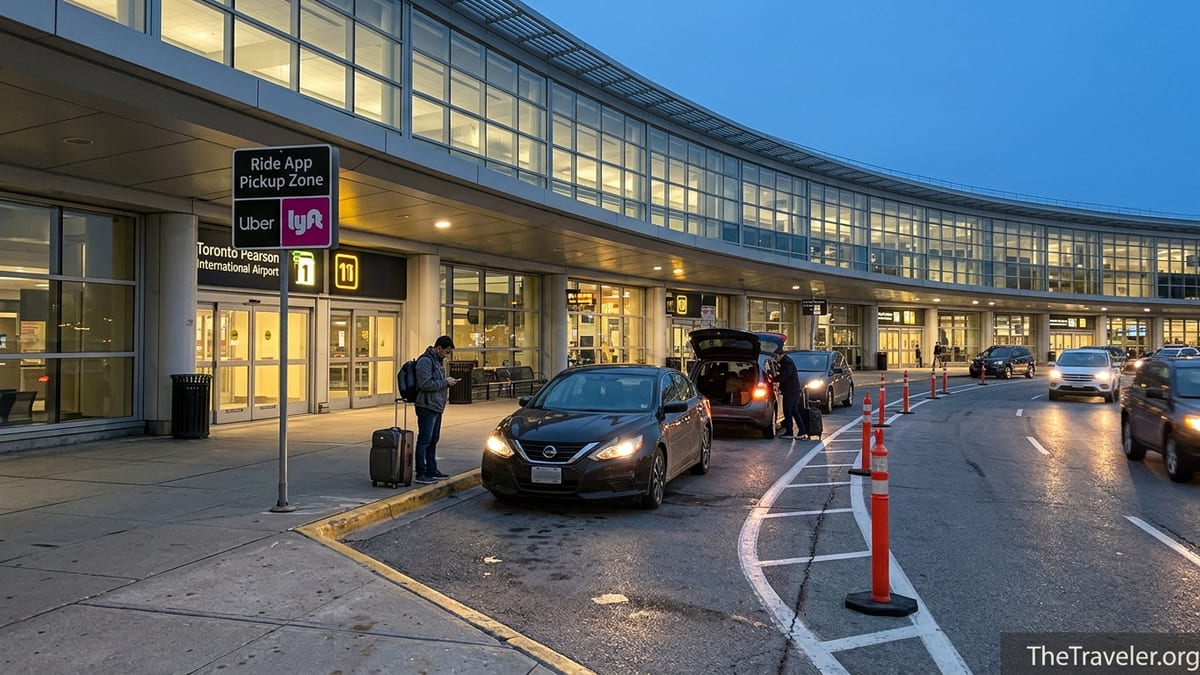
Uber and Lyft are fully authorized to operate at Toronto Pearson, with designated “Ride App Pickup” curbs outside both Terminal 1 and Terminal 3. The Greater Toronto Airports Authority treats Uber, Lyft and local service Hopp as commercial ground transport, so they are restricted to specific curb zones on the lower levels rather than the main arrivals roadway where private vehicles and airport taxis queue.
In practical terms, this means you cannot simply call a ride share to the closest door and expect it to stop right in front of you. When you request an UberX or Lyft ride from the app, it will automatically assign a pickup zone and bay number, and the driver is required to meet you there. At Pearson, those zones are grouped outside marked doors and painted curbs rather than at random spots along the terminal.
Because Pearson is Canada’s primary international hub, pickups can be especially busy in the evening bank of arrivals from Europe and the late-night rush of domestic flights. Rideshare drivers also pay airport fees for each pickup, which are passed through in your fare, so prices to or from Pearson are usually a few dollars higher than an identical trip elsewhere in the Toronto area. For example, a typical off-peak UberX to downtown often lands somewhere in the 35 to 50 Canadian dollar range, depending on traffic, toll route choice and demand.
Terminal 1 Uber & Lyft Pickup: Doors P, Q, R and S
In early 2026, Pearson introduced a new layout for ride share pickups at Terminal 1. All Uber, Lyft and Hopp pickups now occur on the ground level outside doors P, Q, R and S, with the curb divided into numbered zones. Lyft and Hopp are generally grouped in one zone, while Uber is allocated across two adjacent zones, and passengers are assigned a specific bay within those zones in their app.
To reach the ride share curb at Terminal 1, follow signs inside the terminal for “Ground Level” and “Ride App Pickup.” After you exit customs or baggage claim, you will typically be on the arrivals level, which is above the ride share area. Look for escalators or elevators down to the ground level; signage is clearer near the central exits. Once outside, you will see overhead signs for doors P, Q, R and S and painted curbs broken into numbered bays that match what is displayed in your Uber or Lyft app.
Many travelers arriving at Terminal 1 report that the most common pickup point for Uber is outside Door Q, which often appears as the default in the app. In a realistic scenario, you might land on an evening flight from Vancouver, clear baggage in 20 minutes and then request an UberX to a hotel near Union Station. The app could tell you “Pickup at Door Q, Zone 4, Bay 12.” You would then walk down to ground level, follow the Ride App signs to Door Q, and stand next to the Bay 12 marker at the curb. Your driver’s app will match the same bay number, which reduces confusion in heavy traffic.
A common mistake is waiting at the wrong level or near the wrong door and then watching your driver loop the terminal trying to find you. If the app says ground level, do not stay on arrivals; go one level down. If the app shows Door Q, do not wait at Door F or another letter simply because it is closer to where you exited security. Correcting this early saves both you and the driver time, and reduces the odds of a canceled trip fee.
Terminal 3 Uber & Lyft Pickup: Where to Meet Your Driver
Terminal 3 at Pearson handles a large share of leisure and international flights, including many WestJet, Sunwing and some international carriers. Ride share pickups here are also confined to a specific curb area designated for Uber, Lyft and similar services. The layout is simpler than Terminal 1, but the same principles apply: follow the “Ride App Pickup” signs and check your app for the correct door and zone.
After you collect luggage at Terminal 3, look for signs pointing to “Ride App Pickup” on the arrivals level. At Pearson, this usually leads you to a section of the curb that is separated from the taxi queues and private car lanes, with ground markings and posts indicating the ride share area. When you request a ride in Uber or Lyft, the app will prompt you to confirm that you are at Terminal 3 and then give you a specific pickup door and curb area, along with the usual car color, plate and driver details.
Imagine you arrive on a late-night flight from Cancun into Terminal 3 and need to reach a friend’s condo in Mississauga. You request an UberX and the app directs you to “Terminal 3 Ride App Pickup, Door B, Zone 3.” You would walk out through Door B, cross any small pedestrian island if indicated by signage, and wait near the Zone 3 marker. At busy times, you may see a line of ride share cars cycling through the zone; confirm your license plate and driver name before opening the door, because multiple black sedans can look alike in the dark.
If you accidentally request a ride from the wrong terminal, for instance choosing Terminal 1 when you actually landed at Terminal 3, your driver may end up on the other side of the airport. In that case it is usually faster and cheaper to cancel promptly and rebook at the correct terminal rather than asking the driver to make a long loop through Pearson’s one-way road system.
App Tips: Ordering Your Ride Smoothly from Pearson
The most important step when ordering an Uber or Lyft at Pearson is selecting the correct terminal and pickup zone in the app. GPS at large airports can be imprecise, sometimes placing your pin in the wrong part of the complex, so take a moment to confirm the text description rather than relying solely on the map. Your app should clearly state “Toronto Pearson International Airport, Terminal 1” or “Terminal 3” and then show the designated ride share pickup area rather than “Departures” or generic “Arrivals.”
Once you have confirmed the terminal, check that your pickup location line mentions “Ride App Pickup” or the correct door letter and zone. If the app initially drops your pin on an upper-level roadway, use the search field within the app to type “Ride App Pickup Terminal 1” or similar and then tap the suggested location. This small step can prevent your driver from circling the wrong level, a frequent issue at Pearson’s multi-story Terminal 1.
When the ride is confirmed, note the estimated arrival time and the driver’s current location. At Pearson, it can take several minutes for a driver waiting in the airport holding lot to reach your curb, especially during heavy construction or lane closures common in summer. Use this time to walk calmly to the designated door rather than requesting the car while you are still in the immigration line. Many regular travelers time their request for when they are leaving the baggage carousel, so that by the time they reach the curb the car is within two to three minutes.
In the app chat or call feature, it is fine to send a short, clear message such as “I’m at Terminal 1, Door Q, Zone 4, wearing a red jacket.” Pearson’s curbs can be crowded, and a quick visual detail helps your driver pick you out. Avoid asking the driver to meet you somewhere other than the designated ride share curb; airport rules generally discourage this, and drivers risk fines if they load passengers in unauthorized spots.
Understanding Pricing, Fees and Surge at Toronto Pearson
Prices for Uber and Lyft rides from Pearson fluctuate with demand, distance, and the type of service you choose. A standard UberX or basic Lyft to downtown Toronto typically falls in the 35 to 50 Canadian dollar range in light traffic, but this can rise significantly during peak hours or weather disruptions. Premium options like Uber Black or Lyft Lux cost more, often starting around 80 dollars or higher for the same downtown trip, in exchange for upgraded vehicles and experienced drivers.
Both Uber and Lyft pass through an airport fee charged for each pickup at Pearson. This fee is automatically included in the upfront price you see in the app; you will not pay it separately at the curb. Because of this surcharge and the time drivers spend clearing airport security checkpoints and waiting in holding areas, Pearson rides can cost five to ten dollars more than similar trips entirely within the city.
Surge pricing, or so-called “dynamic pricing,” is most common at Pearson during early morning departures, evening international arrivals, major sporting events and periods of bad weather. For example, on a snowy Friday evening when multiple flights are delayed, it is not unusual to see surge multipliers that push an UberX fare to downtown above 70 Canadian dollars. In contrast, on a calm weekday mid-morning, that same trip might come in at around 40 dollars.
If you encounter high surge pricing in the app, consider waiting ten to fifteen minutes to see if demand eases, walking between terminals using the free Terminal Link train to see if prices differ slightly between Terminal 1 and Terminal 3, or comparing with taxi and train options. Travelers heading to central Toronto sometimes use the Union Pearson Express train to reach downtown and then take a short city Uber ride from Union Station to their final destination, splitting the journey to avoid the highest surge windows.
Choosing Between Uber, Lyft, Taxi and Train
For many visitors, Uber or Lyft from Pearson is the simplest door to door solution, particularly if you are arriving late at night or carrying heavy luggage. However, depending on your arrival time, budget and destination, taxis, pre-arranged limousines, or public transit can be competitive or even better.
Airport-licensed taxis and limousines line up immediately outside both terminals on the arrivals level. Fares are usually meter-based with some published flat rates to popular zones. While taxis may look more expensive at first glance, they are often similar to or slightly higher than a surged UberX during peak times, without the uncertainty of changing app prices. For instance, a taxi to a hotel near the CN Tower may end up around 60 Canadian dollars in heavy traffic, which can be close to a heavily surged ride share fare.
For solo travelers or couples heading to downtown Toronto, the Union Pearson Express train is often the fastest and most predictable option. The train station is attached to Terminal 1, and a short free ride on the Terminal Link train connects Terminal 3 to the same station. Travel time to Union Station is typically around 25 minutes with frequent departures, and many riders then take a short city taxi, streetcar or local Uber from Union to their final stop. In practice, a traveler might pay for the train plus a 10 to 15 dollar local ride share within downtown, which can undercut a direct Uber from Pearson during high-demand periods.
Pre-arranged car services, including sedans and larger vans, remain popular with families and business travelers who value certainty. These services pick up in designated pre-arranged zones separate from the on-demand ride share curbs. If you have specific mobility needs, large ski or golf bags, or a group of five or more, securing a pre-arranged vehicle can be more reliable than hoping an appropriately sized UberXL happens to be waiting in the airport holding lot when you land.
Real-World Scenarios: What to Do in Common Situations
Consider a family of four arriving at Terminal 1 from London with two large suitcases, two carry-ons and a stroller, bound for an Airbnb in the Annex neighborhood. At midday on a weekday with no surge pricing, a single UberXL from the Terminal 1 ride share curb might cost in the range of 70 to 90 Canadian dollars. An airport taxi van could be in a similar range. If the parents value simplicity and minimal transfers after an overnight flight, paying a bit more for a direct UberXL or taxi makes sense.
Now imagine a solo business traveler landing at Terminal 3 from Calgary around 9 p.m., headed to a hotel walking distance from Union Station. Surge pricing is active due to a major event downtown, and the app is quoting around 75 Canadian dollars for UberX. In this case, it might be more efficient to follow signs to the Terminal Link train, ride to Terminal 1, catch the Union Pearson Express to Union Station, and then walk or use a short inner-city Uber costing under 15 dollars. The total travel time is similar, but the combined cost is often lower than a single surged ride share.
Another scenario: a local resident returns on a late-night international flight into Terminal 1. It is after midnight, the Union Pearson Express has stopped for the night, and the taxi queue is long because several widebody flights landed at once. The Uber app shows elevated prices but still below premium taxi rates, with cars arriving in five minutes at Door Q on the ground level. Requesting an UberX in this context may save 15 to 20 minutes of standing in the taxi line, a tradeoff many exhausted travelers gladly accept even at a slightly higher fare.
Finally, for passengers connecting between Terminal 1 and Terminal 3, it usually does not make sense to use ride sharing at all. The free Terminal Link train connects the two terminals and the Viscount parking area, and runs frequently. Once you reach your final terminal, you can then request an Uber or Lyft from the correct ride share curb rather than trying to move between terminals by road.
The Takeaway
Navigating Uber and Lyft pickups at Toronto Pearson in 2026 is much easier once you understand that the airport funnels all ride share traffic into specific Ride App Pickup curbs. At Terminal 1, this means heading down to ground level outside doors P, Q, R and S and matching the zone and bay number shown in your app. At Terminal 3, it means following signs from arrivals to the dedicated ride share curb and verifying your door and zone before you request a car.
Use your app strategically: confirm the correct terminal, choose the precise Ride App Pickup location, and time your request so that you reach the curb just as your driver approaches. Keep an eye on dynamic pricing and weigh alternatives like airport taxis or the Union Pearson Express, particularly at peak times or during storms. With these habits, you can turn what might have been a confusing curbside scramble into a predictable and often cost-effective start or end to your visit to Toronto.
FAQ
Q1. Where exactly do I meet my Uber at Terminal 1?
At Terminal 1 you meet Uber and Lyft on the ground level at the Ride App Pickup area outside doors P, Q, R or S. Your app will specify the exact door, zone and bay number.
Q2. Where is the Uber pickup area at Terminal 3?
At Terminal 3 follow signs from the arrivals level to the Ride App Pickup curb. The Uber or Lyft app will give you a specific door and curb zone to wait at.
Q3. Can I ask my driver to pick me up at arrivals or departures instead of the ride share curb?
Drivers are expected to use the official Ride App Pickup areas. Asking them to collect you at regular arrivals or departures curbs can expose them to airport fines and may cause confusion or delays.
Q4. How much does an Uber from Pearson to downtown Toronto usually cost?
In normal traffic, a standard UberX to downtown often falls somewhere in the 35 to 50 Canadian dollar range, but prices increase during peak demand or bad weather.
Q5. Is Uber cheaper than an airport taxi at Pearson?
It depends on demand. When there is no surge, UberX is often cheaper than a taxi for central Toronto trips. During heavy surge periods, the difference can narrow or reverse, so it is worth checking both options.
Q6. How can I avoid surge pricing when leaving Pearson?
Consider waiting a short time for demand to ease, checking both Uber and Lyft, comparing with taxi or Union Pearson Express train options, or splitting your journey by taking the train downtown and a short ride share from there.
Q7. Do I need to tip Uber or Lyft drivers at Toronto Pearson?
Tipping is optional but appreciated. The apps allow you to add a tip after the trip. Many travelers tip a few dollars or a percentage of the fare for good service, especially on longer airport rides.
Q8. What should I do if my driver cannot find me at the curb?
Confirm that you are at the correct terminal, level, door and zone listed in the app. If needed, send a brief message with your exact location and a clothing description. If the driver is clearly in the wrong place and cannot reach you, it can be better to cancel and rebook.
Q9. Is it safe to use Uber or Lyft late at night from Pearson?
Both services operate 24 hours a day and pickups occur in monitored airport curb areas. Use the safety tools in the app, verify the car’s license plate and driver identity, and share your trip details with a friend or family member if traveling alone.
Q10. Can I use Uber or Lyft to travel between Terminal 1 and Terminal 3?
It is usually unnecessary. The free Terminal Link train connects Terminal 1 and Terminal 3 quickly, and then you can request a ride share from the correct terminal’s Ride App Pickup curb.