


More news on this day
A collision between two passenger trains near Bedford in central England has left 28 people in hospital, including nine reported in critical condition, focusing renewed attention on railway safety and the resilience of a key route into London.
Get the latest news straight to your inbox!
Serious injuries after rush-hour impact on key London corridor
Published coverage indicates that the collision occurred late on Friday afternoon near Bedford, on one of the main north–south corridors linking the English Midlands with London St Pancras. A southbound commuter service reportedly struck the rear of another passenger train traveling toward the capital, causing significant damage to several carriages and triggering a large-scale emergency response.
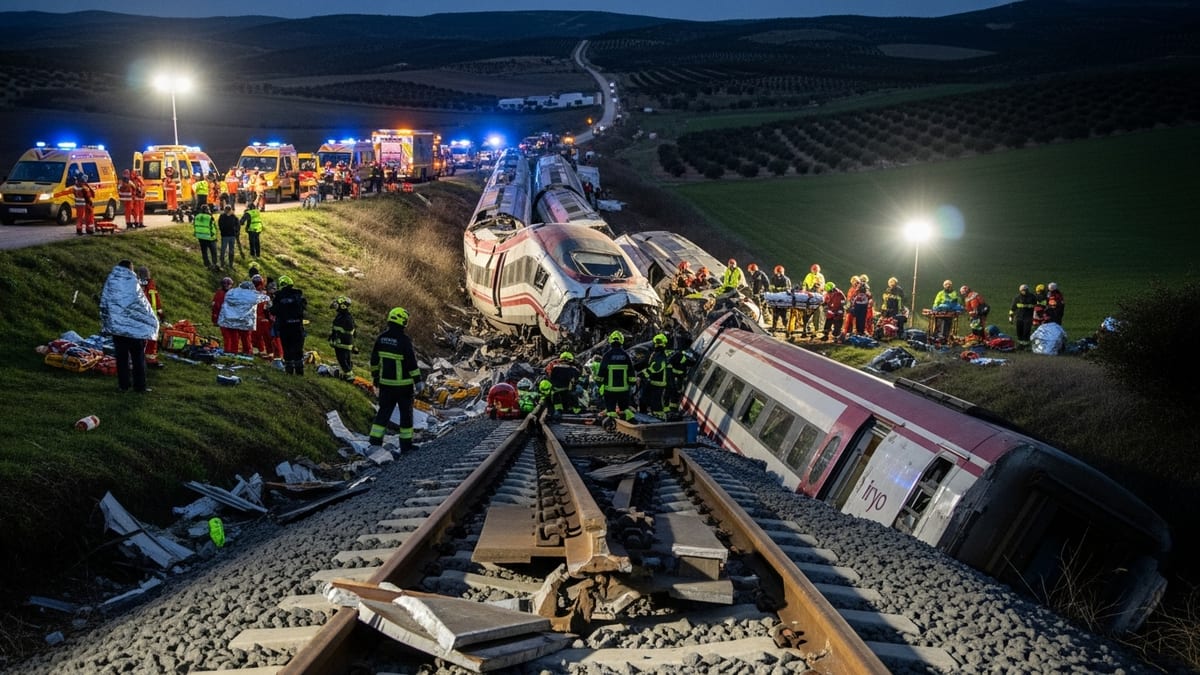
Initial reports described scenes of chaos inside the trains, with passengers thrown from seats by the sudden impact. Images circulating in news coverage and on social media show crumpled carriages, shattered windows and debris along the trackside, as well as multiple fire and ambulance units working under floodlights into the night.
Publicly available information indicates that more than 80 people received medical attention in the hours after the crash. By Saturday, 28 remained in hospital, with nine understood to be in critical condition. One of the train drivers was reported to have died, adding a fatality to an incident already being described as one of the most serious rail crashes in Britain in recent years.
Travel along the busy Midland Main Line was severely disrupted after the collision, with long-distance and commuter services canceled or diverted. Passengers attempting to reach London and the East Midlands faced extended journey times and crowding on alternative routes, underlining the importance of this line for both daily commuting and longer-distance travel.
Emergency response and hospitalisations across the region
According to published coverage from national and regional outlets, emergency services from Bedfordshire and surrounding counties converged on the scene within minutes of the first alerts. The location of the crash, beside a road parallel to the tracks, allowed a large number of ambulances, fire engines and specialist rescue units to reach the site quickly.
Photos and video from the aftermath show passengers being guided from the trains down onto the trackside and then toward the road, where triage areas were established. People with visible injuries, including head wounds and suspected fractures, were treated at the scene before being transferred to hospitals across central and eastern England.
Hospitals in the Bedford region and further afield in the East Midlands and Greater London reportedly received dozens of patients during the evening and overnight period. The decision to distribute the injured across several facilities appears to have been aimed at reducing pressure on any single emergency department and ensuring timely access to surgery and intensive care for those most badly hurt.
Medical updates shared in public briefings and media coverage through Saturday highlighted the seriousness of the situation. While many of the injured were described as stable, nine individuals remained in critical condition, illustrating the force of the impact and the vulnerability of passengers when seated or standing in crowded carriages at speed.
Investigators focus on signalling, speed and train spacing
Specialist rail accident investigators began work at the site soon after the immediate rescue phase concluded. Publicly available information indicates that the inquiry is focusing on how a southbound service to London came to run into the back of another passenger train on the same line, in conditions where signalling and traffic management systems are designed to prevent precisely this kind of event.
Analysts following the case note that regulators will be examining several factors, including train separation distances, signal aspects at the time of the collision, and any potential technical issues with onboard safety systems. Investigators are also expected to study driving logs, data recorders and maintenance records to determine whether human decision-making, equipment malfunction or a combination of factors played a role.
Rail safety specialists quoted in recent coverage stress that rear-end collisions on busy main lines are rare in the United Kingdom, where multiple layers of protection are intended to keep trains apart. The focus on signalling performance and operational procedures reflects long-standing lessons from past incidents, where inquiries have led to upgrades in technology and changes in working practices.
The investigation is likely to take months, during which time interim findings may inform short-term safety recommendations. For rail users, the outcome will be closely watched, as any identified shortcomings in systems or processes could lead to timetable changes, new speed restrictions or infrastructure works along the corridor.
Impact on travellers and confidence in rail safety
The crash has prompted renewed public debate about rail safety at a time when authorities and operators have frequently pointed to Britain’s strong long-term safety record. Travel industry observers note that high-profile incidents can temporarily affect passenger confidence, even when statistics show that serious accidents remain rare compared with road transport.
For regular commuters on the route from the East Midlands and Bedfordshire into London, the disruption has been immediate and practical. Cancellations, diversions and reduced capacity have pushed more travelers onto already busy alternative lines and motorway routes, creating longer door-to-door journey times for work and leisure trips alike.
Industry commentary suggests that clear communication about the status of services, flexible ticketing policies and visible safety measures will be important in encouraging passengers back onto affected trains in the coming days and weeks. Rail users are also likely to pay close attention to any preliminary safety updates, seeking reassurance that the specific factors behind the collision are being addressed.
Travel analysts point out that incidents of this scale can have ripple effects far beyond the immediate region. Tourists and business travelers planning trips that rely on connections through London or the Midlands may adjust itineraries or build in extra time, particularly while investigations continue and infrastructure repairs are under way.
Broader context of recent rail incidents in Europe
The Bedford collision comes in a year already marked by several high-profile rail incidents across Europe, a pattern that has attracted attention from transport researchers and frequent travelers alike. Recent months have seen serious accidents in countries including Spain and Denmark, where collisions and derailments have resulted in fatalities and multiple critical injuries.
Published analyses emphasize that, despite these events, rail remains among the safest modes of long-distance travel. However, the clustering of incidents has intensified scrutiny of issues such as infrastructure investment, maintenance backlogs, driver training and the integration of new digital signalling technologies.
For international travelers, particularly those planning multi-country journeys by train, these developments are a reminder of the importance of monitoring service updates and being aware of potential disruptions on key corridors. Travel advisories and operator announcements increasingly highlight engineering works, temporary speed restrictions and capacity limits that may stem from ongoing safety upgrades.
As investigators work to establish the causes of the Bedford collision and other recent accidents, transport planners and rail operators face continued pressure to demonstrate that lessons are being learned and that safety systems are evolving. For passengers affected by Friday’s crash and for the families of those injured or killed, attention now turns to the recovery of the survivors and the search for clear, evidence-based explanations of how such a serious collision was able to occur.