


More news on this day
Crystal’s ambitious three-ship expansion with Italian builder Fincantieri has hit a timing setback, with the third planned ocean newbuild now expected to arrive around two years later than originally anticipated.
Get the latest news straight to your inbox!
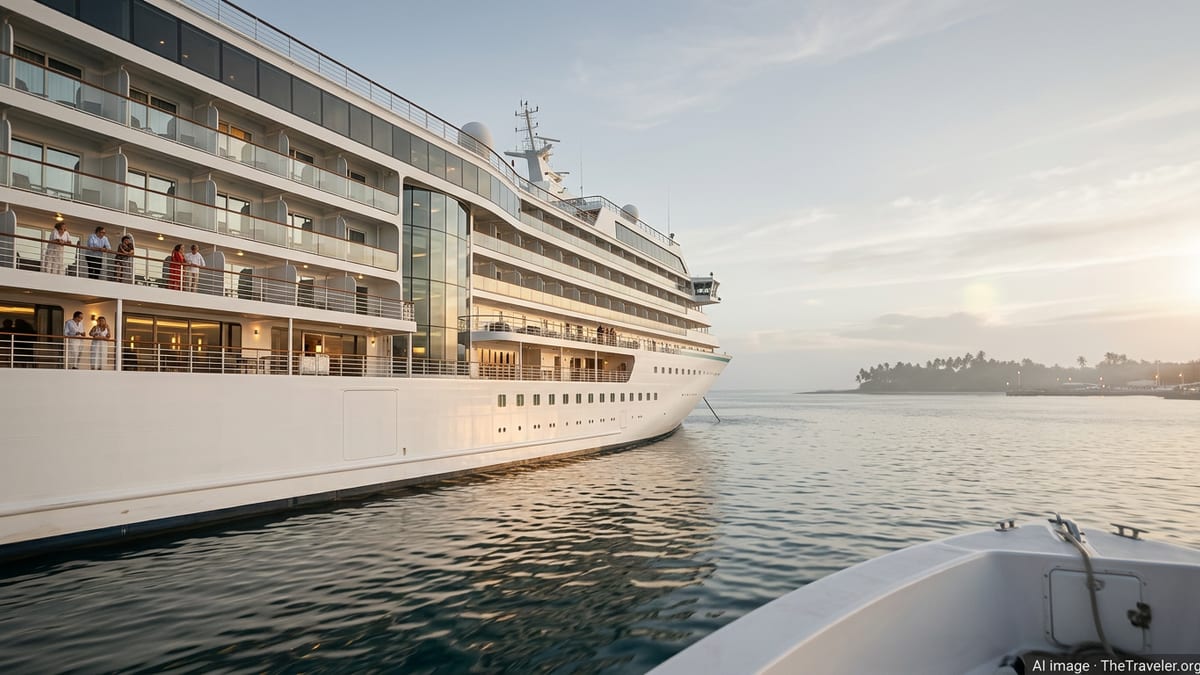
Revised Timeline Extends Crystal’s Growth Curve
Publicly available information on Fincantieri’s cruise orderbook indicates that the third Crystal newbuild, initially slated to follow the first two vessels at relatively even intervals, has been pushed back by roughly two years. While the first ship, Crystal Grace, remains scheduled for delivery in spring 2028, updated delivery patterns for subsequent units suggest that the follow-up pair will now be spaced more widely than first envisaged.
Industry data compiled from Fincantieri disclosures and cruise orderbook reports points to three Crystal vessels arriving in 2028, 2030 and 2033, respectively, instead of a tighter sequence that had previously been discussed when Crystal and Fincantieri first signed their memorandum of agreement. Under that earlier framework, the optioned third ship had been commonly associated with an early-2030s window. The latest schedules imply that the final vessel’s entry into service has shifted approximately two years further out.
The adjustment effectively stretches Crystal’s fleet renewal program into the mid-2030s. For travelers and trade partners, this means that while a new flagship is still planned for 2028, the anticipated rapid succession of sister ships will be more measured, with the third vessel now positioned as a longer-term addition rather than part of a near-term trio.
Crystal has not issued a detailed standalone statement on the change in timing, but the evolving delivery pattern as reflected in shipbuilding documentation and orderbook summaries underscores how quickly large-scale cruise expansion programs can be reshaped by shipyard capacity, financing schedules, and broader market dynamics.
Crowded Fincantieri Orderbook Shapes Delivery Dates
The shift in Crystal’s third newbuild timeline emerges as Fincantieri manages one of the busiest cruise orderbooks in its history. In recent years the Italian group has announced multiple large-ship contracts for several major brands, including Norwegian Cruise Line Holdings and Carnival Corporation, as well as a new Voyager-class series for Princess Cruises scheduled well into the 2030s.
These projects sit alongside an already packed production slate of luxury and premium vessels, plus ongoing work for other segments such as naval shipbuilding. Each contract competes for the same finite block of drydock slots, skilled labor and supplier capacity across Fincantieri’s network of Italian yards. As a result, even firmly contracted deliveries can be rescheduled as the group balances new orders with existing commitments.
Crystal’s first newbuild, Crystal Grace, recently marked its steel-cutting milestone at Fincantieri’s Marghera yard, with a confirmed delivery in spring 2028. That vessel anchors the brand’s expansion plan and is already being integrated into program planning, with 2028 itineraries previewed across trade channels. The second and third sisters, however, are further back in the queue, leaving more room for adjustment as Fincantieri fine-tunes its long-term production calendar.
Analysts following the shipbuilding sector note that such timing revisions are common when a yard’s portfolio grows rapidly. While they can delay capacity growth for individual brands, they also reflect efforts to maintain construction quality and operational efficiency across dozens of simultaneous projects.
What the Delay Means for Crystal Guests and Itineraries
For guests, the immediate impact centers on expectations rather than existing bookings. Since Crystal’s third newbuild had yet to be named or opened for sale, there is no widespread need for rebooking or itinerary replacement. Instead, the delay primarily influences how quickly Crystal can expand its ocean capacity beyond the current duo of Crystal Serenity and Crystal Symphony and the first newbuild, Crystal Grace.
Crystal has already begun promoting 2028 sailings that showcase the debut of Crystal Grace alongside the refurbished existing ships. The updated delivery outlook suggests that new itineraries tied to a second and third newbuild will likely appear more gradually, giving the line more time to refine deployment plans and strengthen demand for its initial expansion steps.
Travel advisors and loyal guests watching Crystal’s recovery and growth will now need to view the third newbuild as part of the brand’s medium- to long-term roadmap. Rather than a near-simultaneous trio of ships reshaping the fleet before the early 2030s, Crystal’s evolution is likely to unfold in distinct phases, beginning with the 2028 launch and continuing in separate waves as subsequent ships are completed.
For itinerary planners, the extended timeline may even offer some advantages. With more years separating each new arrival, Crystal can adjust routes based on the performance of Crystal Grace and evolving demand patterns, calibrating ship deployment across regions such as Europe, the Caribbean and world cruise segments before the final vessel comes on stream.
Competitive Context in the Luxury and Premium Segment
Crystal is not alone in dealing with elongated delivery schedules. Across the industry, long-term orderbooks for builders like Fincantieri and others mean that new cruise ships are commonly planned nearly a decade ahead of launch. In the luxury and upper-premium segments in particular, brands from major groups have lined up multiple newbuilds over the next ten years, tightening available capacity at top-tier yards.
For Crystal, the delay of the third ship may narrow the window in which it can capitalize on being among the newest ultra-luxury fleets at sea. Rivals are investing in hardware with advanced environmental systems, expanded suites and larger wellness and dining spaces, which could enter service before Crystal’s final newbuild is ready. At the same time, the extended timeline may allow Crystal to incorporate newer design elements and technologies that emerge later in the decade.
Market observers also point out that a slower roll-out can help preserve pricing power. With fewer berths entering the market each year, luxury lines can avoid oversaturating key routes, particularly in Europe and popular warm-weather regions. Crystal’s decision to prioritize its first newbuild and accept a later arrival for the third ship may support a more balanced supply-demand environment in the brand’s core segments.
From the customer perspective, the key near-term development remains the 2028 introduction of Crystal Grace, which is expected to set the template for the next generation of Crystal’s onboard experience. The third newbuild, although delayed, is still part of a broader strategy to rebuild and expand the fleet over the long term.
Signals for Shipyards, Investors and the Wider Cruise Market
The rescheduling of Crystal’s third newbuild is another sign of how extended and complex modern cruise ship projects have become. For shipyards, the case illustrates both strong demand and the operational constraints that come with it, as yards juggle multiple large-scale contracts and seek to maintain reliability across a decade-long pipeline.
For investors following the cruise and shipbuilding sectors, timing changes of this kind are increasingly viewed as a normal feature of the cycle rather than an anomaly. Delivery dates can move within multi-year bands as financing conditions, regulatory requirements and internal capacity planning evolve. These factors are particularly visible in the luxury space, where ships are smaller in number but highly customized and technically complex.
The broader takeaway for travelers and the trade is that Crystal’s long-term commitment to new hardware remains intact, even if the final piece of the three-ship program will now arrive later than first anticipated. With one newbuild firmly dated for 2028 and two more still in the pipeline, the brand continues to position itself as a key player in the next wave of high-end ocean cruising, albeit on a slightly more extended timeline than originally expected.