


More news on this day
Trenitalia’s flagship Frecciarossa 1000 high-speed trains have entered a key homologation phase for operation in Germany, marking a major step toward the launch of new Italy–Germany high-speed services planned from late 2026.
Get the latest news straight to your inbox!
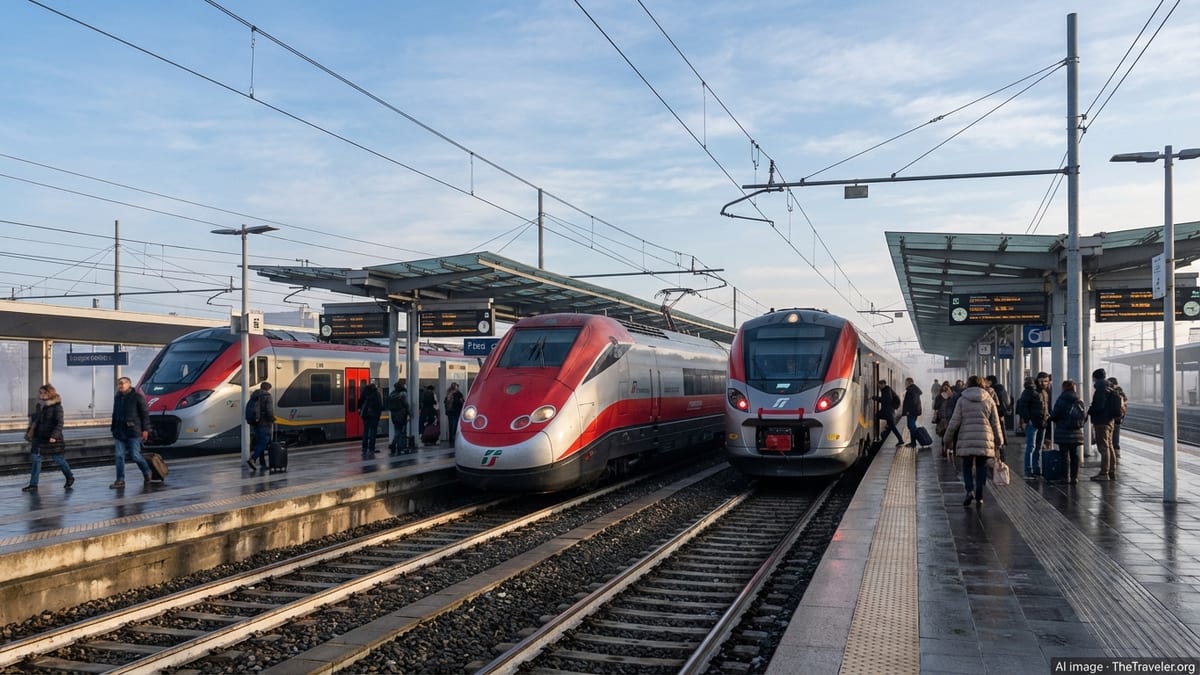
Homologation underway on the route to Germany
Publicly available rail industry documents and recent project updates indicate that Frecciarossa trainsets are now undergoing homologation procedures to run on both the Austrian and German networks. Homologation covers technical approval, compatibility with local signalling and power systems, and safety validation, and is a prerequisite before commercial services can begin.
The trains involved are based on the ETR 1000 platform, designed by Hitachi Rail and Bombardier and already cleared for service in several European countries. Earlier statements from Trenitalia and its suppliers have highlighted that these units were conceived from the outset as multi-system, multi-country trains, capable of meeting the technical standards required in markets including Germany and Austria.
Project documents associated with the cross-border corridor describe a so‑called “three-country high-speed train” concept, in which the same rolling stock operates seamlessly across Italy, Austria and Germany. The Frecciarossa fleet being prepared for the connection is being retrofitted and tested to comply with national rules and European interoperability standards along the entire route.
Reports on recent test activity suggest that dynamic trials are taking place on sections of the German and Austrian networks that will later form part of the commercial route. These tests typically verify braking performance, train protection systems and interaction with local infrastructure, as well as passenger comfort at high speeds.
Part of a broader Italy–Austria–Germany high-speed plan
The homologation phase is one component of a broader plan agreed between Trenitalia, Deutsche Bahn and Austrian operator ÖBB to introduce new high-speed passenger connections linking Italy with Germany and Austria. According to previous announcements and published coverage, the partners aim to start direct Frecciarossa services between Munich, Milan and Rome from the December 2026 timetable change.
The new services are expected to use the existing high-speed backbone in northern Italy combined with upgraded and high-performance lines through Austria and southern Germany. While full high-speed infrastructure is not yet continuous along the entire corridor, the use of high-performance sections and modern rolling stock is intended to significantly cut journey times between major cities.
Documents connected to European corridor planning describe the Italy–Austria–Germany link as part of a wider strategy to strengthen north–south rail axes across the Alps. The Frecciarossa deployment fits into this framework, complementing infrastructure investments such as capacity upgrades around the Brenner corridor and enhancements on German approach routes.
For rail passengers, the project is expected to create a new competitive option alongside existing daytime and night services, with one-seat rides between key Italian and German cities. The planned extension of the Frecciarossa brand beyond current international services reflects a broader European trend of high-speed operators entering new cross-border markets.
Frecciarossa 1000: built for multi-country operation
The Frecciarossa 1000, also known as the ETR 1000, is at the center of Trenitalia’s international expansion. Public technical overviews describe the train as a high-speed unit capable of up to 300 km/h in commercial service, equipped with multiple voltage systems and the European Train Control System to facilitate cross-border operation.
Manufacturer information and recent FS Group communications state that the latest generation of Frecciarossa trains has been designed to be compatible with up to seven foreign networks in addition to Italy. Germany and Austria are among the target markets, alongside France, Spain, Switzerland, the Netherlands and Belgium, reflecting a long-term strategy to position the fleet as a pan-European high-speed platform.
The homologation for Germany builds on experience already gained in other countries, notably France, where Frecciarossa services currently link cities such as Milan and Paris. Lessons from those approvals, including adapting to different signalling systems and operational rules, are understood to be informing the current test and certification campaigns in Central Europe.
By leveraging a single family of trains for multiple markets, Trenitalia aims to streamline maintenance, training and operations while offering a consistent on-board product. The same characteristics that made the Frecciarossa suitable for domestic Italian high-speed routes are now being applied to longer international links that span several rail networks.
Fleet expansion supports cross-border ambitions
The homologation effort coincides with a further expansion and renewal of the Frecciarossa fleet. In recent months, FS Group and Trenitalia have detailed investment plans for dozens of additional high-speed trainsets to be delivered over the coming years, with a view to strengthening both domestic and international services.
Press releases and financial summaries from the company indicate that these new-generation trains are intended not only to increase capacity on busy Italian corridors but also to underpin growth in international passenger volumes. The ability to deploy additional sets on cross-border routes is seen as important for offering more frequencies and for gradually extending the network to new destinations.
Industry observers note that the timing of new train deliveries, infrastructure upgrades and homologation milestones is closely linked. As more Frecciarossa units become available and approvals in Germany and Austria progress, the operators involved will have more flexibility to fine-tune timetables and roll out further extensions beyond the initial Munich–Milan–Rome link.
The investment in extra rolling stock also reflects strong demand on existing high-speed services within Italy and on established international routes. Public data from FS Group show continued growth in high-speed passenger-kilometres, supporting the case for additional trains that can be deployed both domestically and abroad.
What travelers can expect from the future Italy–Germany high-speed link
While final timetables and exact journey times are still subject to regulatory approvals and operational planning, published plans point to at least one direct daily Frecciarossa service linking Munich with Milan and Rome from late 2026. Over time, stakeholders involved in corridor planning have referenced possible extensions toward cities such as Berlin and Naples in later phases.
Travelers can expect a service model based on long-distance, limited-stop high-speed trains running across three countries without the need to change trains at the border. On board, the Frecciarossa concept typically features multiple service classes, a focus on comfort and amenities such as quiet, business-oriented spaces designed for longer journeys.
The new Italy–Germany high-speed connection is also being viewed in the context of wider efforts to encourage rail as an alternative to short and medium-haul flights within Europe. By offering through journeys between major population centers, the Frecciarossa services are intended to provide a competitive option in terms of total travel time when airport transfers and security procedures are taken into account.
As homologation progresses and more details of the operating plan are confirmed, travelers and the wider tourism industry are watching closely. The launch of regular Frecciarossa operations between Italy and Germany would mark another phase in the gradual knitting together of Europe’s high-speed networks, opening new possibilities for cross-border city breaks and multi-country itineraries built around fast, direct rail connections.