

More news on this day
Transport planners in Europe, Asia and North America are recasting rail strategies around a simple idea with complex implications for investment: long-distance passenger services and cross-border freight flows must be treated as equally important pillars of future mobility.
Get the latest news straight to your inbox!
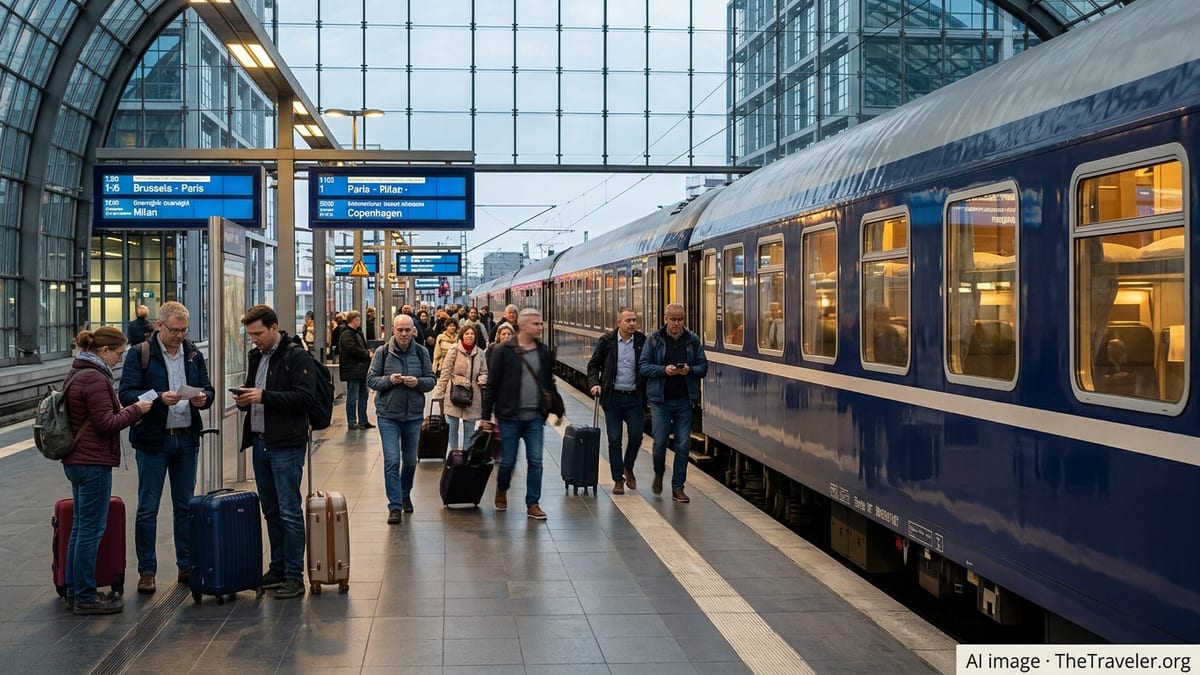
Policy resets put passengers and freight on the same map
Recent policy documents and infrastructure plans on both sides of the Atlantic increasingly frame rail networks as integrated systems, where long-distance passenger services and international freight corridors are planned together rather than in isolation. European Union work on the Trans-European Transport Network, for example, now links high speed passenger targets with dedicated freight corridors along the same strategic axes, with completion milestones set for 2040 and 2050. Publicly available information highlights that these European Transport Corridors are expected to carry both fast passenger trains and heavy freight, reflecting a shift away from treating them as competing modes.
In parallel, United States federal transport reporting points to hundreds of passenger rail projects being advanced alongside grade-separation and capacity upgrades on key freight routes. The focus is not only on flagship high speed corridors, but also on the reliability of conventional long-distance trains that largely run over privately owned freight tracks. By coupling public investment in passenger services with improvements to freight handling and safety, planners are attempting to demonstrate that both market segments can gain from shared infrastructure.
Climate and energy considerations are a major factor in this convergence. Long-distance journeys, whether by people or goods, generate a disproportionate share of emissions, and rail is frequently cited as a lower-carbon alternative to long-haul road and air transport. Policy briefings and research studies in Europe describe a desired modal shift in which more cross-border freight moves from trucks to trains and more passengers choose night trains or high speed rail instead of short and medium-haul flights.
At the same time, reports underline that achieving these goals requires coherent timetabling, capacity allocation and cross-border standards that balance the needs of long-distance intercity trains with freight paths. The new generation of rail capacity rules developing in Europe is presented as one response, seeking to give operators clearer and more predictable access to busy international routes.
Europe tests integrated corridors and night trains
Across the European Union, recent regulatory updates and planning blueprints place long-distance passenger services and international rail freight in a shared framework. The latest revision of the Trans-European Transport Network legislation links high speed passenger performance targets with requirements for freight-friendly gradients, loading profiles and connectivity to ports and logistics hubs. According to publicly available Council and Commission material, cross-border links are being prioritised so that missing sections between countries are completed earlier than the wider network.
The same approach is visible in new capacity-management rules intended to simplify cross-border operations. Draft texts and explanatory notes emphasise that freight operators have long criticised fragmented slot-allocation practices along key corridors, while passenger operators have struggled with late path changes and congestion. The new regulation proposes common processes intended to benefit both groups, reflecting the view that the performance of each depends on the other along shared routes.
Night trains sit at the intersection of this debate. Coverage of European sleeper services points to strong public interest and new rolling stock orders from operators that see an opportunity in long-distance overnight travel. At the same time, analysis indicates that night trains can incur high operating costs and depend heavily on access to suitable paths on mixed-traffic lines that are also used by freight services, particularly during off-peak hours. Industry reports note that some planned night routes have been cancelled or postponed where infrastructure capacity or financial support could not be secured.
Several European governments and regional authorities are experimenting with service contracts, public tenders and cooperative ventures between national railways and open-access operators to keep long-distance and cross-border trains running. Monitoring platforms that track cross-border rail services highlight both successful new links and persistent gaps, illustrating how sensitive these services are to timetable planning, cross-border staffing, rolling-stock approvals and infrastructure funding.
Asia’s land bridges highlight freight’s strategic role
While Europe focuses on knitting together national systems, rail corridors between Asia and Europe underline how central cross-border freight has become to international logistics. Official statistics and trade press coverage show that China–Europe rail services have seen rapid growth over the past decade, with tens of thousands of freight trains now running annually on multiple routes linking dozens of Chinese and European cities. These services carry a growing share of trade value between the two regions and are framed as part of a broader effort to secure more resilient, diversified supply chains.
Recent reports from operators and logistics firms indicate that 2026 is on track for record numbers of China–Europe freight trains, including via alternative alignments that cross Central Asia and the Caspian Sea before reaching Europe. Proponents argue that these rail routes offer shorter transit times than ocean shipping and a lower emissions profile than long-haul air freight, though costs and capacity remain sensitive to geopolitical developments.
Passenger rail plays a different, but related, role along these Asian corridors. Cross-border services between countries in Central Asia, across parts of Eastern Europe and into Western China are being upgraded or extended, often using the same mainlines that host heavy freight trains. International organisations describe these projects as components of a wider transcontinental rail grid intended to support both regional mobility and long-range trade.
Planning documents and academic assessments stress that managing the interaction between long-distance passenger trains and dense freight flows is a technical and political challenge. Issues range from customs procedures at borders, through compatible signalling and safety rules, to decisions about where to invest in extra tracks, passing loops or entirely new alignments dedicated mainly to freight. The evolution of the Eurasian land bridges shows that freight alone can justify major cross-border investment, but that passenger connections are crucial in turning corridors into development axes for the regions they traverse.
North American debates over sharing freight tracks
In North America, the balance between long-distance passenger rail and cross-border freight is framed differently but raises familiar questions. The United States relies heavily on privately owned freight railroads whose main business is moving bulk commodities and intermodal containers domestically and across borders with Canada and Mexico. Amtrak and a growing number of regional agencies operate passenger services on many of these lines under negotiated access agreements.
Federal progress reports and policy discussions describe sizable funding commitments to improve intercity passenger rail while upgrading infrastructure that freight carriers also use. Examples include projects to add passing tracks, modernise signalling, remove level crossings and separate passenger and freight flows on congested segments. These investments are frequently justified in public documentation as delivering dual benefits: faster, more reliable passenger trains and more efficient, safer freight operations.
At the same time, debate continues about the role of long-distance passenger routes that traverse multiple states, often with relatively low frequencies and long end-to-end journey times. Some stakeholders argue that resources should focus on shorter, higher-frequency corridors anchored on major metropolitan regions, while others view the national long-distance network as essential for connectivity, resilience and tourism. The shared use of freight tracks intensifies this discussion, since dispatching decisions and train length trends directly affect timetable reliability for passenger services.
In Canada and Mexico, similar dynamics are visible where publicly supported passenger services operate on networks otherwise dominated by freight. Cross-border freight movements between the three countries are widely seen as critical to integrated supply chains under updated trade agreements, and rail is a core part of that system. Public analyses note that any substantial expansion of long-distance passenger service will need to dovetail with freight capacity planning, making joint corridor strategies increasingly important.
Capacity, digitalisation and climate targets drive integration
Across regions, a set of common themes underpins the emerging view that long-distance passenger rail and cross-border freight are equally important. One is network capacity. Studies released in Europe and North America highlight bottlenecks along strategic corridors where infrastructure is heavily used but difficult or expensive to expand. In such locations, decisions about allocating track slots between long passenger trains and long freight consists directly influence the viability of both markets.
Another theme is digitalisation. New capacity-management regulations, industry research programmes and pilot projects point to the potential of advanced traffic management systems, automatic train operation and improved data sharing to squeeze more performance out of existing tracks. These tools are designed to support mixed-traffic operations, where precise information about train positions, speeds and routing allows both freight and passenger services to run more punctually and with reduced headways, particularly on busy cross-border lines.
Climate law and environmental reporting frameworks also contribute to the convergence. European climate-neutrality scenarios, for example, explicitly assume that by mid-century a far larger share of both passenger-kilometres and tonne-kilometres will be carried by rail instead of road or air. Similar modelling exercises in other regions describe rail as a backbone for low-carbon transport, but they tend to stress that this outcome is achievable only if passenger and freight planning are aligned and supported by predictable long-term funding.
Industry and policy analyses converge on the idea that choosing between long-distance passengers and cross-border freight is a false dichotomy. The most recent strategies emphasise corridor-based planning, interoperability and service design that recognise both as critical to economic competitiveness, territorial cohesion and decarbonisation. How effectively governments, regulators and operators translate that principle into day-to-day timetables and investment choices will shape international mobility and trade flows for decades.