


More news on this day
Typhoon No. 7 is rapidly reshaping travel plans across Japan, as rail operators scale back services and highway authorities prepare for closures amid heavy rain, strong winds and the approach of a second storm system.
Get the latest news straight to your inbox!
Railway Suspensions and Reduced Services Intensify
As Typhoon No. 7 moves toward central Japan, publicly available information shows that disruption is already spreading across major rail corridors. In the Tokai region on June 26, sections of the JR Tokaido Line between Sekigahara and Maibara were suspended after intense rainfall, affecting connections between Nagoya and western Japan. Regional broadcasters report that services are being reviewed on an hour-by-hour basis as rain bands pass over key stretches of track.
On the high-speed network, coverage from Japanese media indicates that JR Central has warned of possible large-scale changes on the Tokaido Shinkansen from the first trains on June 27. Depending on the strength and exact track of the storm, this could range from speed restrictions and extended delays to partial or full suspensions on some sections. Travelers planning trips between Tokyo, Nagoya, Kyoto and Osaka are being urged, through public advisories, to check status information repeatedly in the 24 hours before departure and be ready to adjust plans.
Local and regional railways in Shizuoka, Aichi, Gifu and Mie prefectures are also adjusting operations. Outlines of operating plans published by JR Central for the Shizuoka area show that conventional lines between Atami and Hamamatsu will run on sharply reduced timetables on June 27, with some trains preemptively cancelled. Similar precautionary reductions are being prepared on other coastal and mountain routes where strong crosswinds and the risk of landslides are highest.
Rail operators are emphasizing that even after the worst of the wind and rain pass, inspections of tracks, embankments and power lines may delay the resumption of normal timetables. Experience from previous typhoon seasons suggests that some rural or coastal sections could see longer disruptions if slopes or bridges sustain damage.
Expressway Closures and Road Risk Grow With Heavy Rain
The impact of Typhoon No. 7 is not limited to rail. Highway companies and local governments are moving toward phased closures of major expressways as rainfall intensifies. Traffic advisories note the possibility of speed limits being sharply reduced, followed by closures of elevated and coastal sections if winds strengthen further or visibility deteriorates.
Forecasters expect particularly heavy rain across Gifu, Aichi and Mie through June 27, increasing the likelihood of surface flooding and debris on roads. Japan’s mountainous terrain leaves many arterial routes vulnerable to landslides and rockfalls, and authorities are watching slopes near long viaducts and tunnels along key east–west corridors. Drivers have been advised through official bulletins to avoid overnight intercity travel where possible and to plan alternative dates rather than relying on detours through smaller mountain roads.
Service areas and rest facilities along affected expressways are also preparing for temporary crowding as truck drivers and long-distance motorists wait out the worst of the storm. Past events show that once closures are lifted, congestion can persist for several hours as accumulated traffic moves through bottlenecks at reduced speeds.
Even in urban areas where expressways remain open, surface streets are expected to experience localized flooding and traffic light failures. Travelers relying on airport buses, long-distance coaches or rental cars are being encouraged via public travel advisories to build in additional time and to prepare for last-minute cancellations if key interchanges or river crossings are shut.
Air Travel Disruptions Compound Ground Transport Challenges
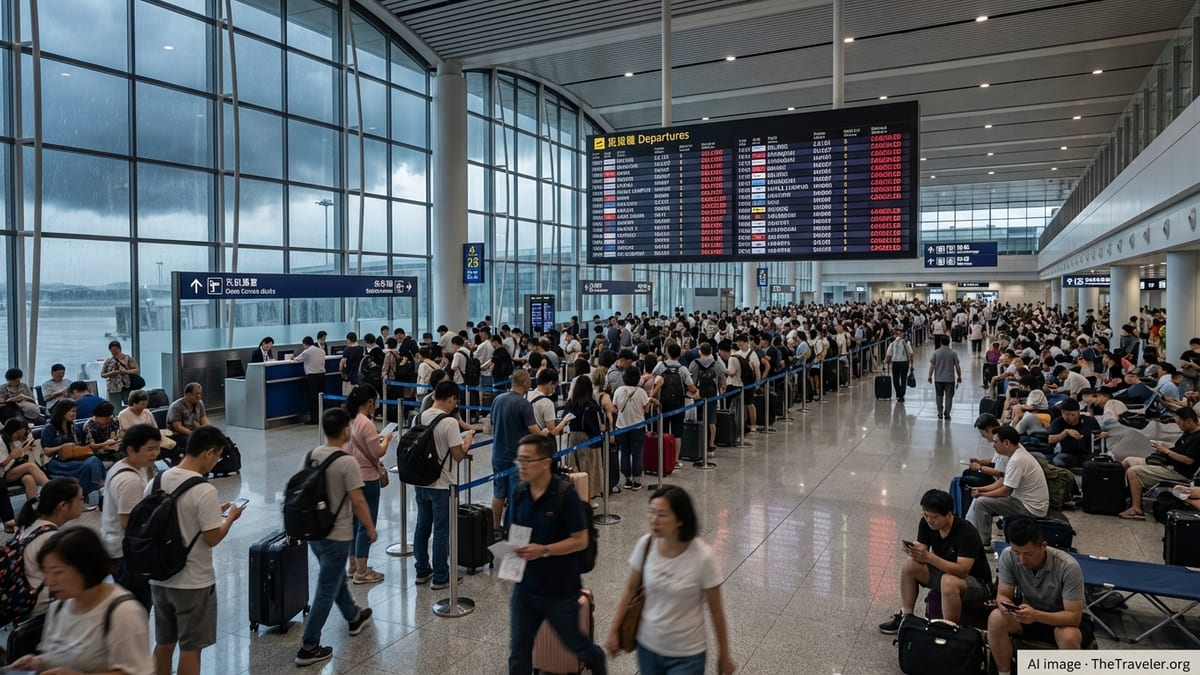
While the primary focus has been on rail and expressways, air travel is already feeling the effects of Typhoon No. 7. Broadcast reports and airline statements aggregated by Japanese media show a growing number of cancelled and delayed domestic flights, particularly on routes linking Tokyo and Osaka with Kyushu and the Nansei Islands. Some carriers have begun issuing change-fee waivers and encouraging passengers to switch to earlier or later departures where seats are available.
As rain and wind intensify along the Pacific coast of Honshu, additional cancellations are expected at Tokyo’s Haneda and Narita airports, as well as at Chubu Centrair near Nagoya and Kansai International Airport serving Osaka. Ground handling operations, including baggage loading and aircraft towing, are especially sensitive to gusty conditions and lightning, and safety protocols can trigger sudden pauses that cascade into broader delays.
For travelers hoping to transfer between air and rail, the combination of disrupted flight schedules and reduced train frequencies presents a particular challenge. Missed connections from delayed flights to the last Shinkansen of the evening, or to the final local trains to regional cities, may leave passengers unexpectedly needing overnight accommodation near major hubs.
Travel industry coverage notes that hotels around Tokyo, Nagoya, Kyoto and Osaka tend to fill quickly around major typhoon events, especially near main stations and airports. Visitors are being urged in consumer advisories to secure flexible bookings ahead of time rather than waiting to see how the storm evolves.
Double-Typhoon Pattern Raises Risk of Prolonged Disruption
Complicating the situation, Typhoon No. 7 is moving in tandem with Typhoon No. 8 in what meteorologists describe as a double-typhoon pattern. Weather services report that moisture from the second system is feeding into a seasonal rain front over western and central Japan, intensifying downpours even before the center of Typhoon No. 7 draws close to land.
This interaction increases the risk that rainfall totals will stay high over several days, beyond the period when the strongest winds are expected. For transport networks, that raises concerns about saturated slopes, swollen rivers and repeated waterlogging of track beds and road surfaces. Even if initial inspections after the first storm pass are favorable, lingering instability may prompt operators to maintain conservative timetables or keep some sections closed longer than usual.
Weather-focused outlets highlight that previous seasons have seen secondary impacts, such as delayed landslides or collapsing retaining walls, emerging a day or more after the peak of a typhoon. As a result, travelers and local residents are being advised in public information campaigns to stay attentive to updated warnings through the weekend, rather than assuming that all risks end once the eye of the storm has moved away.
Emergency management updates also point out that ferry operators and smaller coastal transport services are highly sensitive to wave conditions generated by successive storms. Even if mainline trains and expressways begin to normalize, services to islands and remote peninsulas may remain suspended while seas stay rough.
Advice for Travelers Navigating Japan During Typhoon No. 7
For domestic and international travelers currently in Japan, transport specialists and travel advisories emphasize preparation and flexibility. Rail companies typically publish next-day operating plans for major typhoon events by the previous afternoon, including estimates of how many trains will run on key sections and during which time windows. Checking these plans before setting out and treating them as provisional, rather than guaranteed, can reduce the risk of being stranded mid-journey.
Travel-focused guidance also encourages passengers to keep essential items on hand in case they are forced to wait in stations or service areas. Power banks, light snacks, water and basic medications can be helpful if retail outlets close early or become crowded. When disruption is widespread, mobile networks and transport apps may slow down under heavy demand, so taking screenshots of reservation details and route options is recommended.
Visitors unfamiliar with Japan’s typhoon season are being reminded through tourism information channels that operators generally err on the side of caution, suspending services before conditions reach dangerous levels and restoring them only after safety checks are complete. While this conservative approach can be frustrating for those facing cancelled plans, it is designed to minimize serious incidents on densely used railways and highways.
As Typhoon No. 7 approaches its closest pass to the Tokai and surrounding regions, the pattern of preemptive rail suspensions, reduced expressway capacity and rolling air cancellations is likely to continue evolving through the weekend. For now, the clearest message from publicly available information is that anyone planning to travel across Japan in the coming days should monitor official updates closely and be ready to change departure times, routes or even destinations at short notice.