


More news on this day
Passengers flying between the United Arab Emirates and Kuwait are facing fresh disruption this weekend, with services operated by Emirates, Etihad Airways and Air Arabia affected by a combination of Kuwait Airport constraints and wider regional airspace tensions.
Get the latest news straight to your inbox!
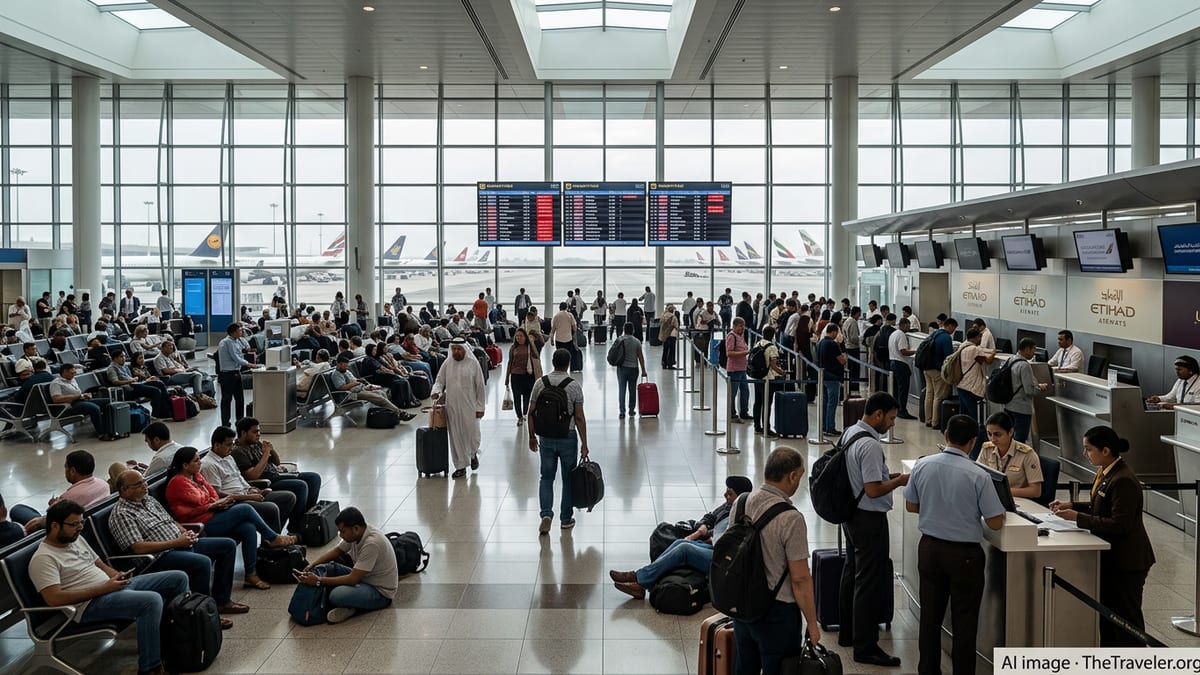
Kuwait Airport recovery slows amid renewed operational constraints
Published coverage indicates that Kuwait International Airport is once again at the center of regional aviation turbulence, with outbound and inbound schedules remaining fragile despite a phased reopening plan announced earlier in the summer. After months of limited or suspended international operations following drone strikes and airspace closures linked to the Iran conflict, flights by foreign carriers have been returning only gradually, and often with reduced frequencies.
Reports from regional outlets suggest that while Kuwait’s own airlines have rebuilt much of their network, the infrastructure and security checks required for a full restoration of foreign services are still constraining capacity. This has created a bottleneck for high-demand routes, notably those connecting Kuwait City with major Gulf hubs such as Dubai, Abu Dhabi and Sharjah, where UAE carriers typically feed large numbers of onward connections to Europe, Asia and North America.
Publicly available flight-tracking and airport data show an irregular pattern of departures on some UAE routes, with short-notice cancellations and aircraft substitutions now a recurring feature. For travelers, that means that tickets purchased weeks ahead are not always a reliable indicator of whether a specific flight will operate as planned on the day of travel.
The fragile status of Kuwait’s international operations means that even small shifts in the regional security or airspace picture can cascade rapidly into widespread schedule changes, especially for airlines whose networks depend on tight rotation times and high aircraft utilization.
Emirates trims Dubai–Kuwait schedule and reroutes passengers
Dubai-based Emirates has emerged as one of the most visibly affected carriers on the UAE–Kuwait corridor. According to updated schedules cited in regional business media, the airline has cancelled multiple Dubai–Kuwait rotations through at least July 19, focusing instead on consolidating passengers onto a smaller number of flights in each direction.
Customer advisories and disruption FAQs on the airline’s official channels outline standard measures that are now being applied more frequently on this route, including automatic rebooking onto the next available service, the option to adjust travel dates without additional change fees on impacted tickets, and, in some cases, rerouting via alternative Gulf gateways if suitable connections exist. These policies, designed for occasional irregular operations, are being tested by a prolonged period of instability affecting Kuwait and surrounding airspace.
Operationally, Emirates is contending with two overlapping challenges: the constrained handling capacity at Kuwait International Airport itself and the need to navigate evolving regional airspace restrictions that can lengthen flight times and complicate aircraft rotations. Industry analysis indicates that the carrier has prioritized protecting long-haul bank waves in Dubai, even if that means cutting back on short regional sectors like Kuwait when disruptions intensify.
The net effect for travelers is a higher likelihood of last-minute notices, with some passengers advised not to proceed to the airport until their flight status has been reconfirmed close to departure. Travel agencies and corporate travel managers are also reporting an uptick in itinerary changes for journeys that rely on the Dubai–Kuwait leg as a feeder or final segment.
Etihad and Air Arabia adjust networks as Gulf airspace remains tight
Etihad Airways and low-cost group Air Arabia are also adjusting their operations in response to the prolonged uncertainty around Kuwait and the broader Gulf region. Flight information carried by regional media lists certain Etihad services between Abu Dhabi and Kuwait as “awaiting update,” reflecting a degree of day-to-day contingency planning while the airline weighs aircraft deployment across its network.
Etihad, which has already been managing schedule changes linked to earlier periods of airspace closure and rerouting over the northern Gulf, is now balancing the restoration of key long-haul connections with the risk of ongoing volatility on short-haul regional routes. Where possible, passengers affected by Abu Dhabi–Kuwait cancellations are being offered alternative dates or routings, but capacity is limited due to tighter slot availability and longer flight times on some other sectors.
Air Arabia, operating from hubs in Sharjah, Abu Dhabi and Ras Al Khaimah, has in recent months focused on rebuilding its broader regional and European network, even as it navigates disruptions at specific airports such as Abha in southern Saudi Arabia. On the Kuwait route, publicly available information suggests that the airline is combining selective cancellations with upgauging on remaining flights in an effort to carry as many booked passengers as possible.
For budget-conscious travelers used to relying on Air Arabia’s dense Gulf network, the new environment means fewer same-day alternatives when a flight is pulled from the schedule, and a greater reliance on travel insurance or flexible fares to mitigate the risk of last-minute changes.
Regional tensions, airspace closures and knock-on effects
The latest wave of disruptions on UAE–Kuwait routes cannot be viewed in isolation. Aviation data and policy briefings trace the root cause to the broader conflict involving Iran and a coalition of regional and Western states, which has led to repeated airspace closures, temporary suspension of operations at key hubs and ongoing caution around certain flight paths.
Economic analysis of the 2026 Iran conflict highlights the cumulative impact on Gulf aviation, with closures over parts of Iran, Iraq, Kuwait and neighboring states forcing airlines to reroute or suspend flights entirely for periods earlier this year. While many restrictions have since been eased or refined, the airspace picture remains complex, with local authorities and international regulators issuing evolving guidance that airlines must incorporate into their daily operational planning.
For UAE carriers like Emirates, Etihad and Air Arabia, the result is a schedule that may appear largely restored on paper but still carries a higher risk of disruption than in previous years, particularly on routes into airports that have experienced direct infrastructure damage or prolonged shutdowns. Kuwait, which has had to manage both physical repairs and heightened security considerations, remains near the top of that risk list.
The knock-on effects stretch beyond point-to-point traffic. Because Dubai, Abu Dhabi and Sharjah function as major connecting hubs, any instability on feeder routes such as Kuwait can ripple out into long-haul networks, affecting passengers who may only be transiting the Gulf without intending to stay there.
What travelers between the UAE and Kuwait should expect now
For passengers planning trips between the UAE and Kuwait in the coming days, industry advisories and airline customer updates point to a few consistent themes. Schedules remain subject to change at short notice, particularly on Emirates flights between Dubai and Kuwait and on selected Etihad and Air Arabia services that rely on Kuwait’s evolving operational capacity.
Travelers are being encouraged, through publicly available airline and airport guidance, to monitor their flight status closely in the 24 to 48 hours before departure and again on the day of travel. Many carriers now emphasize the importance of email, SMS and mobile app notifications, which can provide near real time updates on gate changes, delays or cancellations.
Experts following the Gulf aviation sector note that some degree of disruption is likely to persist through the peak summer period, even if no further major incidents occur. With airspace routing still constrained on parts of the northern Gulf and Kuwait Airport operating below optimal capacity, carriers can do little more than build additional slack into their schedules and adjust day by day.
For now, passengers flying between the UAE and Kuwait are advised to allow extra time for connections, consider more flexible ticket options where possible and be prepared for the possibility that their chosen flight with Emirates, Etihad or Air Arabia may operate at a different time, or not at all, compared with the original booking.