


More news on this day
Britain is moving into line with partners including the United States, Canada and Turkey in warning of a turbulent peak summer season for travel to Europe, as the European Union’s new Entry Exit System continues to trigger long queues, missed connections and mounting frustration across major Schengen hubs.
Get the latest news straight to your inbox!
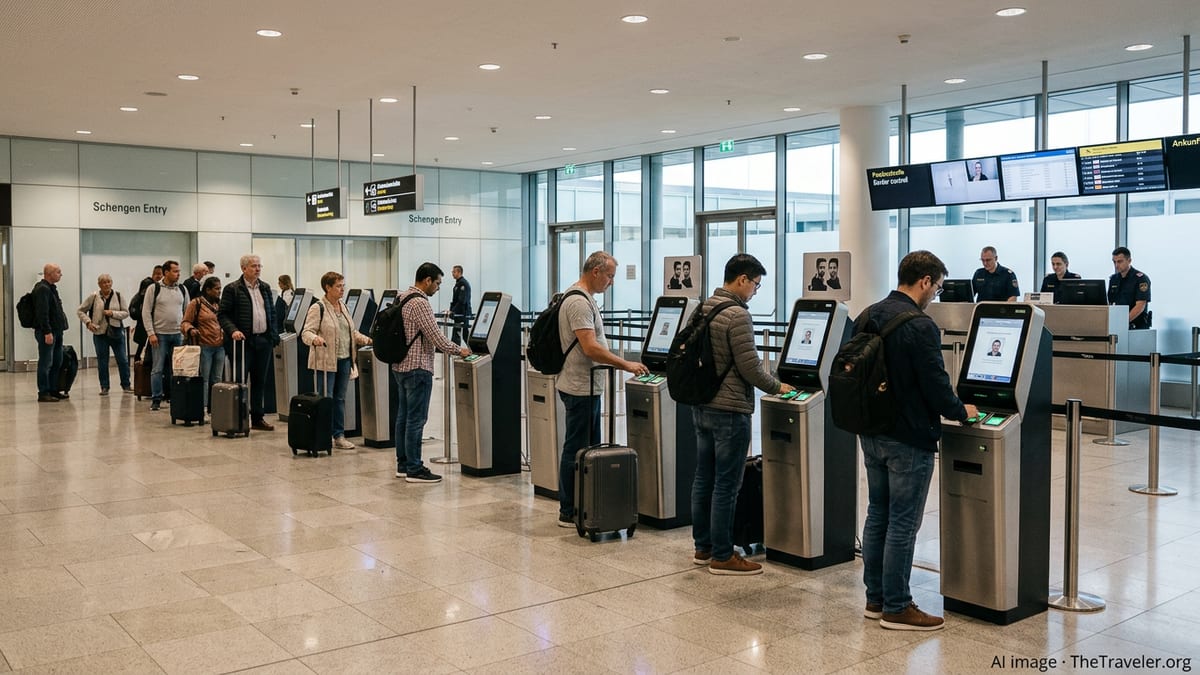
EES Rollout Drives Prolonged Queues Across Schengen Airports
The EU’s biometric Entry Exit System, fully operational at air borders since April 2026 after a staged introduction from late 2025, was intended to modernise checks on non-EU visitors. Instead, reports from aviation bodies and travel media describe a pattern of “chaos” at border posts, with processing times sharply higher than before and bottlenecks at peak hours in France, Spain, Greece and other holiday hotspots.
Industry assessments suggest that the replacement of manual passport stamping with biometric registration, including facial images and fingerprints, has lengthened individual checks and exposed limits in staffing and infrastructure. Airport groups have warned that processing times at some border points have increased by up to 70 per cent, with queues stretching to several hours during busy weekend peaks, particularly where multiple long haul flights arrive within tight windows.
European aviation associations have urged Brussels to show greater flexibility in how EES is applied, describing the system as being at a “critical point” as millions of travellers try to move through Europe’s airports this summer. Calls have included limited suspensions or relaxed use of the system at the most congested hubs, arguing that without adjustments, disruption and missed flights will intensify through July and August.
Publicly available information from civil aviation authorities confirms that countries such as Greece have now rolled out EES at all air border crossing points, while local reports from Spain, Portugal, Italy and France highlight variable performance between airports and even between terminals. Travellers continue to share accounts of unpredictable queues, with some flows remaining relatively smooth and others snarled for hours when systems slow or additional checks are triggered.
UK Aligns Its Warning With North American and Turkish Partners
Against that backdrop, the United Kingdom has sharpened its messaging to outbound travellers, bringing it closer to advisories already issued by the United States, Canada and Turkey warning of longer waits at Schengen borders. Government travel guidance now places the EU Entry Exit System front and centre for anyone planning a trip to the 29 participating European countries, stressing that British citizens are treated as non-EU nationals for the purpose of the new automated regime.
The UK had been preparing for the impact of EES for some time, funding registration kiosks and infrastructure at key juxtaposed border points such as Dover, Eurotunnel and Eurostar terminals. But as evidence of disruption has mounted, the tone of official information has shifted from technical explanation to explicit caution that travellers should allow substantially more time for checks before departure and on arrival.
Recent public statements from UK ministers indicate that London is now pressing EU counterparts for practical measures to ease the pressure over the peak holiday period. According to government readouts, the Transport Secretary has been in contact with senior European figures to seek assurances that border processes will be managed in a way that keeps queues and missed departures to a minimum, particularly where EU checks are carried out on British soil.
This firmer stance brings the UK closer to the position already taken by North American partners. Guidance from United States agencies has for months advised citizens that they must pass through the new EU system and may face delays, while Canadian travel information similarly flags the change in procedures at Schengen borders. Turkish authorities have highlighted the new requirements to their own outbound holidaymakers, many of whom travel to Schengen destinations in the Mediterranean.
Dover, Eurostar and Airports Face a Stress Test
Nowhere is the UK’s exposure to EES clearer than at its juxtaposed controls, where EU border checks take place before travellers even leave the country. The system affects ferry passengers at Dover, rail passengers on Eurostar and those using the Channel Tunnel, placing new strain on ports and stations that already operate close to capacity during school holidays and long weekends.
Parliamentary material and media coverage in Britain describe concerns that the new EU checks are compounding existing bottlenecks. A series of holiday weekends since the system’s launch has produced high profile queues on routes to France, with coaches and private vehicles held for extended periods as travellers are processed through the biometric stages one by one. Industry groups have warned that further spikes in demand later in July and into August could again push infrastructure to its limits.
Airports serving popular Schengen destinations are also bracing for impact. While UK border controls for arriving passengers are unaffected by EES, outbound terminals depend on the ability of partner airports in Spain, Greece, Italy and elsewhere to process returning passengers on time. Airlines have already reported missed connections and departure delays where incoming non-EU passengers have been unable to clear border control quickly enough to make their flights.
Operators are urging holidaymakers to pay close attention to carrier guidance, arrive earlier than usual at departure points and move towards gates as soon as boarding information appears, particularly on return legs from busy Mediterranean hubs. They warn that leaving border formalities to the last minute in the expectation of pre-pandemic processing times is now a recipe for missed flights and disrupted itineraries.
Airlines and Airports Call for Temporary Flexibility
Across Europe, airline and airport associations are intensifying pressure on Brussels to grant more latitude in how EES is deployed during the height of the summer season. Statements from organisations representing carriers, hubs and the wider tourism industry argue that without targeted relief, current wait times risk turning into what some describe as systemic disruption affecting millions of passengers.
Proposals floated in recent weeks include authorised pauses or partial suspensions of EES processing during the busiest peaks at specific airports, reallocating staff to manual lanes, and clearer guidance on when and how alternative procedures can be used to keep queues moving. Industry representatives emphasise that the underlying objective of strengthening border security is not in question, but contend that the pace and manner of implementation have not adequately accounted for seasonal demand pressures.
European travel and tourism bodies have publicly backed an open letter to senior EU leaders urging them to act before the core summer weeks. They warn that reputational damage to Europe as a destination, combined with the practical cost of delays and missed flights, could outweigh the intended benefits of the system if adjustments are not made. For many airlines still rebuilding finances after the pandemic, additional operational disruption translates directly into higher costs and strained schedules.
For now, however, the European Commission has signalled that it expects Schengen states to work within the existing framework, focusing on local improvements in staffing, equipment and passenger communications. An EU official has suggested that it could take up to two years for the system to stabilise fully, a timeline that points to further summers of adjustment unless processes are significantly refined.
What Summer Travellers Should Expect in the Coming Weeks
For British travellers and their counterparts in North America and Turkey, the practical reality this summer is a border system that remains in transition. While many journeys continue to pass smoothly, the risk of encountering lengthy queues at EES checkpoints is materially higher than in previous years, especially when entering or exiting major hubs in France, Spain, Greece, Portugal and Italy during peak hours.
Travel organisations and consumer groups are advising passengers to build greater flexibility into their plans, including longer connection times when transiting through Schengen hubs and an expectation that journeys which once felt routine may now involve unpredictable waits. Some carriers have quietly adjusted schedules or boarding cut off times to accommodate the new constraints, but late arriving passengers are still at greater risk of being offloaded.
There is also a growing focus on clear information at departure points. Authorities and operators in the UK and across Europe are working to expand signage, staff briefings and digital updates so that passengers understand when they will encounter EES checks and what documents or biometrics will be required. The aim is to reduce confusion at kiosks and booths, which has been a recurring trigger for slowdowns in the early months of full operation.
With the peak school holiday period only just beginning, the coming weeks are expected to serve as a major test for the resilience of the new border regime and for the coordination between the UK, Schengen states and long haul partners. Whether incremental fixes and better communication will be enough to prevent another round of headline grabbing queues remains an open question for travellers contemplating European trips this summer.