


More news on this day
Air travel across Europe faced fresh disruption this week as data from flight-tracking and passenger-rights platforms indicated at least 65 cancellations and nearly 2,000 delays in a single day, affecting routes to and from England, France, Portugal and Italy and hitting major carriers including Air France, British Airways and KLM.
Get the latest news straight to your inbox!
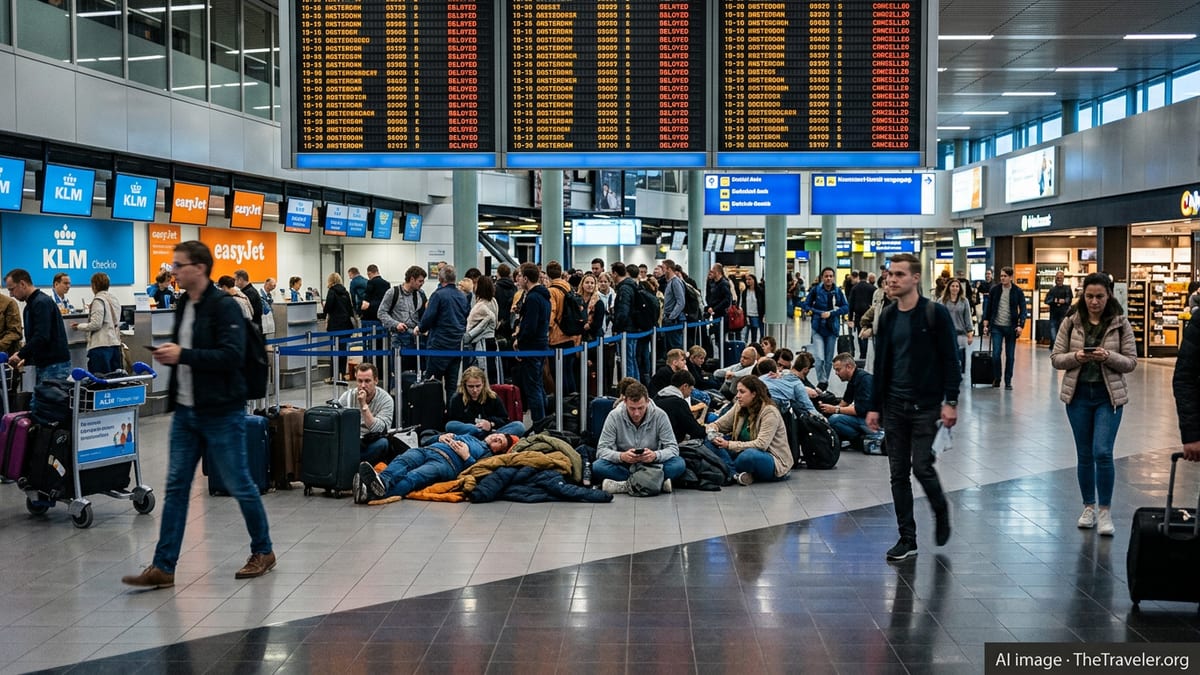
Operational Strain At Key European Hubs
Recent figures from disruption-monitoring services point to mounting pressure on airports in London, Paris, Amsterdam, Lisbon, Porto and major Italian cities, where a combination of air traffic control restrictions, weather constraints and busy summer schedules has pushed punctuality well below seasonal norms. Coverage focusing on late June and early July shows that London Heathrow, London Gatwick, Madrid Barajas and Amsterdam Schiphol have repeatedly featured among Europe’s worst performers for delays and day-of-travel cancellations.
Publicly available statistics for one recent peak day showed more than 1,500 delayed flights and close to 100 cancellations across Europe, with a sizeable share touching the United Kingdom, France, Portugal and Italy. These pressures have continued into mid-July, with at least 65 cancellations and 1,997 delays reported on another day of heavy disruption, according to aggregated operational data from passenger-advocacy sites and aviation analytics firms.
Legacy network airlines have been particularly exposed because of their reliance on congested hubs. Air France and KLM operations at Paris Charles de Gaulle and Amsterdam Schiphol, and British Airways at London Heathrow and Gatwick, have all faced rolling knock-on effects when early morning delays or cancellations cascade through tightly timed schedules.
Eurocontrol’s latest overviews of European aviation trends underline the structural challenge, noting that average air traffic flow management delay per flight has climbed as the summer season intensifies, with en route bottlenecks and airport capacity constraints combining to erode on-time performance across the region.
Air France, British Airways And KLM Battle Knock-On Effects
For Air France, the disruption comes as the carrier ramps up its 2026 summer schedule and continues shifting all Paris operations to Charles de Gaulle, a transition that concentrates more traffic at an already busy hub. Public information from the airline’s schedule updates shows expanded services on a number of European and long haul routes, leaving limited slack when individual rotations run late or aircraft and crew are out of position.
British Airways has likewise faced strain on short haul and medium haul services from the United Kingdom, where peak summer demand overlaps with air traffic control flow restrictions and congested ground handling. The airline’s own customer guidance notes that flights delayed beyond three hours may trigger compensation in some circumstances, while cancellations can lead to rebooking or refunds, although the level of support varies depending on the cause and notice period.
KLM, operating from Amsterdam Schiphol, has published travel alerts through its disruption pages for a rolling list of destinations, acknowledging that customers on affected flights may be able to rebook or claim refunds when cancellations and long delays occur. Passenger accounts shared publicly over recent weeks describe missed connections, overnight rebookings via partner airlines and baggage complications when itineraries are re-routed at short notice.
Collectively, the three carriers form the backbone of European connectivity for many travelers heading to and from England, France, Portugal and Italy, often via their respective hubs. When issues arise at those hubs, passengers across the continent can experience disruption even if their origin and destination airports are not themselves under particular strain.
England, France, Portugal And Italy Among Hardest Hit
Country-level breakdowns from passenger-rights platforms highlight repeated disruption in several popular holiday markets. In Italy, one recent reporting period cited more than 200 cancellations and over 700 delays in a single day, affecting a wide range of airlines including Air France, British Airways and KLM as well as local and low cost operators. A mixture of air traffic control regulations, operational challenges and localized weather factors contributed to the difficult operating environment.
Portugal has seen similar pressure at Lisbon, Porto and Faro, with reports describing a month long pattern of higher-than-normal delays as airlines work through tight summer schedules. Even when flights are not cancelled outright, extended hold times on the ground or in the air have led to late evening arrivals and missed onward connections.
In England, a combination of busy hub operations at Heathrow and Gatwick and network congestion across Europe has translated into repeated early morning disruption that then ripples through the day. Publicly available advice from the UK Civil Aviation Authority for summer 2026 warns that passengers experiencing delays or cancellations leaving or returning to the United Kingdom may be entitled to assistance and, in certains cases, monetary compensation, depending on notice periods and the underlying cause.
France is similarly exposed through Paris and regional airports such as Nice and Lyon. Earlier weather events and capacity issues have already tested resilience at these gateways during the current travel year, and any new round of storms or airspace restrictions risks further stressing operations at the national carrier and its competitors.
What Disruption Means For Passengers This Summer
The latest wave of cancellations and delays underscores how quickly conditions can deteriorate for travelers, even when only a small proportion of total flights are scrubbed. With more than 1,900 delays recorded on some recent days, many passengers are arriving hours behind schedule or missing onward legs despite their flights ultimately operating.
Consumer advocates point to European and UK passenger rights legislation as a crucial safeguard in this environment. Under these frameworks, travelers on qualifying itineraries may be entitled to meals, accommodation and re-routing when flights are heavily delayed or cancelled, and in some situations can claim fixed-sum compensation. However, airlines frequently cite extraordinary circumstances such as air traffic control strikes or severe weather as grounds to decline compensation, which can leave passengers frustrated even when practical support like hotel rooms or rebooking is provided.
Publicly available guidance stresses the importance of keeping boarding passes, booking confirmations and written records from airlines when disruptions occur. These documents can be necessary for later claims and for clarifying whether a delay or cancellation was attributed to factors within an airline’s control.
With the busiest holiday weeks of July and August still underway, industry observers expect Europe’s aviation network to remain under notable strain. Travelers heading to or through England, France, Portugal and Italy are being advised in published advice to monitor flight status closely, allow extra time for connections and familiarize themselves with their rights should their journey be among the dozens of services cancelled and the thousands delayed on any given day.