


More news on this day
On a recent evening beside Dubai Marina, the scene felt almost out of step with the headlines: sunset cruises still circling the harbor, shopping bags swinging through the malls, and planes banking low over the city even as tensions escalate across the Gulf.
Get the latest news straight to your inbox!
A Tourism Hub Under Regional Strain
Dubai entered 2026 on the back of record tourism numbers in 2025, when nearly 20 million international visitors helped cement its status as one of the world’s busiest holiday and transit hubs. Hotel performance data and financial research showed the emirate benefiting from years of investment in resorts, entertainment districts and air connectivity, positioning Dubai as a safe, convenient base for exploring the wider region.
That momentum is now colliding with a fast-moving security crisis stretching from the Strait of Hormuz to Kuwait and Oman. The war that erupted after coordinated United States and Israeli strikes on Iran in late February has drawn in commercial shipping, oil infrastructure and, at times, civilian airports across the Gulf. Maritime advisories describe a sharp increase in attacks on tankers and cargo vessels, while international organizations warn of mounting risks for seafarers and trade.
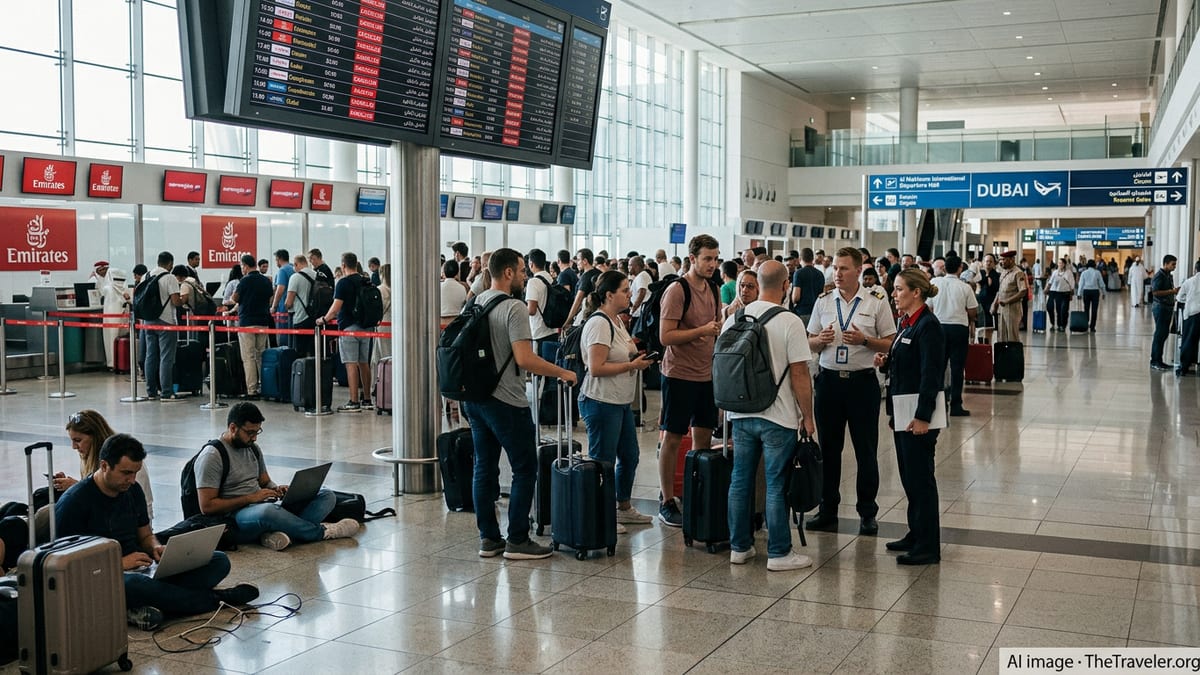
For visitors on the ground in Dubai, the impact is more subtle than the dramatic images from the shipping lanes might suggest. Hotels, restaurants and malls remain open, beaches are busy and attractions continue to market summer offers. Yet the sense of being in a regional crossroads has taken on a different tone, with flight boards displaying rerouted services and travelers swapping updates about airspace closures and insurance fine print.
The emirate’s leadership has sought to project continuity, describing Dubai as “open for business” even as it acknowledges what local commentators call a surreal moment for the wider Middle East. Economic research points to a still-positive growth outlook for Dubai this year, but with tourism and aviation flagged as the sectors most exposed to prolonged instability.
Strait of Hormuz Blockade Ripples Through Air and Sea Routes
The most visible fault line in the current crisis is the Strait of Hormuz, the narrow waterway separating Iran from the Arabian Peninsula and serving as the main maritime route in and out of the Gulf. Since Iran moved to restrict shipping there in late February, and the United States responded with a naval blockade, the volume of commercial traffic has plunged. Industry data cited by international media indicates that monthly transits have fallen by more than 80 percent compared with a year earlier.
Renewed exchanges of strikes between Washington and Tehran this month, including attacks on container ships and retaliatory raids on Iranian missile sites, have deepened uncertainty. In the space of days, global headlines shifted from cautious diplomacy to warnings that the region could slide back toward all-out war. Insurance costs for vessels have risen sharply and some shipping companies have diverted routes away from the Gulf, adding time and expense to global supply chains.
Dubai’s role as a major port and logistics center means these disruptions are being closely watched, even if the city’s tourist districts feel far removed from the tankers and warships. Analysts note that while Dubai’s economy is more diversified than many of its neighbors, any sustained blockage in Hormuz raises questions about energy flows, trade volumes and investor sentiment across the Gulf.
The air picture has been equally fluid. In the early stages of the crisis, airlines operating through the United Arab Emirates navigated a patchwork of airspace restrictions and routing changes. Dubai International Airport still handled tens of millions of passengers over the first quarter of the year, but traffic fell compared with 2025 as carriers adjusted schedules. By late spring, local airport authorities reported that UAE airspace had fully reopened, and flights were being ramped back up in anticipation of renewed demand.
Visitors Weigh Official Warnings Against On-the-Ground Calm
For many would-be tourists, the key question is not whether Dubai is functioning, but how to interpret a series of evolving travel advisories. The United States government in March ordered non-emergency diplomatic staff and dependents to depart the UAE due to the risk of regional conflict, and continues to advise travelers to exercise increased caution. Other countries have issued varying levels of guidance, often distinguishing between the relative calm in cities such as Dubai and the more acute risks closer to the Strait of Hormuz.
Publicly available data from tourism consultancies and industry groups suggests that these warnings are having an effect. Forecasts published in recent weeks point to a potential double-digit decline in international arrivals to the Middle East in 2026, with the UAE among the destinations likely to see a noticeable slowdown. The World Travel and Tourism Council has previously estimated that the conflict could be costing the region hundreds of millions of dollars a day in lost visitor spending.
On the ground in Dubai, however, the picture can appear more nuanced. While some theme parks and adventure attractions have scaled back operations or temporarily closed in response to safety guidance and weaker demand, core urban districts have remained active. Major shopping centers report steady footfall from residents and regional travelers, although hoteliers speak of shorter booking windows and more frequent last-minute cancellations.
Among those who have chosen to travel, there is a pragmatic tone. Travelers arriving from Europe and Asia describe monitoring regional news and airline updates closely before flying, but also weighing the city’s security record, medical infrastructure and reputation for crisis management. For many, Dubai’s role as a transit hub means they pass through even if they do not linger, contributing to a sense of continuity layered over unease.
Economic Incentives Aim To Keep Dubai Attractive
Recognizing the pressure on tourism and hospitality, Dubai has moved to cushion the sector with targeted support. In May, local media reported on a 1.5 billion dirham economic incentive package, including temporary relief on certain taxes and fees for hotels and restaurants. Officials framed the measures as a way to protect jobs and maintain the city’s competitive edge while demand is suppressed by events beyond its borders.
Business groups have responded with campaigns designed to reassure travelers and investors that Dubai remains a stable platform within a volatile neighborhood. Hospitality companies have highlighted flexible booking policies, enhanced security coordination and contingency planning honed during earlier shocks, from the pandemic to previous bouts of regional tension.
Financial institutions tracking the emirate’s performance argue that Dubai’s diversified economy, spanning trade, logistics, real estate and finance, provides some insulation from tourism dips. Recent research notes that while conflict-related uncertainty is a clear headwind, medium-term growth projections for Dubai remain relatively robust compared with many global peers.
Still, the city’s brand as a leisure destination is closely tied to the perception of safety and ease of access. Marketing campaigns that once leaned heavily on images of carefree luxury are being recalibrated to emphasize reliability, connectivity and value. For travelers, that shift mirrors the way holidays themselves are being reconsidered, with more attention paid to insurance coverage, cancellation terms and the proximity of conflict zones.
A City Living With Proximity To Crisis
Dubai’s experience in this moment captures the tension between local normality and regional volatility. From the promenades of Jumeirah Beach to the observation decks of its skyscrapers, daily life continues in a setting built on the promise of predictable comfort. Yet a glance at the news, or at maritime tracking maps of the Strait of Hormuz, is enough to remind visitors that they are within a short flight of one of the world’s most contested waterways.
International organizations monitoring the situation warn that the humanitarian and economic stakes of a prolonged crisis are significant, from stranded seafarers to heightened energy costs. Diplomatic efforts at the United Nations and in regional capitals are focused on securing safer passage for shipping and de-escalating missile exchanges, but recent escalations underline how fragile those efforts remain.
For now, Dubai is leaning on its infrastructure, policy tools and reputation to navigate a crisis largely not of its own making. The city’s ability to keep its lights bright and airports busy while conflict rages over the horizon will be a key test of its resilience, and of the wider Gulf’s ability to remain open to the world even as the Strait of Hormuz becomes a flashpoint once again.