


More news on this day
The UK Foreign, Commonwealth & Development Office has expanded its heightened travel warnings across the Middle East and surrounding region to 16 countries, as late October 2026 updates highlight what public guidance describes as a deeply unpredictable security environment and the risk of sudden escalation affecting airspace, borders and major transport hubs.
Get the latest news straight to your inbox!
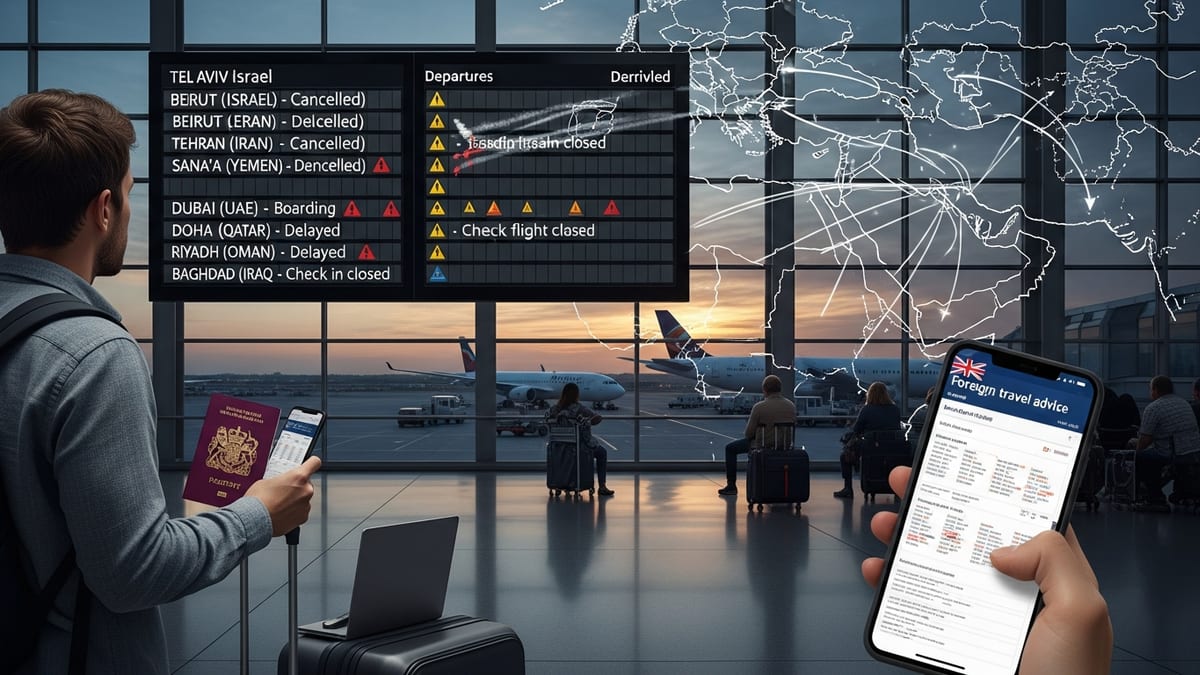
Expanded list spans core Middle East and key transit hubs
According to publicly available Foreign Office travel advice and industry summaries dated 27 and 28 October 2026, the latest alert now applies to a broad sweep of 16 states in and around the Middle East. The list covers Israel, the Palestinian territories, Iran, Iraq, Syria and Yemen alongside major aviation and holiday hubs Turkey, Egypt, the United Arab Emirates, Oman, Qatar, Bahrain, Jordan, Saudi Arabia, Kuwait and Pakistan.
Updated guidance reported by UK travel trade outlets indicates that the changes build on long-standing cautions for conflict zones such as parts of Iraq, Syria and Yemen, but now emphasise the potential knock-on effects of regional tensions across states that have remained open to tourism. The expanded list also reflects the role of Gulf and Turkish airports as global transit points, where travellers may face indirect disruption even when their final destination lies outside the region.
Coverage in specialist travel media describes the situation as fluid, with the wording on official country pages being revised several times through October as cross-border attacks, missile incidents and drone activity have affected perceived risk levels. While the underlying advice varies by country and sub-region, the overall message stresses that conditions could change with little or no warning.
Travel industry briefings note that the latest Foreign Office language does not amount to a blanket ban on holidays across all 16 destinations. Instead, it highlights a combination of elevated terrorism risk, potential for further military activity, and the prospect of sudden airspace closures or restrictions that could affect commercial flights across multiple jurisdictions.
Risk levels differ between countries and within borders
Publicly available Foreign Office country pages continue to distinguish between different levels of risk, both between states and within national borders. For some destinations, including Iraq, Yemen and parts of Syria, advice already in place continues to classify large areas as “advise against all travel” or “advise against all but essential travel,” reflecting prolonged conflict and limited consular access.
For others, including popular winter-sun destinations such as Turkey and Egypt, the latest wording tends to maintain more targeted warnings focused on specific provinces and border regions. Recent UK travel trade coverage notes references to high-risk areas within roughly 10 kilometres of certain frontiers, where a combination of military operations, cross-border fire and terrorism concerns sustain the strictest caution.
In Gulf states such as Qatar, Bahrain, Kuwait and the United Arab Emirates, the current advice highlighted by industry summaries concentrates more on the implications of regional tensions than on internal instability. The Foreign Office material cited in recent reports warns that wider conflict could trigger rapid changes to airspace permissions, as well as increased security around Western-linked locations and major transport infrastructure.
Saudi Arabia currently sits among the most closely watched destinations, with independent trackers of Foreign Office notices pointing to a series of escalations during October 2026. Insurance sector bulletins note that the UK government now advises against all but essential travel nationwide, with particular emphasis on major cities and airport facilities that have previously been the focus of drone and missile activity.
Practical implications for UK holidaymakers and transit passengers
The widened warning list is already influencing how UK travellers plan both direct trips to the region and long-haul journeys involving Middle Eastern connections. Guidance circulated by travel associations in mid to late October urges customers to check Foreign Office advice not only for their final destination but also for any countries they transit, noting that a change in advisory level may affect travel insurance validity.
Several UK-focused travel information services report that standard leisure insurance policies may no longer provide cover for non-essential trips to locations where the Foreign Office advises against all or all but essential travel. In practice, this can affect travellers booked to Saudi Arabia or particular high-risk areas in other states, even if airlines continue to operate scheduled services.
Airline and tour operator policies differ, but publicly shared customer updates indicate that many companies now refer explicitly to Foreign Office wording when assessing refunds, rebooking options or the need to amend itineraries. Industry notices seen in recent weeks suggest that where Foreign Office advice changes after a booking is made, some operators are offering fee-free date changes or alternative destinations, while others continue as planned if flights and local services remain operational.
Reports from travel management companies also highlight the importance of monitoring airspace notices, as temporary closures over parts of Iran, Iraq, Syria and neighbouring areas earlier in 2026 led to extended flight times, diversions and, in some cases, overnight delays for passengers connecting via Middle Eastern hubs. With the latest guidance again pointing to the possibility of further disruption, travellers are being encouraged to allow extra time for connections and to keep airline contact details readily available.
Heightened focus on registration, communication and contingency plans
In tandem with the broadened warning list, UK-based risk and security advisers are drawing attention to tools that can help travellers stay informed while abroad. Public guidance documents from universities, corporate travel departments and insurance partners recommend that British nationals in selected Middle Eastern states consider registering their presence with official channels where available, in order to receive direct updates if local advice changes.
These same sources also stress the value of basic contingency planning. Recommendations include keeping copies of key documents, confirming how to contact airlines and accommodation providers at short notice, and ensuring access to emergency funds if a rapid departure becomes necessary. Travellers are advised to store local emergency numbers, details of any relevant consular contact points and their insurer’s 24-hour assistance line before departure.
Recent analytical briefings on the travel and hospitality sector underline that commercial aviation into many parts of the Middle East continues to operate, and that millions of journeys are still being completed without incident. However, the broadened Foreign Office advisories reflect a recognition that even destinations perceived as stable may be exposed to indirect effects of regional tensions, especially where they serve as major transport or energy hubs.
For now, publicly available information suggests that the key message from UK guidance and industry experts alike is caution rather than panic. Travellers with imminent plans to any of the 16 named states are urged to watch for fresh updates in the days before departure, speak with their airline or tour operator about options if advice tightens further, and make informed decisions based on the latest official wording for each specific area they intend to visit.