


More news on this day
A luxury residential cruise that spent months delayed in Belfast has abruptly suspended its globe-circling voyage in Cambodia, after a steep jump in marine fuel prices left the operator unable to continue sailing and around 200 passengers suddenly searching for a way home.
Get the latest news straight to your inbox!
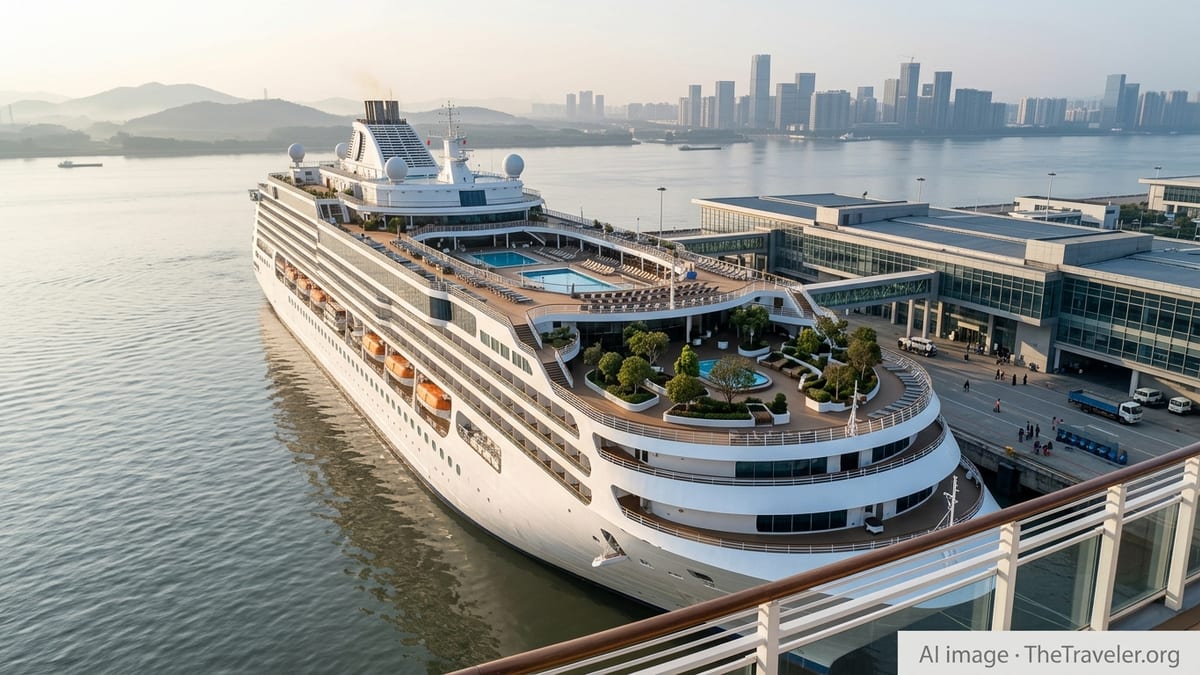
From Belfast delays to a global voyage cut short
The ship at the center of the disruption is the Villa Vie Odyssey, a residential vessel marketed as an “endless” or multi-year world cruise in which passengers own, rent or rent-to-own their cabins as floating homes. Publicly available information indicates that the vessel departed Belfast, Northern Ireland, in October 2024 following extensive refit work and prolonged delays that left guests stranded in the city for several months before the voyage finally began.
Coverage of the ship’s troubled early months describes a launch from Belfast that was postponed by about four months while repairs and interior work were completed, forcing passengers who had already paid to wait in and around the harbor as the operator tried to ready the former cruise liner for a continuous global itinerary. Reports indicate that the extended stay cost the company millions of pounds, while the vessel never reached its advertised capacity of about 650 residents, sailing instead with closer to 350 people on board.
The Odyssey was promoted as a three to three-and-a-half-year continuous circuit of the world, with marketing materials highlighting the ability for long-term residents to live at sea, work remotely and step off at ports from the Mediterranean and Americas to Asia and the South Pacific. For some travelers, it was sold as a “cruise for life” concept, with cabins purchased using proceeds from selling homes or drawing down retirement savings.
Despite those ambitions, the ship’s final weeks saw its pace slow and time at sea reduced. Vessel-tracking analyses shared in maritime forums show that over the last month before the shutdown, the Odyssey spent a smaller share of time underway and at lower average speeds as the operator sought to curb fuel consumption.
Soaring fuel prices push business model past breaking point
The abrupt halt came in late October 2026 as the Odyssey lay in port at Sihanoukville, on Cambodia’s southern coast. In a statement cited across multiple news outlets, operator Villa Vie Residences said it had “suspended operations in Cambodia” while it worked to address what it described as extraordinary increases in fuel costs since the outbreak of conflict involving Iran, which has driven up global oil prices and the cost of refined marine fuels.
According to reporting that draws on company communications, the operator indicated that monthly fuel costs per cabin in parts of Asia had climbed from a historical average of about 1,800 US dollars to between 6,000 and 8,000 dollars. The scale of that increase, combined with the ship’s relatively low occupancy compared with its design capacity, appears to have undermined the economics of a continuous, long-distance itinerary built around slow steaming between far-flung ports.
Marine fuel price data compiled in Singapore, one of the world’s largest bunkering hubs, reflect a similar trend, with the benchmark cost of marine gasoil reportedly close to doubling compared with levels before the Iran-related escalation. Analysts quoted in recent coverage note that operators with thin margins or unconventional business models, such as residential cruises with fixed monthly fees, are particularly exposed when sudden cost surges cannot easily be passed on to travelers.
Villa Vie Residences had already been attempting to rein in expenses by slowing the itinerary, spending more days docked and asking residents to consider fuel surcharges. Publicly available accounts from passengers suggest that, even before the Cambodian lay-up, the company had been seeking additional cash infusions and revising schedules as it tried to keep the program viable.
Passengers told to disembark in Cambodia
The situation for guests crystallized when passengers were instructed to leave the ship in Cambodia, in some cases with limited notice. Accounts compiled in international media and shared on passenger blogs describe residents receiving early-morning communication that the company had been unable to secure the fuel required to continue operations, followed by an order to disembark with their belongings later the same day.
Estimates in published coverage put the number of affected passengers at around 200 at the time operations ceased, although the ship was configured to carry several hundred more. Many had treated the Odyssey as a long-term residence rather than a temporary cruise, transporting personal possessions, pets and work equipment on board. Some had sold property or ended leases on land, which means they now find themselves effectively homeless in a foreign country while they arrange their next steps.
Information released by the company and relayed in news reports indicates that Villa Vie Residences is covering hotel accommodation and local transport for passengers in Sihanoukville and the capital Phnom Penh, but is not funding onward international travel. That leaves residents responsible for booking and paying for flights back to their home countries or onward destinations, at a time when many had already committed substantial resources to the cruise itself.
Passenger accounts suggest that the short timeline and the ship’s location have complicated logistics for some residents, particularly those who were away on excursions when the suspension was announced or who need to coordinate the transport of larger volumes of luggage and personal items. Several reports also note that the vessel is expected to remain laid up in Cambodia while the operator seeks restructuring or new investment.
What the shutdown signals for residential cruising
The difficulties facing the Villa Vie Odyssey are being closely watched across the small but growing niche of residential cruising, in which ships are marketed as floating condominium communities rather than conventional vacation vessels. Industry observers quoted in recent analyses point out that the model depends on relatively predictable operating costs and stable occupancy levels, conditions that have been challenged by volatile fuel prices and uneven post-conflict demand.
In the Odyssey’s case, months-long delays in Belfast, high refit expenses and the inability to fill all cabins meant the program entered service with limited financial buffer. Once fuel prices began rising sharply along key Asian routes, the gap between revenue and operating costs appears to have widened faster than management could respond through itinerary changes or surcharges.
By comparison, larger mainstream cruise lines have some ability to hedge fuel purchases, adjust deployment, or redeploy ships to closer, fuel-efficient itineraries. Residential-focused operators promising continuous global routes have less flexibility, since their appeal rests on constant movement and a fixed promise to residents about where and how the ship will travel.
While other residential ships have operated for years without similar crises, analysts suggest that the Odyssey case could lead to closer scrutiny of new projects that rely heavily on optimistic fuel and occupancy assumptions. Prospective residents may also demand greater financial transparency, contingency planning and protections in the event of future service suspensions.
Travel and consumer implications
For travelers considering long-duration or residential-style cruises, the events in Belfast and Cambodia highlight the importance of assessing both the operator’s track record and its ability to withstand external shocks such as fuel spikes or geopolitical crises. Consumer advocates quoted in media coverage of the crisis emphasize the need to review contract terms related to refunds, relocation support and operator insolvency before committing substantial sums.
The Villa Vie Odyssey example also underscores how disruptions can cascade over time. A refit that left passengers waiting in Belfast for months, a world itinerary that never reached planned occupancy, and a global fuel shock ultimately converged in a lay-up in Cambodia, thousands of miles from where the cruise began. For the passengers now in Sihanoukville and Phnom Penh, the immediate priority is securing flights and new living arrangements, while the operator confronts questions about the future of the ship and any successor projects.
More broadly, the episode illustrates how rapidly changing energy costs can reshape travel plans, from individual vacations to multi-year residential commitments. As fuel markets remain unsettled, similar pressures are likely to influence not only niche products such as residential cruises but also mainstream itineraries, airfare pricing and the viability of other long-haul travel experiences.