

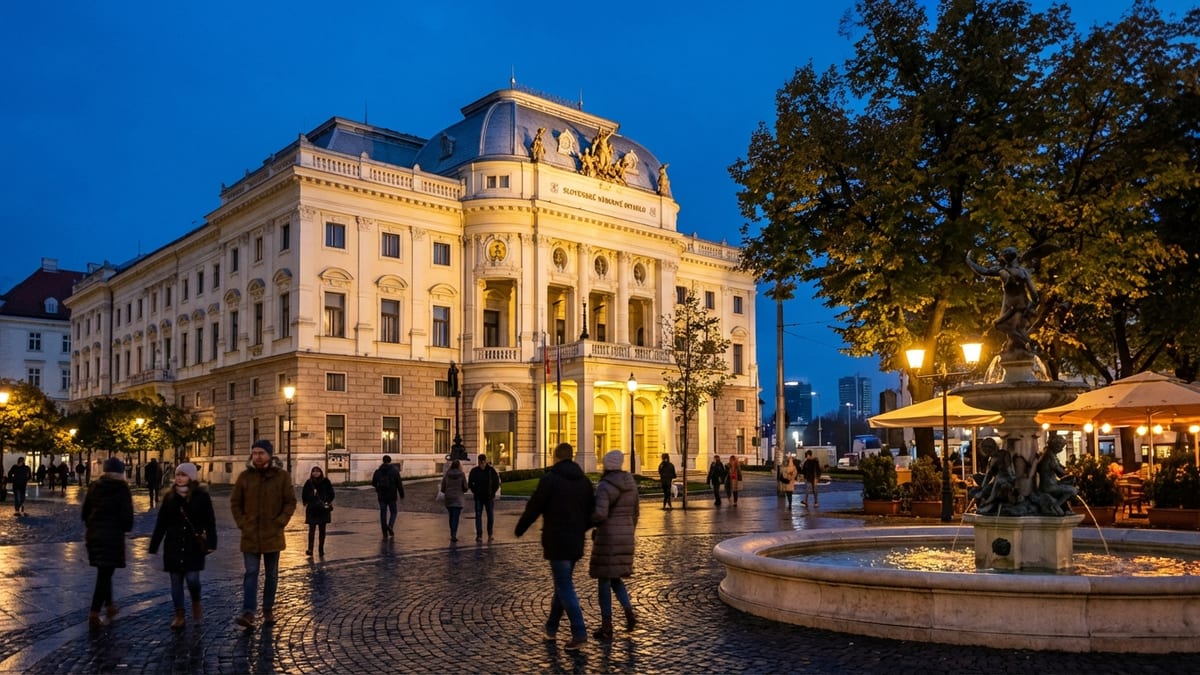
The Slovak National Theatre is one of Central Europe’s most atmospheric cultural stages, an institution where opera arias spill out into historic squares and contemporary drama plays out beneath the glass and steel of a new riverside district. For travelers, it offers far more than a night out.
Between its twin buildings, rich history and wide-ranging repertoire of opera, ballet and drama, the theatre is a vivid way to understand Slovakia’s story from the era of the Habsburgs to a modern European capital. This guide brings together the essential background and practical advice you need to make the most of a visit, whether you are planning a single performance or building an entire trip around the arts in Bratislava.
The Role of the Slovak National Theatre in Slovak Culture
The Slovak National Theatre, known locally as Slovenské národné divadlo, is the country’s oldest professional theatre company and a cornerstone of its cultural life. Founded in 1920, just two years after the creation of Czechoslovakia, it was conceived as a flagship institution to cultivate a distinct Slovak voice in opera, drama and ballet. From the beginning, its ensembles have attracted leading directors, composers, conductors and performers, many of whom helped define modern Slovak culture.
The theatre today operates three permanent ensembles: opera, ballet and drama. Each has its own artistic leadership but they share resources, stages and an overarching mission to balance classic repertoire with contemporary, often Slovak, work. Over the course of a typical season, the Slovak National Theatre presents everything from Verdi, Puccini and Wagner to new Slovak operas, from 19th century story ballets to bold modern choreography, and from Shakespeare and Chekhov to new plays that respond to current social and political debates.
As a national institution, the theatre also has a ceremonial role. It has hosted state visits, key anniversaries and gala events linked to important political milestones. Its performances and premieres are regularly covered by local media, and its artists often become national figures. For visitors, this means that attending a performance is not a niche, elite pastime but a window into mainstream cultural life, one that locals follow closely and passionately.
Crucially, the Slovak National Theatre is also accessible. Ticket prices are comparatively modest by Western European standards, student and senior discounts are common, and weekday performances are popular with residents of all ages. For travelers used to high prices at major houses in Vienna or Munich, Bratislava offers an opportunity to experience world-class productions in an intimate setting with a distinctly local flavor.
Historic Building on Hviezdoslav Square
The historic building of the Slovak National Theatre occupies a prime position at one end of Hviezdoslav Square in the Old Town. Its Neo-Renaissance façade, crowned with sculptural groups, looks out onto a promenade lined with linden trees, café terraces and street performers. This photogenic setting makes it one of the most recognizable landmarks in Bratislava and a natural focal point when exploring the city center.
The site has been associated with theatre since the late 18th century, when a city theatre commissioned by Count Juraj Csáky opened there in 1776. The current building dates from 1886, when the municipal authorities commissioned renowned Viennese architects Ferdinand Fellner and Hermann Helmer to design a new theatre suitable for a growing Pressburg, as Bratislava was then known. They produced an eclectic Neo-Renaissance structure typical of their work, which also includes theatres in Sofia, Brno, Karlovy Vary and other European cities.
Architecturally, the historic building blends elegance with theatrical flourish. Busts of famous composers peer from oval niches in the façade, while the sculptural group of the Muse Thalia presides above the entrance. On the square in front, the celebrated Ganymede Fountain depicts the mythological youth carried by an eagle to Olympus, a playful yet sophisticated piece that remains a favorite meeting point for locals.
Inside, the auditorium is an intimate horseshoe-shaped space hung with rich draperies and ornate plasterwork. A grand chandelier and frescoed ceilings recall the glamour of imperial-era evenings in the theatre. Although the building has undergone renovations, including modern technical upgrades in the late 20th century, it retains the charm of an old-world opera house where every seat feels close to the stage. Even when performance schedules shift toward the new building, the historical house is still central to the theatre’s identity and to the city’s sense of place.
The Modern Riverside Complex: New Slovak National Theatre
In contrast to the 19th century opulence of the historic building, the New Slovak National Theatre offers a strikingly contemporary face. Located on Pribinova Street near the Danube riverfront, this complex was opened in April 2007 after a long and sometimes controversial construction process that stretched over two decades. The result is a large, multi-venue cultural hub designed to accommodate the full technical and spatial demands of 21st century opera, ballet and drama productions.
The new complex comprises multiple stages and rehearsal spaces, with a total capacity of around 1,700 spectators. The main opera and ballet hall, with its adjustable stage machinery, orchestra pit and lighting systems, allows for technically ambitious productions that would be difficult to mount in the more compact historic theatre. A separate drama stage and smaller studio spaces support an active repertoire of straight theatre, experimental work and smaller-scale performances.
Architecturally, the new building is all sharp lines, glass and pale stone, with generous foyers and circulation spaces that double as informal galleries. Large windows open views toward the river and across to the rapidly developing Eurovea quarter. The building’s public spaces are designed to feel open and civic, encouraging locals and visitors to drop in for a coffee, an exhibition or simply to admire the interior even when they are not attending a performance.
For travelers, the new Slovak National Theatre has practical advantages. Facilities are modern and accessible, acoustics are carefully engineered, and amenities such as cloakrooms, bars and restrooms are abundant and efficient. The location near the Danube also makes it easy to combine an evening at the theatre with a riverside stroll or dinner at one of the many nearby restaurants. As the primary home of the theatre’s ensembles during ongoing work on the historic building, it is the main venue you are likely to visit for performances today.
A Brief History: From Pressburg City Theatre to National Stage
The story of the Slovak National Theatre is closely intertwined with the political and cultural transformations of Central Europe over the last century and a half. When the current historic building opened in 1886 as the City Theatre of Pressburg, the city was part of the Kingdom of Hungary within the Austro-Hungarian Empire. The repertoire then was dominated by German and Hungarian touring companies, and Slovak-language performances were rare.
The turning point came after the First World War and the establishment of Czechoslovakia in 1918. The new state invested in cultural institutions that could express its multinational identity, and in 1920 the Slovak National Theatre was officially founded in Bratislava. Initially, many productions were in Czech, reflecting the composition of the first ensembles and the limited number of Slovak professional actors and works available at the time. Gradually, as Slovak playwrights, composers and performers emerged, the balance shifted and the theatre became a true Slovak institution.
Over the following decades, the theatre navigated complex political landscapes. It operated through the interwar years, the wartime Slovak state, the postwar restoration of Czechoslovakia, the decades of socialist rule and finally the transition to democracy after 1989. Each period left traces in the repertoire and the internal life of the theatre, from officially sanctioned socialist realism to more daring productions that tested the limits of censorship. Despite these pressures, the theatre became a place where important Slovak works were premiered and where international classics were interpreted through a local lens.
Physical expansion mirrored artistic growth. In the mid 20th century, as the company grew, the drama ensemble moved to a separate permanent stage while the historic building became primarily associated with opera and ballet. The long-planned new building, conceived in the 1980s and opened in 2007, was a major milestone that allowed all three ensembles to be reunited under one modern roof while preserving the historic house as an active performance venue. Today, the institution presents itself as a bridge between tradition and innovation, conscious of its history yet oriented toward contemporary European theatre practice.
Opera, Ballet and Drama: What to Expect from a Performance
The Slovak National Theatre’s opera ensemble is perhaps the best-known internationally. Its repertoire balances canonical works by Mozart, Verdi, Puccini, Tchaikovsky and Wagner with occasional rarities and Slovak or Czech operas less frequently seen in larger Western houses. Productions range from traditional stagings with period costumes and sets to more modern, concept-driven interpretations. Casting often mixes Slovak and Czech artists with guest singers from across Europe, and the resident orchestra provides a solid musical foundation for the ensemble.
The ballet company offers a similarly diverse program. Classic story ballets such as Swan Lake, The Nutcracker and Giselle share the stage with 20th century masterworks and new creations by contemporary choreographers. The company has a reputation for strong storytelling and expressive ensemble work rather than mere technical display. For many local families, attending a ballet at the Slovak National Theatre is a cherished tradition, especially around the winter holidays, and tickets for popular titles can sell out well in advance.
The drama ensemble is deeply rooted in Slovak literary and theatrical traditions while maintaining a wide international outlook. Productions might include Slovak classics, contemporary local plays, adaptations of novels and major works from the global canon. Directors often experiment with staging, multimedia and non-linear storytelling, making the drama repertoire particularly attractive for visitors interested in current Central European theatre trends. While performances are in Slovak, some productions are occasionally surtitled in English, particularly during festivals or special events.
Regardless of ensemble, performance evenings in Bratislava tend to start earlier than in some other cities, often around 7 p.m. or 7:30 p.m. Most productions run with one or two intervals, and the atmosphere in the foyers during breaks is sociable but relaxed. Dress codes are flexible. Locals might attend in business attire or smart casual wear on weekdays, with more formal dress for premieres and gala performances. As a visitor, you will feel comfortable in neat, modest clothing without needing a full evening gown or tuxedo unless it is a particularly high-profile event.
Planning Your Visit: Tickets, Seasons and Practicalities
The Slovak National Theatre operates on a season-based calendar, typically running from early autumn through late spring or early summer. Performance schedules for opera, ballet and drama are published several months in advance, with tickets going on sale progressively. For the most popular titles and premiere runs, it is advisable to book weeks ahead, especially if you have limited dates in the city or require specific seating areas.
Tickets are generally affordable by international standards. Prices vary depending on the production, cast and seating zone, but even prime seats in the main halls are often significantly cheaper than equivalent tickets in Vienna, which lies just across the border. Concessions for students, children and seniors are widely offered. Same-day or last-minute tickets can sometimes be found for less in less central seats, which can be a good option for flexible travelers who do not mind a bit of spontaneity.
The theatre maintains central box offices associated with its venues, where you can purchase tickets in person and often obtain guidance in English or German. Box office opening hours typically cover weekday daytime and early evening, with additional sales one hour before performances. Online booking platforms linked to the official system are convenient if you want to secure seats before arriving in Slovakia; as always, purchase only through recognized outlets to avoid third-party markups or scams.
When planning your evening, factor in time for security checks and cloakroom use. Even at busy performances, operations tend to be efficient, but arriving 20 to 30 minutes in advance is sensible. Cloakrooms are normally obligatory for coats and large bags, yet the fees are minimal or already included. Photography during performances is usually prohibited, though you are welcome to take pictures in the foyers, public areas and square outside the historic building.
Experiencing the Buildings: Tours, Architecture and Surroundings
Seeing a performance is the most immersive way to experience the Slovak National Theatre, but it is not the only option. Organized guided tours of the historic building are offered on selected dates, typically once a month, often on Saturdays. These tours usually last around 90 minutes and are led by experienced guides who take visitors beyond the auditoriums into backstage areas that are normally off-limits. Depending on scheduling and technical needs, you might see the orchestra pit, stage machinery, rehearsal rooms, costume workshops, and even the presidential lounge used for official functions.
These behind-the-scenes tours are particularly rewarding for travelers interested in architecture, stagecraft or the everyday life of a working theatre. They trace the evolution of the building from its 19th century origins, through various renovations, to its present role alongside the new complex. Practical notes are important: the tours involve many stairs and narrow corridors, and they are not always suitable for visitors with limited mobility. Group sizes are usually controlled to maintain safety and ensure good visibility, and advance ticket purchase is essential given the limited number of dates.
Even if you do not join a formal tour, you can enjoy the theatre’s architectural context. Hviezdoslav Square, in front of the historic building, is one of Bratislava’s most atmospheric public spaces, framed by historic facades, hotels, embassies and cafes. In summer, the square hosts outdoor events and festivals, while in winter it becomes a key site for Christmas markets, with the theatre’s illuminated façade providing a dramatic backdrop.
The new building’s setting is equally engaging. Positioned near the riverbank, it anchors a redeveloped district filled with shopping arcades, riverfront promenades and modern office buildings. Before or after a performance there, you can stroll along the Danube, cross pedestrian bridges to newer neighborhoods, or sit in contemporary cafes that contrast sharply with the Old Town taverns around the historic theatre. Taken together, the two buildings invite you to experience both the historical and modern faces of Bratislava in a single cultural itinerary.
Beyond the Curtain: Nearby Cultural Highlights and Local Life
One of the advantages of focusing your visit on the Slovak National Theatre is its proximity to other major cultural institutions. A short walk from the historic building brings you to the Reduta concert hall, home of the Slovak Philharmonic. This eclectic early 20th century building hosts symphonic concerts and the prestigious Bratislava Music Festival, offering another way to experience high-level classical music during your stay. For culture-focused trips, it is feasible to alternate evenings between opera or ballet at the theatre and concerts at Reduta.
The Old Town streets around Hviezdoslav Square contain several small galleries and museums, including venues devoted to Slovak art, city history and design. Many travelers choose to spend the late afternoon exploring these institutions, then enjoy an early dinner at one of the restaurants on or near the square before attending a performance. Side streets around Laurinská, Gorkého and Ventúrska contain a mix of traditional Slovak eateries, wine bars and international options, making it easy to tailor your pre-theatre meal to your preferences.
At the new building, the surrounding riverfront developments offer a different set of experiences. Shopping centers house cinemas, casual dining and retail outlets, while riverside paths attract joggers, cyclists and families. During spring and summer, outdoor terraces come alive, and it is common to see audience members lingering over drinks after an evening performance, enjoying views of the Danube. From here, you can also access boat services and river cruises that connect Bratislava with Vienna and other Danube towns, an appealing extension for travelers combining performance-going with regional exploration.
Crucially, the theatre is integrated into everyday city life rather than being isolated as a tourist enclave. You will share the audience with local students, professionals and families, overhear conversations in Slovak and other Central European languages, and witness how cultural outings fit into the rhythms of a modern Central European capital. For many visitors, this sense of immersion in local life is what makes a night at the Slovak National Theatre a highlight rather than just another entry on a sightseeing checklist.
The Takeaway
For travelers seeking more from Bratislava than a quick day trip and a few postcard views, the Slovak National Theatre offers a powerful focal point. Through its twin buildings and three ensembles, it encapsulates the city’s evolution from imperial outpost to national capital and contemporary European hub. The historic house on Hviezdoslav Square offers architectural romance and a deep sense of continuity, while the new riverside complex speaks to ambition and renewal.
Attending a performance here is both accessible and rewarding. Ticket prices invite experimentation, the repertoire is broad enough to suit a wide range of tastes, and the overall experience is informal yet unmistakably special. Add a backstage tour or a wander through the surrounding streets and riverfront, and you have the outline of a trip that feels genuinely connected to Bratislava’s cultural heartbeat.
Whether you are an opera devotee, a theatre enthusiast, a casual traveler curious about local life, or simply someone who values meaningful experiences over checklists, the Slovak National Theatre can anchor your time in the Slovak capital. Plan a night in the stalls or the balcony, linger in the foyers and squares before and after the curtain rises, and you will leave with a richer understanding of both the city and the country whose stories unfold on its stages.
FAQ
Q1: Can I visit the Slovak National Theatre even if I do not attend a performance?
Yes. You can admire both buildings from the outside at any time, and on selected dates guided tours of the historic building are offered, leading you through public and backstage areas. The foyers of the new building sometimes host exhibitions and events that are accessible without a performance ticket, but access to auditoriums is usually linked to scheduled shows or tours.
Q2: Which building will my performance take place in?
Performance information specifies the venue, usually described as the historical building on Hviezdoslav Square or the new building on Pribinova Street. Opera and ballet increasingly use the new complex, especially during renovation or technical work in the old house, while drama is typically staged in the new building’s drama or studio spaces. Always double-check the venue on your ticket before you go.
Q3: Are performances surtitled or translated into English?
Many opera productions use surtitles above the stage, most commonly in Slovak, and sometimes also in another language depending on the production. Drama performances are generally in Slovak without translation. Occasionally, especially during festivals or special events, selected productions may offer English surtitles, but this should not be assumed; if language is critical, check the performance details in advance.
Q4: How far in advance should I buy tickets?
For popular operas, ballets and premieres, it is wise to book several weeks in advance, especially for weekend performances or central seating zones. For less well-known titles or weekday evenings, you may find good availability closer to the date, and sometimes even on the day itself. If your time in Bratislava is limited or if you have your heart set on a specific production, advance purchase is strongly recommended.
Q5: What is the typical dress code for an evening at the theatre?
There is no strict dress code, and the atmosphere is generally relaxed. Smart casual clothing is perfectly acceptable for most performances. Locals may dress more formally for premieres, gala events or opening nights, but evening wear is not obligatory. The most important thing is to feel comfortable and presentable rather than to follow a rigid standard.
Q6: Is the Slovak National Theatre suitable for children?
Yes, especially for selected opera and ballet performances that are family-friendly, such as The Nutcracker or shorter fairy-tale adaptations. Some productions specifically target younger audiences with earlier start times and shorter durations. However, certain operas and dramas may be long or thematically mature, so it is wise to review the content and running time before bringing younger children.
Q7: How do I get to the theatre by public transport?
The historic building on Hviezdoslav Square lies within easy walking distance of most Old Town hotels and is served by nearby tram and bus stops along the riverfront and around the square. The new building on Pribinova Street is reachable on foot from the Old Town in about 10 to 20 minutes, depending on your starting point, and is also served by several bus and tram lines that stop in the expanding riverside district.
Q8: Are the buildings accessible for visitors with reduced mobility?
The new Slovak National Theatre was designed with modern accessibility standards, offering lifts, adapted restrooms and reserved spaces in the auditoriums for wheelchair users. The historic building, being older, presents more challenges, with steps and narrow passages, and some backstage tours may not be suitable for visitors with limited mobility. If accessibility is a concern, contact the theatre’s box office in advance to discuss specific arrangements.
Q9: What time should I arrive before a performance?
Arriving 20 to 30 minutes before the scheduled start time is usually sufficient. This allows you to collect or confirm tickets if necessary, check coats and bags at the cloakroom, find your seat without rush and perhaps enjoy a drink in the foyer. Latecomers may be asked to wait until an appropriate break in the performance before being admitted, so it is better not to cut it too close.
Q10: Can I take photos or videos inside the theatre?
Photography is generally permitted in public areas such as foyers, staircases and outside the buildings, provided you do not disturb other visitors. However, taking photos or videos during performances is typically prohibited to protect artists’ rights and to avoid distracting audiences. If in doubt, follow posted signs and announcements, or ask staff for guidance before the performance begins.