


More news on this day
A Union Pacific freight train derailed 39 rail cars in rural New Mexico, disrupting a key western rail corridor and triggering a multi-agency response focused on clearing wreckage and checking for potential environmental impacts, according to early reports.
Get the latest news straight to your inbox!
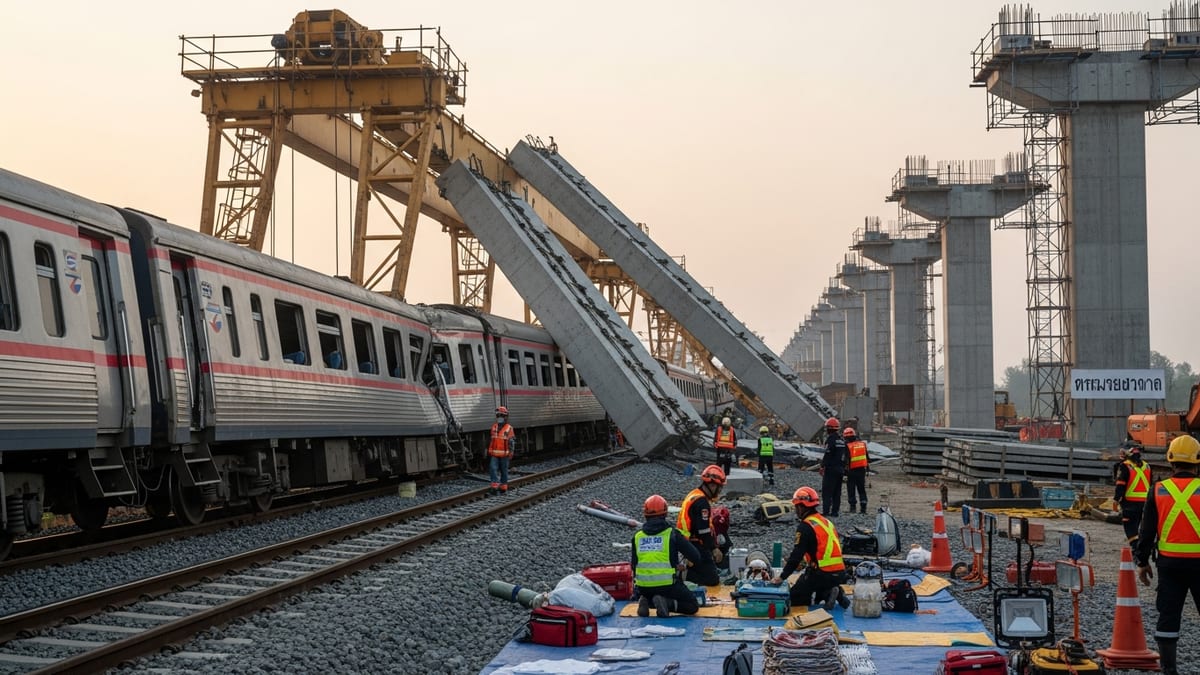
Freight Consist Leaves Tracks Near Key Rail Corridor
Initial reports indicate the derailment occurred on a Union Pacific freight line crossing a sparsely populated area of New Mexico, where long manifest and intermodal trains routinely move goods between the Southwest and West Coast. The incident involved 39 cars leaving the tracks, with several coming to rest on their sides along the right-of-way.
Publicly available rail safety data and local coverage describe a freight consist with a mix of loaded and empty cars, some carrying general merchandise and others hauling bulk commodities. The derailment unfolded along a segment of track that forms part of a heavily used transcontinental route, where long trains operate at relatively high speeds through remote desert terrain.
Images and video shared through regional outlets and social platforms show multiple cars jackknifed or accordioned beside the rails, with damaged track and torn ballast visible along the curve where the train left the line. Rail traffic was immediately halted in both directions while crews assessed damage and began to secure the scene.
There were no early indications of serious crew injuries or harm to nearby residents, reflecting the relative isolation of the location. The lack of dense development near the right-of-way significantly reduced the risk of off-line damage compared with derailments that occur near towns, road crossings, or industrial facilities.
Hazardous Cargo Checks and Environmental Precautions
Information compiled from rail safety filings and regional news coverage suggests that some of the derailed cars were designated to transport hazardous materials, a common feature of long freight consists in the western United States. Early accounts, however, indicate that no significant leaks or fires were detected at the site.
Standard procedure in freight derailments involving mixed cargo includes isolating any tank or container cars bearing hazardous placards, conducting air monitoring, and visually inspecting for signs of product release. In this case, available reports point to precautionary sweeps around the wreckage rather than an active hazardous materials emergency.
Environmental assessments typically focus on the integrity of car shells, valves, and fittings, as well as nearby waterways, dry washes, or drainage paths that could carry spilled material away from the tracks. In the New Mexico derailment, the location in open desert and the absence of immediate surface water features reduced the likelihood of large-scale contamination, though agencies generally continue monitoring until cleanup is complete.
Railroads are required to document any hazardous materials involved, and subsequent filings often provide additional detail on whether shipments were compromised. At this stage, available information points to a derailment with primarily mechanical and logistical consequences rather than a major environmental incident.
Disruption to Freight Flows and Local Communities
The corridor affected by the derailment is an important artery for freight moving between California, Arizona, Texas, and the broader interior of the United States. The loss of a mainline track section, even temporarily, can ripple through freight schedules, leading to congestion at yards and delays for shippers far from the incident scene.
Reports indicate that rail traffic in the area was suspended while Union Pacific and contracted crews worked to rerail salvageable equipment, cut and remove heavily damaged cars, and rebuild sections of track and ballast. Detours over parallel routes are sometimes possible in the railroad’s western network, but capacity constraints mean some trains are held until the line is cleared.
For nearby communities in rural New Mexico, the derailment primarily translated into visual disruption, intermittent noise from heavy equipment, and road activity as work crews, inspectors, and support vehicles moved in and out of the site. In the absence of significant hazardous material leaks, local impacts were largely tied to rail noise, lighting, and temporary restrictions near the right-of-way rather than evacuations or long-term closures.
Passenger operations can also be affected when derailments occur on shared lines. In comparable incidents on western freight corridors, long-distance passenger trains have faced diversions, bus bridges, or overnight delays while waiting for mainline tracks to reopen.
Early Focus on Track Conditions and Train Handling
While a full causal analysis typically takes months, rail safety investigations of similar derailments in the region have frequently highlighted a combination of track conditions, mechanical failures, and train handling dynamics. Publicly available records of earlier Union Pacific derailments in New Mexico and neighboring states point to issues such as broken wheel components, rail defects, or stresses generated by long, heavy consists traversing curves at speed.
Investigators generally review locomotive event recorders, wayside detector data, and recent track inspection logs to reconstruct the sequence leading up to a derailment. They examine whether any prior alerts were generated for overheated bearings, wheel impacts, or geometry irregularities, and whether train speed and braking matched posted limits and company rules.
In desert environments like the affected New Mexico segment, temperature swings, rail expansion, and ballast conditions can all contribute to long-term stress on the track structure. Freight trains measuring well over a mile in length can amplify those forces, especially when negotiating curves, grades, or transitions between older and newly maintained sections of rail.
Mechanical analysis will typically focus on the first car or group of cars believed to have left the track, as indicated by damage patterns and gouging on ties and ballast. Determining whether a single component failure or a broader track condition initiated the derailment shapes both regulatory follow-up and any future infrastructure work along the route.
Derailment Renews Attention on Rail Safety Across the West
The New Mexico derailment follows a series of high-profile freight incidents across the United States that have intensified public scrutiny of rail safety, train length, and infrastructure investment. While many derailments occur without injuries or major spills, cumulative incidents have prompted renewed calls for stricter oversight and more frequent inspections.
Industry data compiled by federal rail regulators indicate that derailment rates have declined over past decades but remain a central safety challenge, particularly on busy freight corridors. Western lines that carry long trains through remote territory can be slower to draw national attention, yet they play an essential role in moving fuel, agricultural products, consumer goods, and industrial materials.
According to published research on freight risk and derailment patterns, strategies such as enhanced wayside monitoring, predictive analytics for track and equipment failures, and revised operating practices for very long trains are increasingly important in limiting both the frequency and severity of accidents. Railroads and policymakers are weighing how best to incorporate these tools while maintaining efficiency in a highly competitive freight market.
For residents and travelers in New Mexico, the latest derailment is a visible reminder of the infrastructure that underpins daily life yet often remains out of sight. As debris is cleared and service restored, attention is likely to turn to how the line will be monitored and maintained in the months ahead to reduce the chance of a repeat incident along this critical desert corridor.