

More news on this day
United Airlines has quietly updated its contract of carriage to explicitly allow crews to remove, and even permanently ban, passengers who play audio or video on personal devices without using headphones, turning what was once an etiquette issue into an enforceable rule.
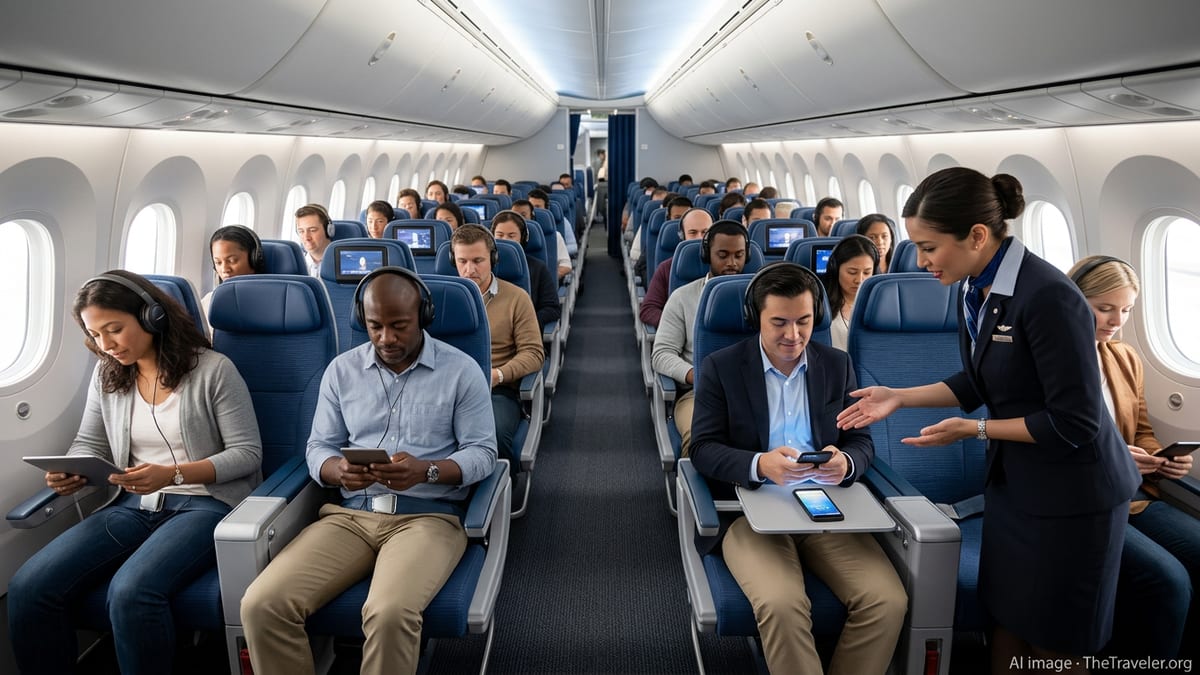
New Rule Targets Loud Personal Devices in the Cabin
The revised policy, added to United’s contract of carriage on February 27, 2026, states that passengers who fail to use headphones while listening to audio or video content may be refused transport, either temporarily or permanently. The language places loud, speaker-based device use alongside a broader list of behaviors that can trigger denial of boarding or removal from a flight.
Any traveler who listens to music, watches a video or scrolls social media with sound audible in the cabin is now required to wear headphones. If a passenger ignores crew instructions to comply, they can be removed from the aircraft at any point in the journey and, in serious cases, face a long-term or lifetime ban from the airline.
United has long encouraged passengers to keep sound to themselves, but this marks the first time the carrier has elevated the expectation to a formal rule. The change effectively transforms a courtesy reminder into a contractual obligation that passengers agree to when they buy a ticket.
Why United Is Cracking Down on In-Flight Noise
United’s move comes amid growing frustration among travelers and crews over onboard etiquette, particularly around the use of phones and tablets on speaker. Flight attendants say unmanaged noise can spark tensions between passengers, distract from safety briefings and make it harder to hear announcements in the event of an emergency.
The airline is also rapidly expanding high-speed Wi-Fi across its fleet, including Starlink connectivity on many aircraft, which is expected to drive even more streaming, social media use and short-form video consumption at cruising altitude. As more customers watch content or scroll feeds for entire flights, United is seeking to keep that increased usage from spilling into the shared soundscape of the cabin.
Industry observers note that the new rule aligns with how most travelers already behave, but gives crews clearer authority when a small number of people ignore repeated requests to turn the volume down. For flight attendants who previously had to rely on persuasion alone, the headphone requirement provides a formal backstop if a passenger refuses to cooperate.
How the Headphone Requirement Will Be Enforced
The new language appears under Rule 21 of United’s contract of carriage, a section titled “Refusal of Transport” that outlines situations in which the airline can deny boarding or remove a passenger. The clause covering loud devices is listed alongside more familiar reasons such as intoxication, smoking or vaping on board, assaulting staff and other disruptive or unlawful conduct.
In practice, crews are expected to start with a warning and a reminder to use headphones. United has said that basic wired earbuds may be provided free of charge when available, giving forgetful travelers a way to comply without having to sit in silence for the duration of the flight.
If a customer continues to play sound over speakers after being warned, the airline now has explicit authority to remove that person from the flight. In more serious cases, particularly if the noncompliance leads to delays or diversions, United can place the passenger on an internal list that blocks future bookings, effectively banning them from flying the carrier.
First Among Major U.S. Airlines, but Likely Not the Last
Travel experts say they are not aware of another major U.S. airline that has written a headphone mandate directly into its contract of carriage. Other large carriers urge passengers to use headphones and avoid speakerphone calls, but stop short of linking noncompliance to removal or permanent refusal of service in formal legal terms.
As a result, United stands out as the first large U.S. carrier to treat loudspeaker use as a material breach of contract. That distinction is drawing attention across the industry, especially as complaints about onboard behavior have risen in recent years and airlines search for ways to support crews while preserving a tolerable cabin environment.
Analysts note that if the policy proves effective in reducing conflicts and noise complaints, competitors could feel pressure to adopt similar language. For now, United’s approach will serve as a test case for whether codifying etiquette into enforceable rules can meaningfully improve the experience of shared space at 35,000 feet.
What United Passengers Need to Know Before Flying
The immediate takeaway for travelers is simple: if you plan to watch or listen to anything with sound on a United flight, you must have headphones and be prepared to use them whenever audio is playing. That applies to music, movies, podcasts, video games, social media clips and any other content that would otherwise be heard by people nearby.
Passengers should also be aware that the rule is not limited to long-haul routes or premium cabins. It applies across the network, from short domestic hops to international services, and covers both personal devices and any audio routed through the airline’s onboard Wi-Fi or entertainment systems.
For those who forget their own headphones, asking a flight attendant early in the boarding process may increase the chances of receiving a complimentary pair, since supplies can be limited. United is steadily upgrading seats with Bluetooth capability, allowing travelers to pair their own wireless earbuds, but the responsibility to keep sound private still lies with the passenger.
As the busy spring and summer travel seasons approach, United’s stricter stance on loud devices signals that basic courtesy is no longer optional. For anyone flying the carrier, packing a reliable pair of headphones has effectively become just as essential as a boarding pass and a government-issued ID.