

More news on this day
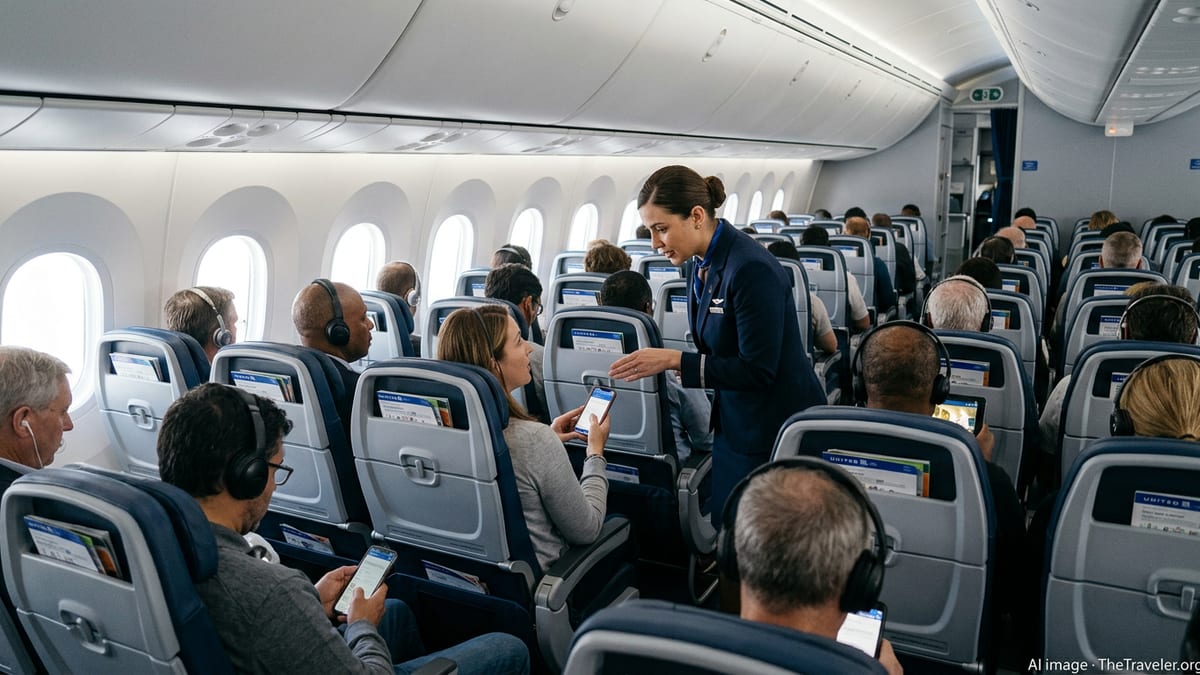
United Airlines has turned a long-standing etiquette expectation into a formal rule, giving its crews the power to remove or even permanently ban passengers who play audio or video out loud on board without using headphones.
A Quiet Crackdown Written Into the Contract
The Chicago-based carrier quietly updated its contract of carriage on February 27 to state that passengers who “fail to use headphones while listening to audio or video content” may be denied transport or removed from a flight. The clause appears in Rule 21, the “Refusal of Transport” section, which lays out behaviors that constitute a material breach of the travel agreement between United and its customers.
By moving the issue of loud personal devices from the realm of courtesy into a legally binding condition of carriage, United has given flight crews a clear basis for intervening when a traveler refuses to lower the volume. Under the revised language, the airline reserves the right to refuse transport on a temporary or permanent basis, meaning repeat or severe offenders could face an effective ban from flying with the carrier.
The rule also specifies that passengers whose conduct leads to operational disruptions or diversions can be held responsible for any resulting loss, damage or expense. That mirrors other provisions covering unruly behavior, signaling that blasting videos or music in the cabin is now grouped with more traditional forms of disruptive conduct.
Industry watchers note that while other major U.S. airlines strongly encourage headphone use, United appears to be the first to enshrine the requirement directly in its contract of carriage. That distinction makes the policy enforceable in the same way as rules on smoking, intoxication or interference with crew instructions.
How the Headphone Rule Will Be Enforced in the Cabin
United has not outlined a step-by-step script for enforcement, but aviation sources and passenger conduct experts expect a graduated approach. In most cases, crew members are likely to start with a polite reminder to use headphones when sound from a phone, tablet or laptop can be heard beyond the user’s seat. If the passenger complies, the matter ends there.
Should a traveler refuse or repeatedly ignore requests, cabin crew can escalate the situation to the captain and ground operations team. Depending on the timing and severity of the disturbance, consequences could range from a formal warning recorded in the passenger’s file to removal from the aircraft while still at the gate. In extreme instances, particularly if a diversion is required, the airline’s new language allows it to consider a permanent ban.
United emphasizes that it is not trying to limit the use of personal devices themselves. Passengers remain free to stream music, watch movies, scroll social media or join work platforms as long as sound is contained through headphones. The airline already reminds travelers in its onboard Wi-Fi terms to keep audio private and notes that complimentary wired earbuds may be available for those who forget their own.
For flight attendants, the change is likely to be welcomed as another tool for managing an increasingly crowded and emotionally charged cabin environment. With more passengers relying on personal entertainment instead of seatback screens, complaints about loud phones and speakers have become a frequent source of tension between travelers.
A Response to Rising Friction in the Skies
The headphone mandate comes against a backdrop of ongoing concern about unruly behavior on U.S. flights in recent years. Federal Aviation Administration data show hundreds of reported incidents annually, ranging from verbal confrontations to physical altercations, often sparked by seemingly minor grievances such as seat reclining, armrest disputes or noise.
United’s decision to treat loud device use as a safety and comfort issue reflects a broader trend among airlines to codify what was once considered common courtesy. Behaviors including going barefoot in the cabin, making phone or video calls after the doors close, or viewing offensive content on personal screens have been appearing with increasing specificity in contracts of carriage and inflight announcements.
Travel analysts say the new rule is aimed squarely at a small but noticeable subset of passengers who resist social cues and crew requests. For the majority of travelers who already use headphones, the practical impact will be limited, but the policy could reduce the number of in-flight confrontations triggered by unwanted noise.
Passenger advocacy groups largely view the move as a reasonable step, provided it is enforced consistently and proportionately. They argue that clearer expectations can ease tensions, as customers are less likely to view crew interventions as arbitrary when the rules are spelled out in advance as part of the ticketing agreement.
What Travelers Should Know Before Their Next United Flight
For anyone booked on an upcoming United flight, the most practical takeaway is straightforward: pack headphones and be prepared to use them anytime you play audio or video content. This applies to everything from short social media clips to long-haul movie marathons, and to both personal devices and laptops.
Passengers who forget headphones can ask a flight attendant whether basic wired earbuds are available on their flight. United has been expanding in-seat USB power and Bluetooth connectivity on many aircraft, allowing customers to pair wireless headphones with seatback screens or use their own devices more comfortably over long journeys.
Experts also recommend that travelers pay closer attention to preflight emails and app notifications, where airlines increasingly highlight policy changes alongside gate updates and boarding information. Because the headphone rule sits within a broader list of conduct provisions, United customers implicitly agree to it when they purchase a ticket, even if they have not read the full contract of carriage.
While removal from a flight or a permanent ban is expected to be rare, the revised language confirms that such outcomes are possible. For frequent flyers who rely on United’s network, particularly through hub airports such as Chicago, Denver and Newark, ignoring the new rule could carry significant long-term consequences beyond a single delayed trip.
Implications for the Wider Airline Industry
United’s move is likely to be closely watched by competing carriers, many of which already frame headphone use as essential to a pleasant cabin environment. Some, including low-cost airlines, note in their inflight materials that headphones are required when listening to audio, but they stop short of embedding the rule in their formal contracts with passengers.
If United’s policy proves effective at reducing complaints and in-flight conflicts without generating a wave of negative publicity over enforcement, analysts expect other major airlines to study similar language. That could lead to a more standardized experience for travelers across carriers, where playing content out loud is treated as a clear violation rather than a gray area of manners.
The rule also underscores how the definition of disruptive behavior is evolving in an era of constant connectivity. As streaming services, short-form video apps and portable speakers become ubiquitous, airlines are grappling with how to preserve a level of quiet that allows passengers to rest, work or simply endure long flights in relative peace.
For now, United has drawn a firm line around personal audio: use your headphones or risk being asked to leave the aircraft. For many weary travelers, that firm line may sound like welcome news.